The Irish Presidency of the Council of the European Union Should Welcome Scrutiny from Academia
Mark Dempsey, Anna Marchese / Aug 3, 2026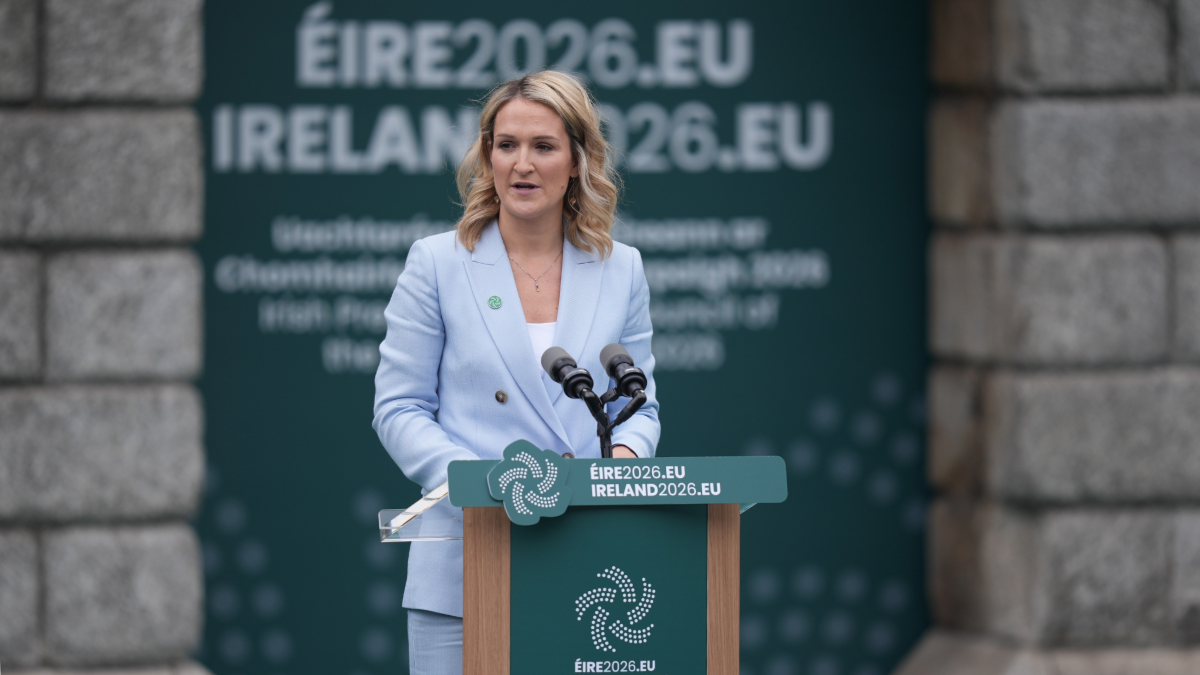
Irish Minister for Foreign Affairs Helen McEntee delivers a speech at Dublin Castle in Dublin, during the opening ceremony of Ireland's EU presidency on Wednesday July 1, 2026. (Niall Carson IRISH Press Association via AP Images)
On July 9, days after Ireland assumed the 6-month rotating presidency of the Council of the EU, over fifty academics (the number is now closer to a hundred) published an open letter asking the country to recuse itself from chairing meetings on digital and tax files given its “insurmountable conflicts of interest”. Unsurprisingly, the recusal request was not met. In fact, Ireland’s official response was a mixture of anger and denial, aptly encapsulated in Taoiseach Micheál Martin’s insistence that his country would be an “honest broker” in upcoming negotiations.
That academics like Shoshana Zuboff, Mariana Mazzucato, Sandra Wachter, Isabella Weber and many others felt compelled to sign the letter must be taken seriously, not least because their concerns do not appear in isolation. Leading Irish economists like David McWilliams and Sinead O’Sullivan, the European Commission, and the Irish Fiscal Advisory Council have expressed similar unease about the country’s financial dependence on the foreign-owned multinationals it is responsible for regulating.
Worse still, shortly after the letter appeared, photos emerged of Ireland’s Minister for Enterprise, Peter Burke, dining with Meta executives at the Dublin residence of the US ambassador. Their aim? To discuss “the digital agenda for Ireland’s EU presidency,” according to the Irish Independent.
Not to worry though, we have been assured that Ireland can still act as an honest broker.
An ever-present tension: when economic reliance clashes with regulatory independence
Google, Meta, Apple, TikTok, OpenAI, X, and Microsoft have their EU headquarters in Ireland and the country’s regulators, most prominently the Data Protection Commission (DPC)—by virtue of the ‘country of origin’ principle—has become the primary watchdog for the tech sector. Unfortunately, as has been well documented, Ireland’s record of enforcement is not good. Defenders will point to the €4 billion in GDPR fines imposed by the DPC to assuage concerns. This, however, paints an incomplete picture. In the Meta case, which led to a €1.2 billion fine against the company in 2023, the DPC at first recommended no financial penalty. Only after the European Data Protection Board (EDPB) intervened did the Irish agency reverse course. This is not an isolated incident. It has regularly faced accusations of leniency, evidenced by the two-thirds of its GDPR decisions that have been subsequently overruled by the EDPB.
Days before the publication of the academics’ letter, which lays out a litany of troubling enforcement actions by the country, more facts have shed light on Ireland’s role as the hub of Big Tech’s EU business and the custodian of Europe's tax base.
On June 30, Microsoft published its first country-by-country report—an EU-mandated breakdown of its profit and income tax by country. Ireland accounted for 38% of the revenue and pre-tax profit reported in Microsoft's country-by-country filing. That’s $196 billion in total. To put that in perspective, the company reported thirty times more revenue in Ireland than Germany, fifty-one times more than France, one hundred fourteen times more than Italy and a hundred seventy two times more than Spain. With $47 billion in pre-tax profits in Ireland, the company generated roughly $7 million in profit per Irish employee, compared with an average of $375,000 per employee across its global workforce. These figures are difficult to justify, which might be one reason why Ireland voted against legislation mandating their public disclosure in 2019 and again, unsuccessfully, in 2021. Considering Ireland’s own opposition to tax transparency, calls for the Irish Presidency to step aside from tax files are hard to dismiss.
It's easy to see why this might be a hard pill to swallow. Today, Ireland’s economic transformation is regarded as one of the EU’s greatest success stories, with a GDP per capita that stands at more than double the bloc’s average. Yet, within the country, maintaining this momentum is framed as a fraught choice: protect the economic interests of American tech and pharma companies or jeopardize thousands of jobs and risk a return to the economic malaise of the 1970s, when GDP per capita was less than 60% of the EU average and under one-quarter of that of the US.
This approach is admittedly simplistic, as the long-term unsustainability of Ireland’s economy on corporate tax income is now common lore. It also ignores the public costs of failing to hold tech companies to account. From undermining democratic institutions to knowingly deploying products that harm children, the damage that flows from weak oversight is no longer hypothetical. Tech entrepreneur and Fair Patterns founder Marie Potel-Saville recently wrote of how platforms use “predatory design” to target kids, citing internal company research describing these methods as an “addict’s narrative”. It is long past time for Ireland to take its responsibility in mitigating these harms more seriously.
The Presidency as an opportunity
Ireland should treat this moment of renewed scrutiny as an opportunity to demonstrate real leadership and assert its regulatory power vis-à-vis Big Tech. As the EU prepares to rework its digital and tax rulebooks and as pressure from Washington continues to mount against European officials on both fronts, this Presidency can, if Ireland’s leaders so choose, also model how public institutions ought to respond when faced with conflict-of-interest accusations.
Instead of accepting the familiar argument that if Brussels’ EU institutions struggle to withstand Big Tech lobbying efforts, Ireland stands little chance of systematically rooting out illegitimate influence, Ireland should act today and build on the expectations of its European partners by reinforcing enforcement milestones, strengthening disclosure requirements, and embracing accountability mechanisms that identify and guard against both actual and perceived conflicts of interest. Crucially, there are clear ethical guidelines that deal directly with the latter. The mere appearance of a conflict is treated akin to an actual conflict, because, when it comes to public authority, these optics are just as damaging to institutional trust.
Ireland should therefore welcome new accountability guarantees. In this environment of rapidly moving legislation, and in a sector flooded with corporate money, no safety measure is superfluous.
There are ample opportunities to show resolve. A new report in Competition Policy International shows that a booming re-identification industry is routinely undermining the intent of the GDPR’s core privacy protections. We invite the Irish DPC to investigate this industry as a matter of urgency.
The European Parliament can be a crucial ally
With its history of establishing committees of inquiry, the European Parliament would be a natural ally in this effort. These committees have reassured EU citizens that their elected representatives and public servants work in the public interest—not for private business or foreign powers—by exposing occasions when they have failed to do so. Examples include the TAXE Special Committee created in the wake of the Lux Leaks scandal which implicated then Commission President Jean-Claude Juncker, the PANA Committee following the Panama Papers revelations and the PEGA Committee established to investigate the use of Pegasus spyware.
The relationship between Big Tech firms and the institutions responsible for regulating them on behalf of the European Union warrants the same level of parliamentary scrutiny. As the EU prepares to debate the Digital Omnibus process under the Irish Presidency, a dedicated DIGI committee could document and monitor every stage of the legislative deliberations, gather needed testimony from regulators, industry representatives, and independent experts, and issue recommendations for institutional reform or referrals to the appropriate authorities should it reveal evidence of maladministration or breaches of EU law.
As others have pointed out, pressure on the EU’s digital rulebook extends beyond Ireland. Across Europe, policymakers are insisting on the rollback of regulatory safeguards dealing with today’s dominant digital platforms and AI companies for the sake of “competitiveness”. Nowhere is that pressure more acute than in Ireland.
The issue is not whether Ireland can completely insulate itself from corporate lobbying—no democracy can—but whether it is willing to manage institutions and make public commitments that inspire confidence in the impartiality of its decisions. By embracing parliamentary oversight and accountability, this Irish Presidency has the occasion to prove that Europe's digital rulebook is enforced fairly, with vigor and beyond reproach.
Authors