Blaming Ireland Misses Where Europe’s Digital Agenda is Really Set
Mark Scott / Jul 23, 2026Mark Scott is a contributing editor at Tech Policy Press.
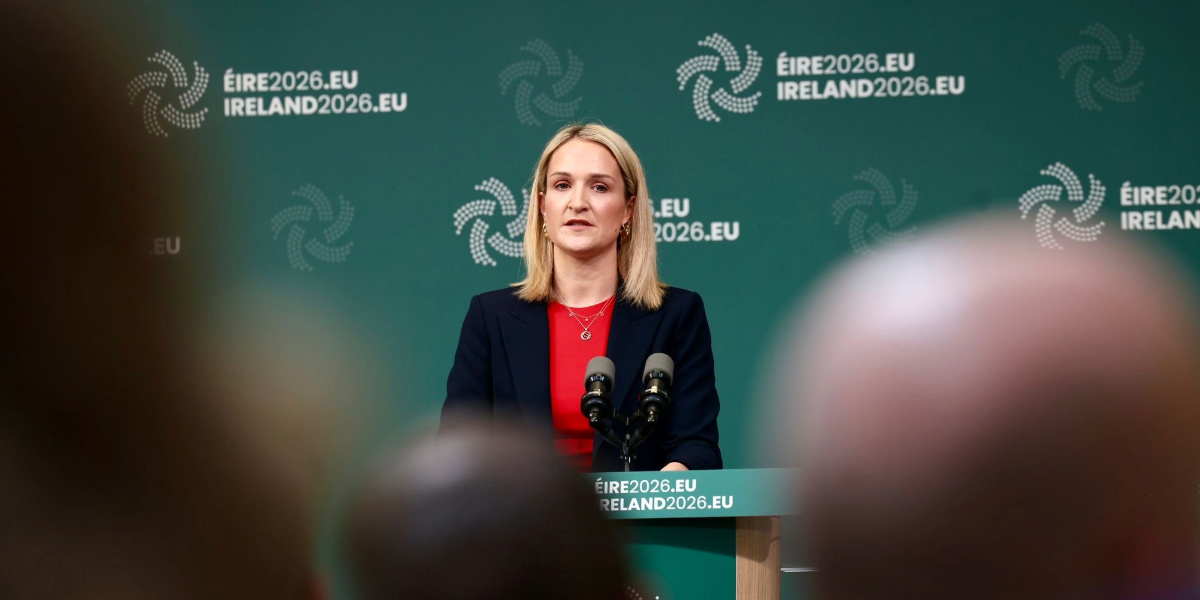
Helen McEntee, Ireland's Minister for Foreign Affairs and Trade, outlines priorities for Ireland's upcoming EU Council Presidency on June 10. Source: Irish Presidency of the Council of the EU 2026.
As the Brussels Bubble heads into the August break, a storm is brewing around Ireland’s role in the European Union’s digital agenda.
Earlier this month, the country took over the six-month rotating presidency of the Council of the European Union, or the body that represents the national governments of all 27 countries. The role is akin to chairing a board meeting. Dublin helps organize the Council’s agenda, chairs most Council meetings and negotiations, and is expected to be a neutral actor in representing the interests of all EU governments.
"Ireland is seen by other member states – and rightly so – as a pro-European country and an honest broker,” said António Costa, the standing president of the European Council, during a recent visit to Dublin.
The Irish Council presidency comes as Brussels is shifting gears from building its digital rulebook to prioritizing AI-powered economic growth to keep pace with China and the United States. The EU is negotiating its so-called Digital Omnibus package that could amend parts of several flagship digital laws, including aspects of the General Data Protection Regulation (GDPR) and the AI Act, as part of its broader competitiveness pivot.
Ireland will play a central role in how these negotiations develop until the end of the year.
Many of the priorities Ireland is expected to oversee — from AI deployment to digital competitiveness and regulatory simplification — closely match those already championed by the European Commission. Council presidencies do not start from scratch. They inherit legislative priorities that have already been set by the wider EU institutions.
Yet critics have called on Dublin to recuse itself from overseeing discussions on many of these digital negotiations because so many non-European technology firms, including Meta, Apple and TikTok, have set up shop in the Irish capital. They have done so, in large part, to take advantage of Ireland’s low corporate tax rate compared to other EU countries.
In the minds of critics, Ireland cannot be seen as an honest broker, in terms of shepherding the implementation of the bloc’s digital rules and setting the EU’s policy objectives toward artificial intelligence. They argue that the country is too close to many of the companies affected by such policies and that its reliance on tax revenue generated from these tech giants almost certainly undermines its objectivity.
“Ireland’s reliance upon giant non-EU firms creates insurmountable conflicts of interest, as evidenced by the country’s record in the area of data regulation and taxation,” according to an open letter signed by scores of European academics in the Financial Times. “We expect that Ireland will recuse itself from any role in these two areas.”
Such a recusal is not on the cards.
Other EU countries’ previous Council presidencies have also overseen policy areas in which their own national interests were front and center. During France's 2022 Council presidency, for instance, Paris chaired politically sensitive negotiations on the EU’s agricultural policies despite being the bloc's largest agricultural producer and the biggest beneficiary of such funding.
At the time, there were no comparable calls for France to step aside over alleged bias.
As part of Ireland’s six-month Council agenda, the country has prioritized online child safety, digital competitiveness, and AI-enabled growth and security as part of its wider program. It will also host an AI summit in Dublin in October whose central focus is positioning the EU as a leader in trustworthy AI
The event, according to Peter Burke, the country’s minister for enterprise, tourism and employment, “will bring together global leaders to explore how artificial intelligence can be harnessed to drive productivity, competitiveness and innovation across Europe.”
For those who believe Dublin is too close to Big Tech, they point to the role of the country’s privacy regulator in enforcing the bloc’s world-leading privacy rules. Since GDPR came into force in 2018, the country’s Data Protection Commission (DPC) has taken years to hold the likes of Meta and TikTok to account for their data protection breaches.
The agency’s supporters argue this slowness reflects the demands of the Irish legal system, where decisions must withstand extensive judicial review and are frequently challenged by well-resourced companies. Critics respond that the regulator has often taken an overly cautious approach to enforcement. They also point to Niamh Sweeney, a former senior Meta official, as one of the regulator's commissioners as evidence of its closeness to industry.
Yet as of mid-2026, the DPC had imposed more than €4 billion in GDPR fines on companies including Meta, TikTok, LinkedIn, WhatsApp and X. That is by far the highest cumulative total of any EU data protection authority.
What complicates the criticism is that Dublin's published Council priorities on digital closely mirror those of Ursula von der Leyen since she began her second term as European Commission president in 2024. The Irish Council Presidency is not setting Europe's digital direction. It is stewarding one already greenlit in Brussels.
Von der Leyen's first term was defined by building the EU's digital rulebook, including landmark legislation such as the Digital Services Act, Digital Markets Act, AI Act and Data Act.
Yet since 2024, the German politician has favored proposals aimed at simplifying the bloc’s digital rulebook, boosting AI uptake in the name of economic competitiveness and embracing a “digital sovereignty” agenda, as described in Brussels’ recent European Tech Sovereignty Package.
Critics complain this pivot plays into industry’s priorities, particularly those legacy European firms trying to compete with American and Chinese tech giants. Yet describing the European Commission's current digital agenda as one that simply favors Big Tech is hard to reconcile with continued enforcement actions and ongoing investigations into companies like Apple, Meta and AliExpress.
Ireland's published objectives related to AI adoption, digital competitiveness, regulatory simplification, cybersecurity and digital sovereignty closely track the Commission's own agenda.
That includes Dublin’s emphasis on regulatory simplification that builds on a competitiveness report published by former Italian prime minister Mario Draghi and the Irish Presidency’s AI summit whose focus on productivity and innovation is an extension of the EU’s AI Continent Action Plan.
These are not uniquely Irish priorities. They reflect the Commission's broader shift toward competitiveness, AI deployment and digital sovereignty.
That may be hard for Ireland's critics to stomach. But if they object to the EU's shift from drafting digital rules to promoting AI competitiveness, that debate belongs in Brussels, and not Dublin.
Authors