The Internet Had a North Star. The UN’s Global Dialogue Made Clear AI Doesn't.
Konstantinos Komaitis / Jul 15, 2026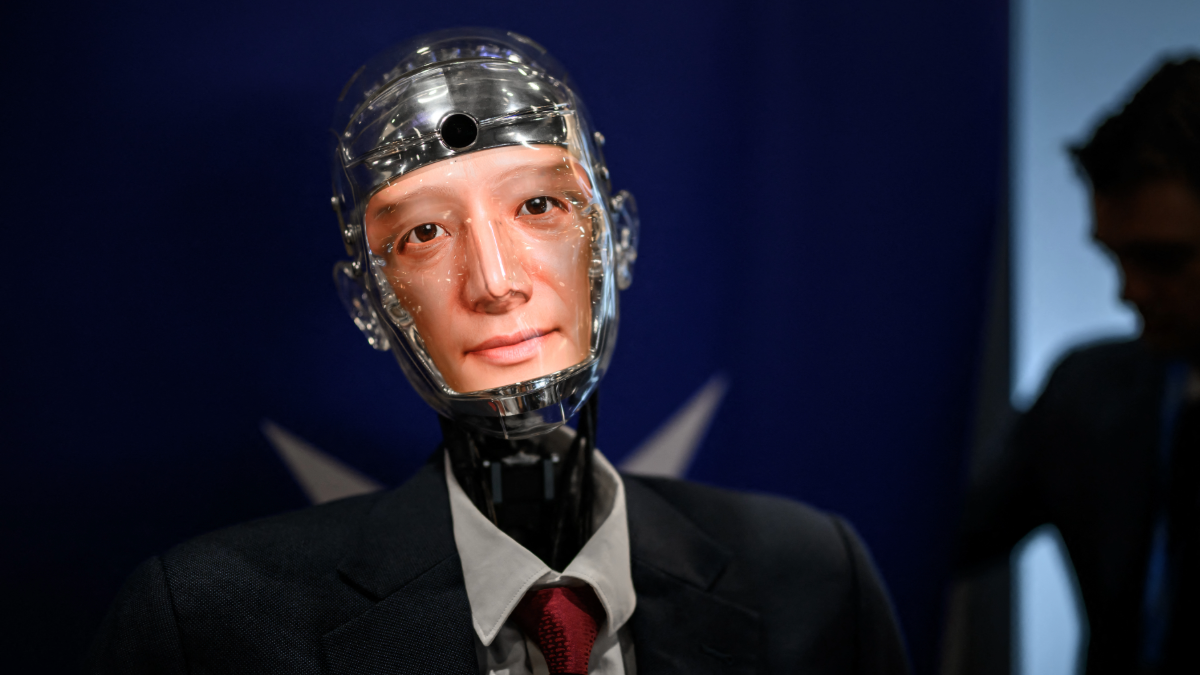
This photograph shows Robert the Robot, an advanced conversational humanoid developed by Geneva-based technology company RB Labs, at the AI for Good Global Summit, a United Nations flagship event aimed at shaping the future of artificial intelligence, in Geneva on July 7, 2026. (Photo by Fabrice COFFRINI / AFP via Getty Images)
In 1945, as the world emerged from the devastation of World War II, leaders faced a challenge far greater than redrawing borders or rebuilding shattered economies: they had to decide if humanity could build institutions capable of preventing its own destruction. The creation of the United Nations was born from a shared, if imperfect, conviction that international cooperation was not just desirable, but necessary for survival. It was an acknowledgment that certain existential threats surpassed the boundaries of the nation-state, requiring a collective framework to safeguard the global public good.
Eighty-one years later, the first UN Global Dialogue on AI Governance, held last week in Geneva, revealed a very different historical moment. Governments, technology giants, academic researchers, and civil society advocates gathered to debate how to govern one of the most transformative technologies of our times. There was polite consensus on the surface. Speakers repeatedly invoked the need for safety, accountability, agency, inclusivity, and human rights. Yet beneath the carefully negotiated diplomatic language lay a fundamental crisis: the world increasingly agrees that artificial intelligence needs governance, but we completely disagree on what that governance is ultimately meant to achieve. This distinction is not academic; it is the defining political challenge of the AI era.
The Internet offers the clearest historical contrast to the current AI policy paralysis. Its success did not stem from universal political harmony. Democracies and autocracies have bitterly disagreed over privacy, censorship, and surveillance. Those deep ideological rifts persist today. Yet, those fights occurred within a broader, shared ambition that transcended geopolitical rivalries. The architects of the Internet believed in a foundational principle, which was that networks must be able to connect regardless of geography, ownership, or political boundaries. Interoperability became the organizing principle around which technical standards, global institutions, and governance mechanisms evolved. The Internet had a North Star.
Artificial intelligence has no equivalent North Star. Without a shared destination, governance becomes an empty vessel. We are left asking whether AI is primarily an engine of economic growth, a tool for scientific discovery, a weapon for strategic dominance, or a commercial platform. Should it be accelerated, constrained, or democratized? Because the international community cannot answer this prerequisite question, AI governance is reduced to a chaotic exercise in balancing competing national interests rather than steering a common future.
According to Elonnai Hickok, Managing Director at the Global Network Initiative (GNI):
The absence of shared objectives has long undermined international AI governance, resulting in fragmented initiatives with limited coordination and impact. While processes such as the AI Summit series and the UN Global Dialogue on AI Governance have convened diverse stakeholders, they have produced few sustained mechanisms for collective action. MAP-AI—led by GNI and the Centre for Communication Governance—addresses this gap by developing a shared, bottom-up vision for AI governance, grounded in the priorities and experiences of stakeholders across regions. By connecting national, regional, and international efforts, the project aims to foster a more coherent, inclusive, and effective global AI governance ecosystem.
This absence of purpose was glaringly obvious in Geneva, characterized first by an illusion of leadership. The United States and China, the principal architects of the AI revolution, were technically in the room. Their representatives walked the convention hall corridors and engaged in conversations. Yet their reluctance to deeply engage in collective, multilateral commitments was striking. Leadership requires more than technological dominance; it requires a willingness to invest political capital in building common institutions. Instead, the major AI powers continue to view governance almost exclusively through the prism of strategic competition.
Questions of safety, standards, infrastructure, and innovation increasingly intersect with concerns about economic competitiveness, technological supremacy, and national security. Under these conditions, governments naturally seek to preserve strategic flexibility rather than define common rules. The consequence is that the countries most capable of shaping AI's trajectory remain the most reluctant to shape the institutions capable of governing it collectively. The elephant in the room was not technological uncertainty; it was political unwillingness.
Furthermore, the process exposed a dangerous tendency to confuse consultation with collaboration. The UN process treated AI governance as a traditional, state-centric affair. Governments sat firmly at the center of decision-making, while tech companies, open-source developers, and civil society organizations were relegated to consultative roles. This is a critical mistake that ignores how modern technology actually operates. The Internet thrived because of a distributed responsibility model where engineers wrote standards, companies built services, and governments set high-level public policy. No single actor possessed all the necessary knowledge or authority, and the resilience of the network emerged precisely from that distribution of responsibility.
Artificial intelligence is even more distributed. Frontier models are built in private corporate laboratories, open-source communities innovate rapidly across fluid borders, universities conduct foundational research, and a handful of companies own much of the world's physical compute infrastructure. Civil society groups are frequently the ones who identify social harms, algorithmic bias, and labor exploitation long before governments are even prepared to address them.
As Mahsa Alimardani, Associate Director of the Technology Threats & Opportunities program at WITNESS put it:
At WITNESS we have been sounding the alarm on AI's harms to our shared sense of reality since 2018. We were happy to see our thesis in the report of the Panel opening the Dialogue, but naming harms is not the same as governing them, and with some major frontier developers absent from the dialogue or any conversations about our priorities, there was too little discussion of rights and guardrails to change that.
By treating these crucial actors as mere guests rather than co-governors, the architecture invites participation but stops short of sharing power. Consultation is episodic, while collaboration is institutional. One invites participation; the other shares responsibility. The Dialogue frequently demonstrated the former but stopped short of embracing the latter, a distinction that may ultimately determine whether AI governance produces meaningful outcomes or simply more inclusive conversations.
This structural confusion was reflected in how the concept of inclusion was handled throughout the Dialogue. The word appeared repeatedly in official statements, and commitments to inclusive participation were undoubtedly sincere. However, inclusion cannot be measured by who receives an invitation to Geneva; it must be measured by who actually shapes the agenda and final outcomes. Many representatives from developing countries rightly argued that AI governance cannot be separated from questions of physical infrastructure, compute access, talent development, and economic opportunity. For much of the global majority, the immediate challenge is not regulating theoretical existential risks of frontier models, but avoiding total economic exclusion from the next technological revolution. These urgent concerns were politely acknowledged, yet they remained largely disconnected from the central governance conversations dominating the main stage.
To maintain diplomatic harmony, the Dialogue naturally self-censored. Contentious issues like corporate monopolies, labor displacement, mass surveillance, military applications, and the growing concentration of corporate power received considerably less attention. Perhaps this restraint was inevitable. The United Nations remains one of the few places where geopolitical rivals continue to meet under the same roof, and preserving dialogue often requires avoiding the issues most likely to fracture it. But there is a severe cost to this avoidance. If international institutions do not confront the political disagreements shaping AI, those disagreements will not disappear. They will simply migrate elsewhere — to national capitals, closed corporate boardrooms, and minilateral negotiations where far fewer voices are represented and far less public accountability exists.
The Geneva Dialogue was far from a failure. The simple fact that such a fractured international community gathered under one roof to discuss AI governance under the auspices of the United Nations is a significant milestone. Only a few years ago, such a comprehensive conversation would have been difficult to imagine. But neither was it the breakthrough many had hoped for. The Dialogue demonstrated that the international community recognizes the need for collective action, but it did not demonstrate that we have agreed on what that collective action is ultimately supposed to accomplish.
Geneva functioned as a mirror, reflecting an uncomfortable reality: a world that understands AI cannot be governed alone, yet lacks the courage to decide what governing together is actually meant to achieve. Until the international community identifies its North Star, every new UN dialogue, declaration, or commission risks becoming just another mechanism for managing disagreement. The defining challenge of the AI era is no longer technological; it is political. We must decide, together, what kind of future this technology is meant to build.
Authors