Stop the FISA Fearmongering and Allow Fair Votes on Reforms
Jake Laperruque / Jun 9, 2026Jake Laperruque is a Tech Policy Press Fellow and the Deputy Director of Security & Surveillance at the Center for Democracy & Technology.
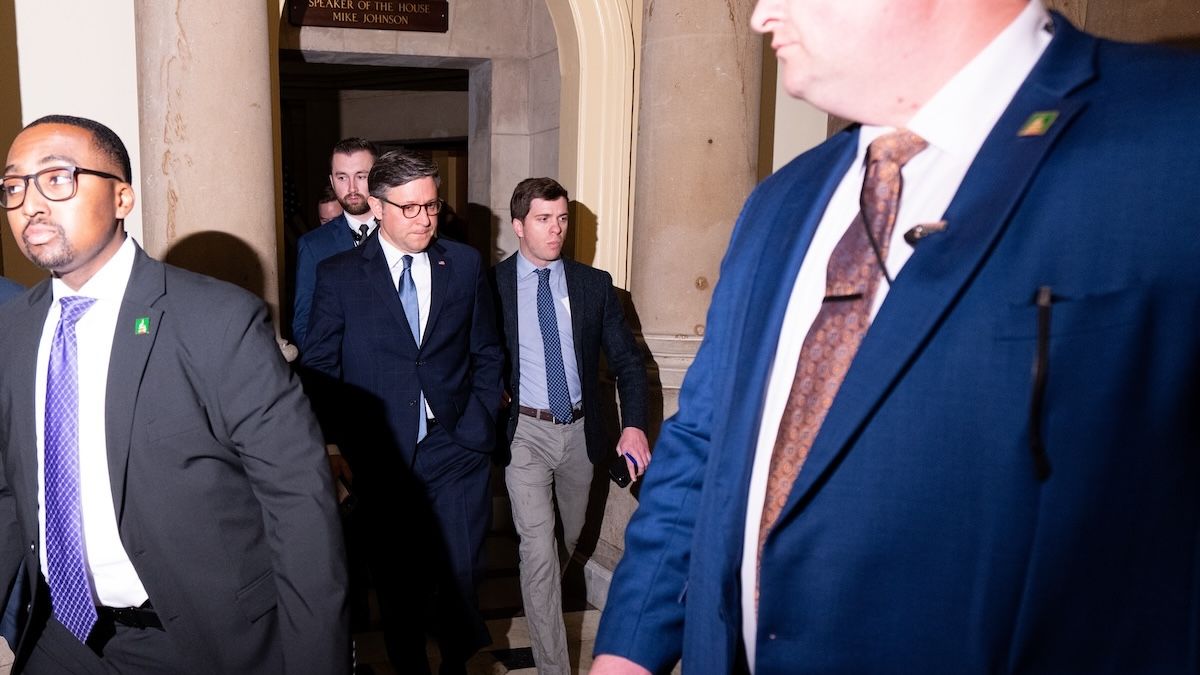
UNITED STATES - APRIL 30: Speaker of the House Mike Johnson, R-La., walks to the House chamber for the vote on the rule on FISA, the farm bill and ICE funding on Thursday, April 30, 2026. (Bill Clark/CQ Roll Call via AP Images)
Last weekend, as the June 12 statutory deadline for reauthorizing Section 702 of the Foreign Intelligence Surveillance Act (“FISA 702”) approached, a pair of senators issued a letter on the pending sunset. Their missive is meant to amp up political pressure on those demanding votes on reforms to the warrantless surveillance law. But the letter instead shows just how desperate the effort from opponents of reform has become. It’s crucial that this ploy is rejected, and lawmakers hold strong in calling for new safeguards against surveillance abuse.
In their letter, Sens. Tom Cotton (R-Ark.) and Chuck Grassley (R-Iowa), who respectively chair the Intelligence and Judiciary Committees, warned that the statutory lapse of FISA 702 this week would cause “a potential significant gap in foreign-intelligence collection.” But the text of the law makes clear that this threat of collection suddenly going dark next week is fearmongering and not a genuine possibility. Specifically, the law contains a savings clause that addresses the question of ongoing collection during a temporary lapse, stating:
“Any order, authorization, or directive issued or made under [FISA 702] shall continue in effect until the date of the expiration of such order, authorization, or directive.”
This means that so long as an approved FISA 702 certification is active, collection from communications providers based on directives stemming from that certification will continue. Because the FISA Court approved the most recent annual certifications this March, this lapse would not occur until 2027.
Just as spurious is Cotton and Grassley’s claim of who is obstructing an extension of FISA 702. Their letter blames Sen. Chuck Schumer (D-N.Y.) for “marching Democrat Senators over a cliff” and blocking “an agreement with our Democrat counterparts.” But Sen. Dick Durbin (D-Ill.) Grassley’s counterpart as Ranking Member of the Judiciary Committee was not included in negotiations on a bill and strongly opposed the substance of the agreement Cotton and Grassley were promoting.
The overall partisan framing of the letter rings false as well. The Cotton-Grassley proposal (which would extend FISA 702 for three years while largely preserving the status quo) actually had much more across-the-aisle opposition than support. Only two Democrats have shown support for the measure: Intelligence Committee Vice Chair Mark Warner (D-Va.), who was involved in drafting the proposal, ultimately voted against it due to reservations about acting Director of National Intelligence Bill Pulte, while Sen. John Fetterman (D-Pa.) voted for it on the floor. In contrast, opposition to the bill came not just from Democrats but also seven Republicans who voted to block their bill and are calling for meaningful FISA 702 reforms.
This bipartisan push for reform disproves the false binary the letter portrays: that passing their bill is the only way to extend FISA 702 and voting against it is synonymous with trying to shut down the authority. In reality, there is strong support in Congress for extending FISA 702 so long as this extension is accompanied by meaningful reforms. That is what the over half a dozen Republicans who opposed the Cotton-Grassley measure have advocated for, along with a similarly bipartisan coalition in the House. But Congressional leadership in both chambers has taken a dangerous my-way-or-the-highway approach to FISA 702, refusing to allow any votes on reforms or amendments in a break with precedent. It is that uncompromising brinksmanship—not the refusal of a bipartisan majority to accept one particular flawed proposal—that has the law on the verge of expiration.
Even more alarming is what Cotton and Grassley call on the White House to do in response to a potential lapse. Their letter states that the Administration should pursue alternate means to replace FISA 702 collection through Executive Order rather than statute. The unique value FISA 702 provides is its power to compel US companies to turn over users' communications without a warrant.
Coercing providers to assist with warrantless surveillance through executive order would be unconstitutional — a clear violation of separation of powers and overreach into a sphere Congress has established limits for — especially if such an effort were made after Congress rejected legislation requiring such assistance. The notion that such compelled production could be forced via an executive order was decisively rejected in the early years of the war on terror (including by legal authorities within the executive branch itself), and that conclusion has remained the clear legal consensus ever since.
Because of this, it’s highly unlikely communications service providers would accept such orders made via executive fiat. The senators’ letter essentially implies that communications service providers would comply with a constitutionally dubious executive order demanding that they turn over user data, but would ignore a time-tested statute with a clear savings clause requiring them to do so. Made in tandem, these incompatible assertions only serve to show the emptiness of claims that the collection will go dark as a sunset occurs.
It’s important that lawmakers reject the binary notion that FISA 702 must either be extended without meaningful reform or simply die off. If Congressional leadership allows votes on reforms—in particular requiring a warrant for queries of Americans’ communications and closing the data broker loophole—the fight over FISA could be finished this week. It's time to stop playing a game of chicken with this authority, allow the open debate lawmakers are calling for, and resolve this issue.
Authors