Meta’s Settlement Deal Won’t Give Me Back the Years I Lost to Social Media
Maddie Freeman / Sep 25, 2026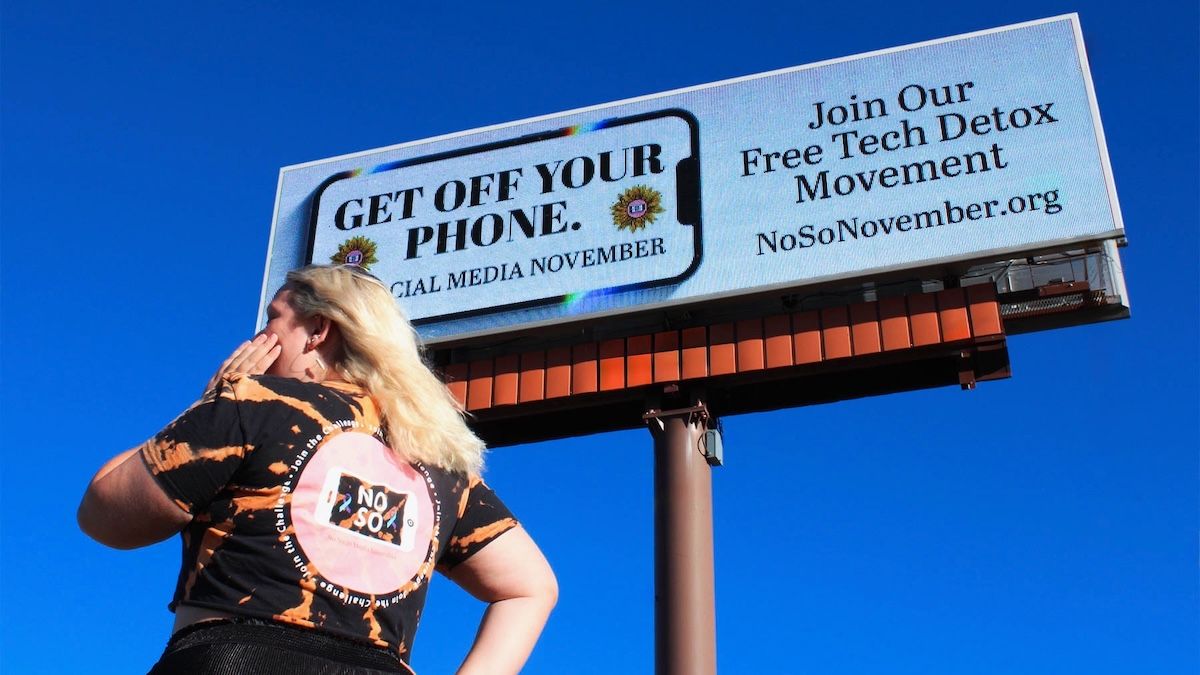
Maddie Freeman stands in front of a billboard advertising her social media detox movement, “No Social Media November”, in Denver, Colorado in 2005 (Photo credit: Maddie Freeman)
The recent $17 billion dollar teen social media settlement by Meta is more than historical. For me, it’s personal.
From a young age, I became hopelessly addicted to social media. I watched as my community became collateral damage in Meta’s ferocious quest to colonize our brains in the pursuit of profitability. I feel Meta is finally being held accountable for addicting an entire generation to its products, using misleading advertising and deliberately continuing to perpetuate addictive features that harm mental health.
A young mind is no match for an addictive algorithm. At just 12 years old, I participated in thigh gap challenges and weight loss challenges that were recommended to me by algorithms, leading me to develop lifelong body dysmorphia and eating disorders. I was exposed to graphic self-harm and glamorized suicide content online that, among other things, led me to develop serious suicidal ideation. Platforms pushed me to friend and DM strangers and predators much older than me. I had a daily average screen time of 10 hours per day and snuck to the bathroom every day during class to tweet at celebrities and scroll on Instagram. I used social media as a coping mechanism when I was depressed and it made my symptoms virtually impossible to cope with. I was also frequently exposed to online misinformation, leading to in-person conflicts and debates at school.
I feel that I wasted years of my life unknowingly giving hoards of personal data to Meta that they used against me to intentionally addict me to their platform. The path of destruction these platforms created didn’t end with me; I watched helplessly as my friends and classmates suffered endlessly through similar harms too.
High school is supposed to be a time of discovery and exploration, but mine was filled with candle-light vigils, funerals, and memorial posts. I lost multiple friends to suicide, and our grief lived on social media. The friends I lost posted their suicide notes on their Snapchat story, bought fentanyl-laced drugs on Instagram, shared self-harm photos begging for attention and help, and made humorous TikToks about suicide weeks before actually passing away. I thought this is what growing up felt like. I thought this was normal. While social media did not singlehandedly cause any of these deaths, these platforms incentivized us to play out our darkest moments on a massive stage for everyone to see, which I believe furthered suicide contagion.
In the face of evidence that social media was fueling a mental health crisis, proven internally by their own research, Meta seems to have forged ahead, doubled down, and implemented more harmful features in the name of maximizing shareholder value.
While I’m celebrating this first step toward accountability, financial payments and some new safety features are not enough. All social platforms should have a duty of care to protect all users (not just children), and the attention-for-profit business model that relies on data harvesting and addictive algorithms must be banned.
There is a high risk of repeating the excruciating circumstances I experienced firsthand that affect me to this day, especially now as we enter the age of AI.
At some point Meta and its shareholders must have decided that the profit potential of Meta’s products was more important than the health and happiness of millions of children. The overwhelming influence one company had over the brains of Gen Z is a horror that no amount of money can ever correct. My entire life trajectory shifted off course as a result of my own devastating experience.
It led me to found the global ‘No Social Media November’ movement and create a youth-led nonprofit called NoSo Connection Collective that empowers teens to learn about addictive design, detox from social media, and lead community initiatives to push back against the reign of Big Tech. My full-time job is now to sweep up the pieces of a broken system that intentionally treated my community as collateral damage.
The Meta settlement is an excellent first step toward accountability, but if I’ve learned anything from the last seven years of ethical technology and digital wellbeing advocacy, it’s that we must attack the root of harm. The unending data harvesting from Meta’s users, which results in targeted advertising that pushes us to interact with addictive features, propels mental health issues. And Meta is not the only platform either. All social media companies should be held accountable to the same high standards and regulations. The $17 billion settlement is a drop in the bucket for one of the most powerful companies in the world, while nothing can bring back the friends I lost, nor give me back the years of my life I suffered as a direct result of corporate negligence.
If you or someone you know may be considering suicide, you can contact the 988 Suicide & Crisis Lifeline in the US, or any of these numbers internationally.
Authors