Are the Meta Settlement Terms a Win for Kids or a Digital Rights Risk?
Dean Jackson / Sep 14, 2026Dean Jackson is a contributing editor at Tech Policy Press.
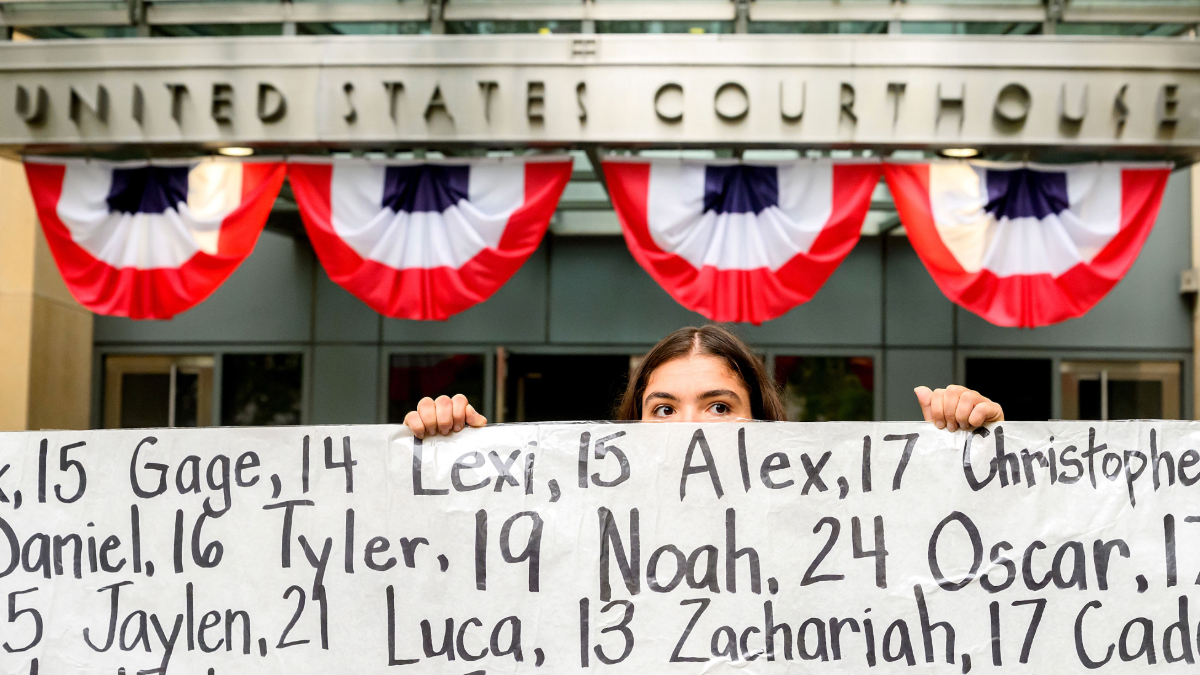
Olivia Konar holds a banner with names of young people who advocates say died as a result of social media outside the Ronald V. Dellums Federal Building and US Courthouse on Tuesday, Aug. 18, 2026, in Oakland, Calif. Her sister Coco Konar died in 2022 when she was 17. (AP Photo/Noah Berger)
Meta admitted no wrongdoing in the August 26 settlement that brought its legal dispute over child safety with 47 state attorneys general, the District of Columbia, and three US territories to its abrupt, anticlimactic end. There would be no testimony or bombshell cross-examination of Meta founder and CEO Mark Zuckerberg, nor a suspenseful reading of the verdict. This conclusion is unlikely to inspire a prestige legal drama.
Instead, the company reached a complex agreement which will require it to pay up to about $17 billion and make certain product changes in the name of child safety. Some observers cried foul, concerned that the plaintiffs had won concessions which would not survive constitutional scrutiny had they been mandated by law or court order. Others crowed that Big Tech’s bill was finally coming due.
Taking stock of the settlement
Analysts and advocates spent the days following the settlement considering the balance of what the parties involved won and lost.
By nature, a settlement has some upside for both parties. “Although this settlement is not perfect,” Holly Grosshans, senior counsel for tech policy at Common Sense Media, told Tech Policy Press, “it includes many of the protections we have been fighting for across the country: safety-by-default rules, meaningful time limits and warnings, robust age assurance, and, at least some independent oversight of Meta.”
At the same time, Grosshans said, “It was clearly in Meta’s interest to settle. Faced with the risk of more damaging internal evidence becoming public and Mark Zuckerberg taking the stand, Meta made a business decision: agree to these product changes in exchange for resolving [the plaintiffs’] claims… we would have preferred for this particular trial to continue so the public could hear more of the evidence about what Meta knew, when it knew it, and how those decisions affected young people.”
What about the money? The settlement will cost Meta about three months’ profit; while no figure ending in “billion” is small, plaintiffs were initially seeking much more in damages.
Laura Marquez-Garrett, an attorney at the Social Media Victims Law Center, said the settlement “was never about the money… In the long term, product changes and our ability to get transparency into what these companies are doing and for the world to see that they can make these changes, that is what’s going to move the needle further.”
Other observers praised those design changes while noting their shortcomings. “The requirement for Meta to provide a non-personalized recommendation system as an option strikes me as a major missed opportunity,” said Mariana Olaizola Rosenblat, a policy advisor at the New York University Center for Business and Human Rights. “Feeds are clearly important and directly related to what this case was about: design features that were engineered for compulsive use and therefore harmful.”
Rosenblat said that the decision to make an alternative, non-personalized feed opt-in is unfortunate because few users change their default settings. Further, she said, the requirement only applies to the “home” feed and the alternative—a chronological feed—is not ideal. “People who have studied algorithmic feeds, like the authors of the Knight-Georgetown Institute paper, ‘Better Feeds,’ have pointed out that chronological feeds [are] not the best alternative from the point of view of user safety and autonomy. Not only do users dislike the chronological option—and so are unlikely to choose it over the Meta-curated one—but it may actually be counterproductive in terms of promoting user value and autonomy,” Rosenblat said. She would have preferred Meta offer users the opportunity to customize their own recommendation system based on “content categories, people, and themes that users themselves explicitly select.”
Kate Ruane, the director of the Free Expression Project at the Center for Democracy and Technology, told Tech Policy Press that “some of the changes strike me as quite reasonable in isolation, including limiting notifications during school hours and at night, turning off autoplay by default, and creating different feed options… but even these provisions require a trade-off if a teen needs flexibility.”
Ruane also raised concerns that the settlement’s age assurance requirements will force “Meta to conduct much more data collection and surveillance of all their users.” And she worries that Meta’s new legal obligation to restrict minors’ access to sexual content and nudity could lead to government censorship in areas like LGBTQ+ identity or reproductive health.
A constitutional clamor over design changes
Every parade lives under the threat of rain. Critics say that state attorneys general have achieved design changes through settlement which would be ruled unconstitutional if obtained through court order or legislation.
Ruane told Tech Policy Press that as far as the settlement is concerned, the constitutional questions are largely closed. A settlement is a consensual agreement between two private parties; “It’s not clear whether anyone, even users who will be directly censored by this settlement, have any legal recourse to prevent or amend its implementation,” Ruane told Tech Policy Press. Or as Marquez-Garrett said: “Private parties can do what they want.”
That’s not true for changes obtained through legislation or court order—and there are clear analogs from both. Design changes similar to most of the settlement’s provisions have been mandated by legislation and challenged in court, with pending but mixed results. Some were also ordered by a New Mexico judge as the result of a separate lawsuit, New Mexico v. Meta.
What Meta agreed to build, and whether states could have required it
For most of these changes, the devil is in the details. For instance, California’s time limits have so far withstood scrutiny because they target specific design features the state alleges are manipulative, while Virginia’s uniform time limit was compared to requiring children to shut a book after sixty minutes.
The most survivable laws appear to involve requiring privacy-by-default for accounts belonging to underage users; courts appear most skeptical of restrictions on like counts, on First Amendment grounds. These findings are both based on the Ninth Circuit Court of Appeals ruling in NetChoice v. Bonta, which enjoined the like-count ban in California’s Protecting Our Kids from Social Media Addiction Act; the court left other aspects of the law in force. Meanwhile, questions about age assurance and verification are controversial, but unsettled, with different laws and cases reaching opposing conclusions.
Perhaps most consequentially, legislation affecting algorithmic curation of content passes or fails review depending on whether or not courts consider it a design choice or an expressive one by platforms. In a concurrence to the Supreme Court decision in Moody v. NetChoice, Justice Amy Coney Barrett suggests that this is a fact-dependent question which will vary by algorithm.
This game of constitutional tennis between legislatures and the courts is ongoing. On September 10, signed three bills—Assembly Bills 2 and 1709 and Senate Bill 1119 into law. AB 2 creates civil penalties for social media platforms found to harm children; AB 1709 says bluntly, “A covered platform shall not provide an addictive feature to a user who is under 16 years of age”—a provision which requires age verification for compliance and applies to recommendation feeds, autoplay, and other features determined to qualify by the state’s attorney general. SB 1119 creates obligations, an audit regime, and penalties affecting companies which provide chatbots accessed by minors.
Knowledge is power, but the road to change is long
Common Sense Media’s Grosshans was more confident that many of the design changes required by the settlement would survive judicial scrutiny if legislated; but she also said that the settlement provides additional value merely by proving they are technically possible. “Meta has always had the ability to make these design changes had it wanted to do so. Meta voluntarily agreed to them here, and the First Amendment does not prevent that,” she said, continuing on to say that “the First Amendment also would not prevent many, if not all, of these same protections from being required by law or court order… This settlement does not resolve constitutional questions. But it does significantly undercut the argument that Meta, through their trade association NetChoice, has repeatedly made, that these design changes are somehow unworkable.”
Most of the Meta settlement’s mandated design changes run for up to 10 years; Marquez-Garrett says that this is “plenty of time for us to get comprehensive federal legislation that preserves state rights.” As for constitutional scrutiny, they believe that one of the main benefits of these court cases has been to expose evidence of how social media platforms operate. Eventually, they told Tech Policy Press, they believe there will be “enough evidence and enough certainty [that] we can create very precise laws that will survive appeal… [but] it’s going to be a slog. Meta will make it that way; they have money and resources and we do not. But we have families and kids and constituents.”
Authors