India’s Telegram Ban Cleared a Threshold Nobody Tested, and the Executive Moved On
Sarthak Gupta / Jul 14, 2026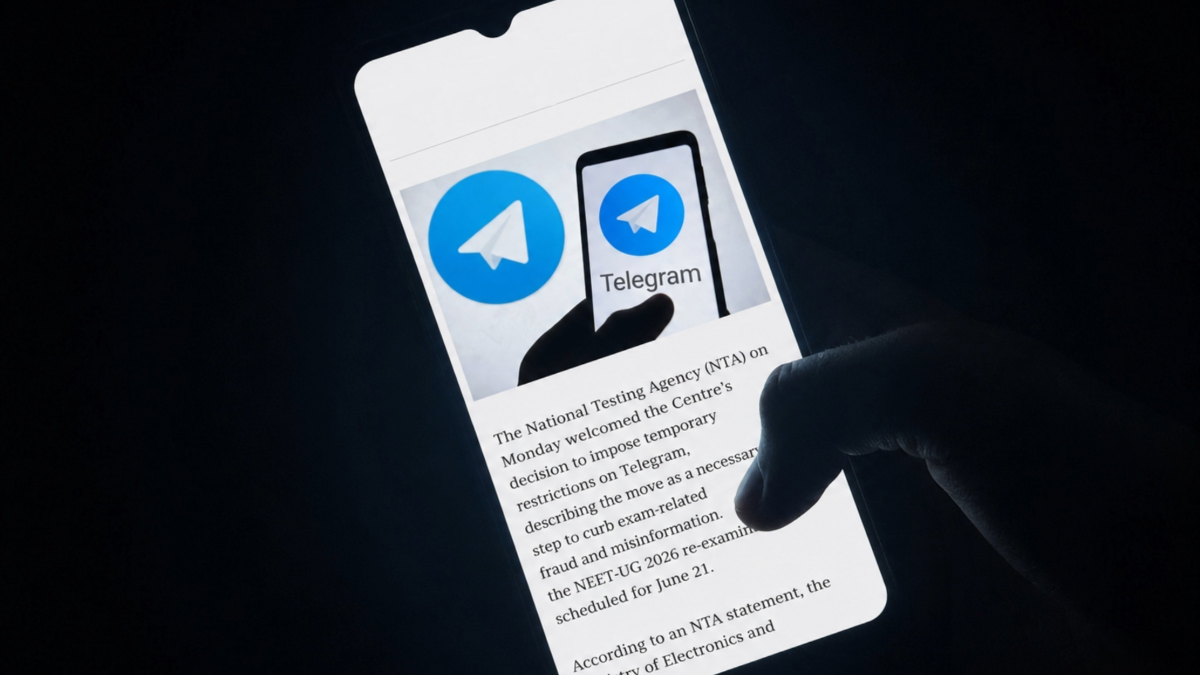
JUNE 16, 2026: A person reads a news report on a smartphone regarding the temporary restriction of Telegram in India ahead of the NEET-UG 2026 re-examination. Authorities said the measure was introduced to curb examination-related fraud, paper leaks and the spread of misinformation during the conduct of the test. (Photo by Waris Nissar/Sipa via AP Images)
On June 16, the Ministry of Electronics and Information Technology (MeiTY) ordered Telegram to be blocked across India, invoking Section 69A of the Information Technology Act, 2000, over fraud on the platform connected to a national medical entrance examination. Three days later, in Telegram FZ LLC v Union of India, the Delhi High Court dismissed the platform's challenge, holding the block was proportionate according to the legal framework laid down in a prior ruling, Anuradha Bhasin v Union of India.
Two pieces on Tech Policy Press have already examined that finding and found it wanting. Amber Sinha argued that reading an entire platform into the statutory term “information” normalizes platform-wide blocking as a default tool. Apar Gupta traced how the Attorney General's submission on Telegram's technical architecture inverted the burden proportionality is meant to impose. Both treat this as a proportionality failure. That framing is correct as far as it goes, and incomplete in a way that should matter more than either piece allows for.
Proportionality is a second-stage inquiry. It asks whether a restriction is a necessary, least-intrusive means to a legitimate end. It does not ask whether the end invoked was the correct one to begin with. Justice Karia's judgment spends four paragraphs (¶¶38–41) working through the Anuradha Bhasin proportionality checklist—appropriateness, necessity, least restrictive measure—and finds the Telegram block satisfies all four. What it never does, and what neither the Union of India’s submissions nor the Rule 7 Committee's Final Order attempt, is establish that “public order” was the right label for what the paper-leak fraud on the NEET UG 2026 exam actually threatened. The order simply asserts it. Justice Karia held that the “underlying object” was to avert disruption of public order (¶40) and further noted the Committee found narrower takedown measures ineffective. (¶45) At no point does the Delhi High Court’s reasoning pause on whether examination fraud, however serious, rises to the constitutional threshold “public order” describes, as opposed to the threshold “law and order” describes. That omission, not the proportionality analysis built on top of it, is the judgment's fundamental defect.
The threshold that got skipped
Indian constitutional doctrine has an answer to this question, and it predates the internet by half a century. In Ram Manohar Lohia v State of Bihar (1965), a Constitution Bench of the Supreme Court distinguished detention orders citing “law and order” from those citing “public order,” holding the two are concentric circles of differing radius rather than interchangeable labels, security of the state at the center, public order around it, law and order the widest ring. Arun Ghosh v State of West Bengal (1969) supplied the test for telling them apart, asking whether the act disturbs the even tempo of the life of the community, or merely injures a particular person or defined class without reverberating outward into general disorder. An act can be a serious criminal wrong and still fail that test.
It is fair to ask whether a test built for preventive detention under Article 22 travels intact into a blocking order made under Section 69A. It does, because the legal vocabulary does the traveling for it. The Suspension Rules [Rule 2(1) read with Section 7 of the Indian Telegraph Act, 1885] and the 2009 Blocking Rules [See Form- Question 17(v)] both use the words public order and security of the State without redefining them for the digital context, and Anuradha Bhasin measured internet shutdowns against that same borrowed vocabulary rather than inventing a separate one for the online sphere. If public order were meant to carry a lower threshold when a platform is blocked than when a person’s liberty is restrained, that would need to be argued and defended on its own terms, not assumed by using the word and moving on. Neither party in Telegram FZ made that argument, and the Court therefore had no reason to test it.
Apply it to what the record in Telegram FZ actually describes. NTA’s communications to MeitY, reproduced in the Final Order, identify channels operating under names such as “PAPER LEAKED NEET” and “Re-NEET 2026,” extracting money from candidates and families in exchange for supposed access to leaked material. That is extortion and fraud directed at an identifiable class—examination candidates and their families—through identifiable channels. It is not, on the face of the material recited in the judgment, an act with the potentiality Lohia and Ghosh require to disturb the even tempo of the community at large. The judgment does not argue otherwise. It does not argue the point at all. It moves directly from “misuse of the platform” to “public order situation” as though the two were self-evidently the same thing, and having made that leap, spends its analytical energy entirely downstream, on whether the resulting block was proportionate.
A rationale that has lost this argument before, informally, every time
The claim that examination integrity justifies extraordinary suspension powers is not new to Indian internet governance. The record spans many states, which inter alia include Gujarat, which suspended internet service in 2016; Rajasthan, which suspended in February 2018, twice more that year and again another examination in 2021, and 2023; Arunachal Pradesh, which imposed statewide suspensions in 2018 and again in 2020; and West Bengal, which suspended internet services every day its higher education examinations were concluded.
This is not an aberration state governments occasionally reach for. This standing administrative reflex, repeated across four states over six years, entirely outside anything Telegram FZ required a court to test.
It was also, at least once, formally renounced. In 2018, the Rajasthan shutdown was challenged before the Rajasthan High Court. The State Government submitted an Affidavit before the Court that no order suspending internet services would be issued in future during examinations, and in Dhirendra Singh Rajpurohit v State of Rajasthan (D.B. Civil Writ No. 10304/2018) the writ petition was disposed of as infructuous on the strength of that undertaking. Three years later, for REET 2021, the same state government shut the internet down again, in more districts than in 2018, with no official consequence for violating an affidavit before the Constitutional Court.
There is a further detail that goes directly to the threshold question raised above. The suspension orders do not strictly invoke “public order” at all. Read them and the recurring phrase, across Rajasthan in 2018 and again in 2021, is that suspension is necessary “to maintain law and order” in the district or division concerned, language the district magistrates and divisional commissioners issuing these orders used deliberately, since the Suspension Rules themselves list public order as a separate, narrower ground. The Executive’s own contemporaneous description of this harm—rumor, paper leaks, exam-fraud gangs operating through mobile internet—has for six years been law and order, the wider and less demanding of the two categories Lohia identifies. MeitY's Telegram order breaks with that settled administrative self-description without acknowledging it, reclassifying the same genus of harm as public order for the first time, at the one moment the claim finally reached a forum with the authority to make the reclassification binding.
Executive has (already) moved on
The clearest evidence that the judgment’s cost lies less in the blocking power itself than in the reasoning it left unexamined arrived within a fortnight. On July 1, MeitY sent Meta a notice directing it to defer the rollout of WhatsApp’s usernames feature, followed by Signal and Telegram in India pending consultations, and to explain within three days why regulatory action should not follow under the IT Act and the 2021 Intermediary Guidelines. Reporting on the notice records that it draws directly on arguments the government made in the Telegram litigation itself, that username-based communication conceals identity, that a single account can spin up dozens of bots, that mirror accounts can be recreated within minutes of enforcement action. These were Solicitor General of India’s submissions to Justice Karia, describing why Telegram’s architecture made narrower measures futile. They have now been redirected at a platform that has not been found to have hosted a single fraudulent channel, to justify pausing a feature before it has launched.
What makes this different in kind, not just in its target, is that it happens entirely outside the framework Telegram FZ was decided under. There is no Section 69A order here, no Rule 7 Committee, no interim direction confirmed by a final one. There is a notice—on uncertain statutory footing—backed by the threat of unspecified “regulatory action” if the explanation offered does not satisfy the Ministry and hence has no clear basis in law and amounts to a product approval regime no statute authorizes. Whether or not that characterization survives Meta’s response, the sequence is instructive on its own terms. A blocking order for which the “public order” finding went untested has, in under three weeks, supplied the vocabulary for an intervention that does not even attempt the procedural discipline, thin as it was, that Section 69A requires. The architecture-as-danger framing outlived the case that produced it and is now doing work in a register where nobody has to justify it to a court at all.
What actually needs fixing
There is a further problem with the causal story the block rested on. NEET UG was not the last examination compromised. On June 27, Maharashtra police intercepted a leaked Maharashtra Teacher Eligibility Test paper hours before the exam was due to begin, forcing the State to postpone it statewide, with the investigation tracing the breach to a private printing press in Agra that has produced the state’s papers for close to two decades. Two days later, Jaipur police broke up a cheating racket running through a Rajasthan Paramedical Council examination center, organized through invigilators paid in cash to seat and assist particular candidates. Neither leak travelled through Telegram or any other app. Neither needed to. The mechanism the government told Justice Karia made Telegram uniquely dangerous- encrypted mass distribution reaching millions of downstream users within minutes- was never the only route, or even the primary one, by which examination integrity in India actually fails. Printing presses, transport chains and paid exam proctors require no platform architecture at all. A government that shut down one distribution channel while the leak itself kept occurring upstream of any platform, in the same fortnight, was not addressing the harm it named. It was being seen to act on a deadline that had already passed.
None of this bears on the threshold question directly. It shows that even bracketing that question and meeting the judgment on its own proportionality terms, the causal premise was already false. Lohia and Ghosh have supplied one for sixty years, and it has simply gone unargued at the one moment its application would have mattered most, a reasoned High Court judgment concerning a platform used by roughly 150 million people in India. The Rule 7 Committee did not ask the threshold question. Neither of the parties pressed it either, arguing proportionality rather than antecedent legitimacy. The Court, accordingly, never needed to answer it. That is how a claim with an eight-year losing record acquires precedential weight without ever being made to defend itself on its own terms. The WhatsApp notice is what happens next once it has. Examination fraud is a real and serious harm. Whether it is a public order harm remains, formally, an open question for Indian courts.
Authors