India's Telegram Ban Risks Normalizing Platform-Wide Blocking
Amber Sinha / Jun 22, 2026Amber Sinha is a contributing editor at Tech Policy Press.
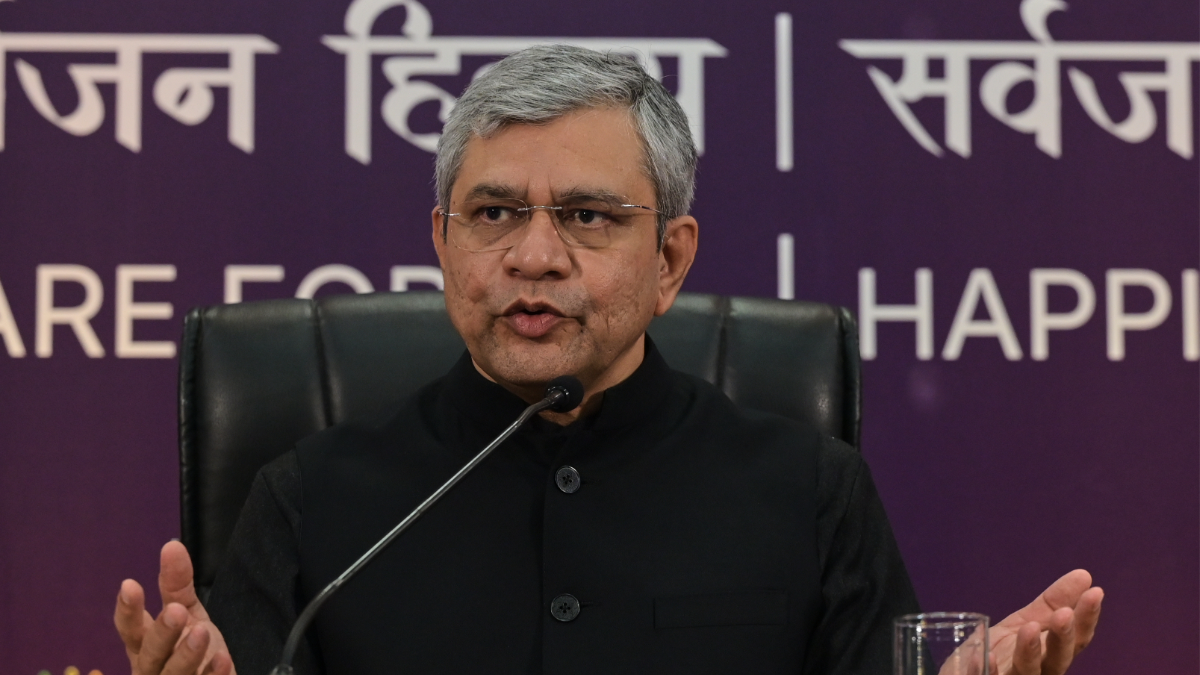
Indian Technology Minister Ashwini Vaishnaw addresses a press conference during AI Impact Summit in New Delhi, India, Tuesday, Feb. 17, 2026.
The intersection of digital platform governance, state authority, and constitutional rights in India has been a battlefield with shifting boundaries for the past decade and a half. However, the mid-June 2026 emergency action taken by the Ministry of Electronics and Information Technology (MeitY) against the cloud-based messaging platform Telegram—and its subsequent validation by the judiciary—marks another milepost in the consolidation of power in state authority. By analyzing the statutory maneuvers, the judicial deference displayed by the court, and the broader political economy of the Indian internet, we can observe a worrying phenomenon: the normalization of platform-level blocking as an acceptable, primary regulatory tool.
Examination paper leaks as a new ground for blocking
The catalyst for this unprecedented regulatory intervention was the systemic crisis surrounding the National Eligibility-cum-Entrance Test (Undergraduate) or NEET-UG 2026. Following the cancellation of the original May exam due to pervasive paper leaks and institutional irregularities, a re-examination was scheduled for June 21. In the days leading up to the re-test, the National Testing Agency (NTA) and the Indian Cyber Crime Coordination Centre (I4C) flagged what they described as an uncontainable proliferation of cheating networks, paper-leak syndicates, and coordinated misinformation campaigns operating across Telegram.
The technical specifications of the app—its large public channels, automated bot ecosystems, and high-capacity file-sharing features—were deemed by authorities to act as a "new dark web." Furthermore, security agencies pointed to a distinct structural feature: Telegram's message-editing capability. Fraudsters were allegedly exploiting this feature to alter historic messages, inserting actual exam papers into old posts after the fact to manufacture a false timeline of pre-exam leaks, thereby destabilizing public confidence and stoking student panic.
Faced with these infrastructural challenges, MeitY bypassed localized, content-specific interventions. On June 16, the ministry issued an emergency blocking order directing internet service providers to completely restrict access to Telegram across India until June 22, alongside an explicit mandate disabling the platform’s message-editing feature until June 30.
The legal anchor for this sweeping action was Section 69A of the Information Technology (IT) Act, 2000, read alongside Rule 9 of the Information Technology (Procedure and Safeguards for Blocking for Access of Information by Public) Rules, 2009. Section 69A grants the Central Government the power to direct intermediaries to block public access to information in the interest of the sovereignty, integrity, or defense of India, the security of the State, friendly relations with foreign states, or—critically here—public order and the prevention of incitement to cognizable offenses. Under Rule 9, the state invoked its emergency powers to execute this blockade immediately, deferring the standard procedural requirement of a pre-decisional hearing.
Telegram’s judicial challenge
Telegram FZ LLC promptly mounted a constitutional challenge before the Delhi High Court, seeking a stay on the platform-wide restriction. The intermediary argued that a wholesale blockade directly infringed upon the fundamental speech and associational rights of over 150 million legitimate Indian users who relied on the platform for educational resources, professional coordination, and lawful communication. Centrally, Telegram argued that Section 69A is structurally designed for the targeting of ‘specific information’ or particular URLs, and cannot be creatively stretched into a statutory license for complete platform decapitation—especially when the intermediary had already complied with taking down over 900 of the 1,300 specific URLs flagged by MeitY.
Dismissing the writ petition on June 19, Justice Tejas Karia systematically dismantled these safeguards. The court accepted the Union government's premise that entity-specific, localized interventions had repeatedly failed due to the platform’s unique architectural resilience, where the deletion of a single channel merely triggered the instantaneous creation of mirror channels and the rapid migration of subscribers.
To bridge the statutory gap between blocking ‘specific information’ and blocking an entire platform, the court turned to an expansive exercise in definition. Justice Karia highlighted Section 2(1)(v) of the IT Act, which includes ‘codes, computer programs and software’ within the statutory definition of ‘information.’ By treating an entire software-based communication application as a monolithic unit of “information” generated or hosted within a “computer resource,” the court concluded that the state was fully empowered under Section 69A to block access to the entire platform.
Evaluating the measure against the landmark proportionality standards established by the Supreme Court in Anuradha Bhasin v. Union of India (2020), the High Court held that the order was the "’least restrictive measure’ available. It reasoned that the extreme public interest of protecting 2.2 million medical aspirants outweighed the temporary informational disruption, concluding that the strict time-bound nature of the order (operative only until June 22 and 30, respectively) saved it from the vice of disproportionality.
Redefining the limits of content moderation
Despite the court's presentation of this outcome as a neatly tailored emergency response, the Telegram FZ decision is deeply flawed. First and foremost, the judgment's statutory translation exhibits a profound failure to engage with the structural grammar of the IT Act, 2000. By reading "software" so broadly that it encompasses an entire multi-layered social network and messaging platform, the court creates an alternate regulatory logic where the state can switch off an entire ecosystem under the guise of content moderation.
Furthermore, the court’s proportionality analysis is startlingly underdeveloped. To satisfy the Anuradha Bhasin framework, the state must demonstrate that no alternative, less intrusive means exist to achieve the regulatory objective. Yet, the court accepted the state’s claims of "inadequacy" with minimal evidentiary probing. The fact that students were actively using Proton VPNs or migrating to other encrypted applications immediately after the ban indicates that the measure was both overbroad for innocent users and remarkably ineffective at stopping determined criminal networks.
By failing to subject MeitY’s assertions to rigorous empirical scrutiny, the High Court transformed the constitutional test of proportionality from a strict hurdle into a rubber stamp, offering future litigants a narrow but necessary path to distinguish this ruling based on proper technical and structural definitions of networks.
This judgment should concern every internet platform operating in the Indian market. In the digital economy, consumers rely on the friction-free integration of platforms into daily personal and professional workflows. A temporary suspension of this nature is potentially catastrophic, permanently shattering user habits and causing immense economic and operational disruption. The judicial blessing of this order will embolden MeitY from threatening any internet intermediary with complete infrastructure blocking to enforce conformity with even legally dubious content-takedown or data-access demands.
The inevitable consequence will be the rise of highly aggressive, proactive corporate censorship across all social media platforms. Intermediaries, operating under the perpetual hanging sword of a total shutdown, will almost certainly over-comply with informal executive desires. Crucially, these sweeping exercises of state authority will no longer require radical justifications; they will be framed through universally palatable and emotionally charged narratives: public safety, morality, national sovereignty, and, as we have now witnessed, examination integrity.
What this means for digital rights in India
Historically, the sheer inertia, technical illiteracy, and clumsy drafting of the state bureaucracy often meant that over-broad blocking orders were flawed, procedurally deficient, and easily dismantled upon judicial review.
The Telegram blocking order demonstrates that this assumption no longer holds true. MeitY’s contemporary orders reveal a striking leap in procedural sophistication, granular technical description, and legal reasoning. What is certain is that the Indian state is ostensibly speaking the language of the judiciary. By presenting an order that is polished, superficially compliant with procedural frameworks, and wrapped neatly in the vocabulary of "narrow tailoring" and "temporary restrictions," the executive has demonstrated that it can easily overcome this challenge.
The Telegram FZ order has effectively codified a dangerous precedent: in the digital age, the Indian state no longer needs to censor the message if it can simply turn off the medium.
Authors