In Brazil, Lula's Army Fought Meta on Meta's Own Turf
James Görgen / Nov 4, 2026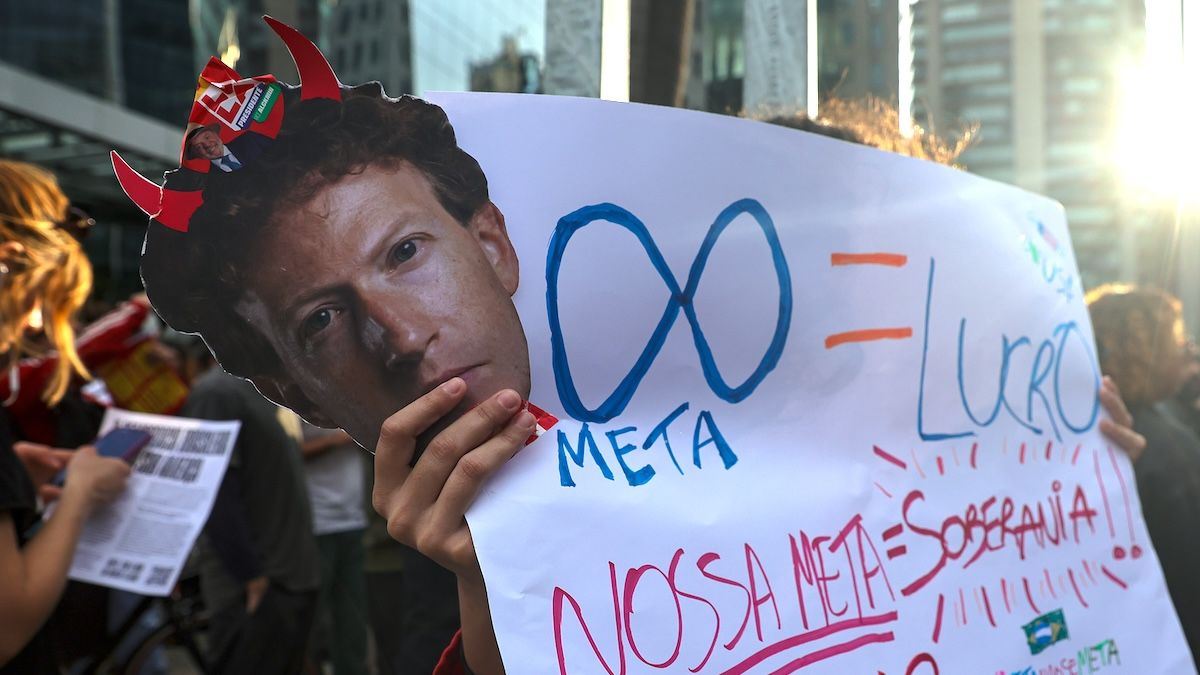
A protest outside Meta headquarters in Sao Paulo, Brazil, on October 19, 2026. (Allison Sales/NurPhoto)
For most of Brazil’s runoff in October, President Luiz Inácio Lula da Silva’s campaign treated Meta as a hostile actor. It accused the company of attempted electoral interference in favor of his right-wing opponent Senator Flávio Bolsonaro, took the case to the Superior Electoral Court (TSE), and complained to the national data protection authority and the Organization of American States.
In those same weeks, the campaign’s most effective organizing tool was a Meta product. Exército do Lula (Lula’s Army), a WhatsApp channel run by federal deputy André Janones, reached 10.5 million followers by October 23 and became the second largest channel on the app in Brazil. Two days later Lula won 51.79% of the vote. It was the first time in Brazil’s history that a presidential candidate overturned a first-round defeat.
The WhatsApp channel worked as a command center. Janones issued daily missions asking followers to share posts, comment on videos, search for specific terms on Google and push hashtags on X. Each member was told to invite four more people. It affected the public agenda. In past cycles, much of the left’s online energy went into rebutting Bolsonarist narratives. This time, the missions focused on Flávio’s fiscal plans and proposed cuts to social programs. Flávio’s campaign responded by launching a website with answers to the topics and comments circulating online. The right even copied the whole channel format with Tropa do Flávio (Flávio’s Troop), which attracted 1.9 million subscribers by the time Lula’s Army had passed 4.8 million.
The allegations against Meta were serious. Brazilian newspaper Folha de S.Paulo obtained internal messages in which Meta employees acknowledged that temporary restrictions had harmed Lula’s Instagram accounts, and that the platform had algorithmically recommended Flávio’s profile and his WhatsApp channel — a practice the TSE prohibits. Meta initially blamed a global data outage. According to the internal messages, that outage lasted just five hours on October 7, while Lula’s campaign could not boost feed posts for nearly 24 hours on October 9. The campaign estimated that about 1.3 million people were not shown its ads. In none of the conversations reviewed by the newspaper did employees admit to interference. They did discuss the severity of the problems, the slow response of engineering teams and their concern that a narrative of interference was gaining ground.
Meanwhile, lawyers of a coalition supporting Lula argued that Meta AI generated images favoring Flávio while restricting image requests depicting Lula. The nonpartisan organization CTRL+Z collected more than 1,100 reports of restricted or banned accounts, mostly from Lula supporters. On October 15, TSE Justice Marco Aurélio Bellizze barred Meta from unequally reducing reach, excluding recommendations, or restricting searches under a daily fine of BRL 500,000 (around $90,000). The full court upheld the order unanimously the next day. Meta denied any bias and said every incident had a direct and documented technical explanation.
All roads lead to Meta
Meta was at once the stage of the campaign, the defendant in the interference case and the referee of the channel that arguably helped swing the race.
WhatsApp’s search results suggested Tropa do Flávio to users looking for Lula’s Army, a result also recorded in Meta’s internal messages, while a search for Flávio’s channel returned no Lula-related results.
When certain terms promoted by Janones trended on X and spiked on Google between October 18 and 20, Flávio’s campaign asked the TSE to question the platforms and contested Meta’s finding that WhatsApp had detected no coordinated election interference in the channel. The legitimacy of Lula’s main organizing tool came to depend on an integrity assessment issued by the company his campaign was accusing of bias. The court went further. In an October 13 ruling, TSE President Kassio Nunes Marques ordered Meta to proactively monitor the public channels named in the case and remove any content substantially similar to content that had previously been ordered removed. Essentially, a private company was tasked with deciding what counts as an election violation. Lula’s Army was suspended twice in three days by single-judge rulings before it returned.
Leaving the platform was never an option. Because the TSE bans algorithmic recommendations of candidate accounts by social media platforms, paid boosting is the only way for campaigns to expand their reach online. With Google having eliminated political advertising since 2024, Meta holds what Folha de S.Paulo describes as a virtual monopoly on electoral advertising in this election. The response to suspected bias was to occupy the platform more intensely.
As Clara Iglesias Keller, Robert Gorwa and João C. Magalhães noted in Tech Policy Press, suspicion of bias became a mobilizing weapon. That weapon ran on Meta’s servers, was ranked by Meta’s recommendation systems and could be throttled by Meta’s integrity tools. Every follower Janones gained added engagement to the very company the campaign was holding to account. The counter-mobilization deepened the dependence that made interference plausible in the first place.
The TSE’s order to give candidates equal treatment on October 15 exposed the limits of the current accountability toolkit. The same decision noted that, up to that point, there was no evidence of deliberate manipulation of the algorithms, an absence that also reflects the lack of outside access to them by independent investigators. Compliance would be assessed through Meta’s own report delivered five days after the results of the election would be known. The case also reached Washington. On October 22, three days before the runoff vote, 12 members of the US Congress led by Pramila Jayapal, D-Wash., and Senator Bernie Sanders, I-Vt.,wrote to Mark Zuckerberg asking about the 17 measures Meta adopted to comply with the TSE order, possible contacts with the Trump administration and whether the company would allow for an independent audit.
A home grown alternative?
This election period has shown once again that Brazil needs independent audits of recommendation and content moderation systems throughout the electoral cycle, with access to distribution parameters for the TSE’s technical staff and accredited researchers. It also needs a public log of any changes to generative AI filters affecting political content, since TSE Resolution 23.755/2026 bars such systems from favoring candidates, although it doesn’t specify who should verify compliance. Delegated moderation, which today leaves platforms to decide what is equivalent to content already banned, should face the same scrutiny.
Audits reduce opacity without reducing dependence. As long as Brazil’s political mobilization activities run on apps controlled by foreign companies, each election will remain subject to distribution rules written beyond the reach of Brazilian law.
The country’s industrial policy already points to a path of greater digital sovereignty. Mission 4 of Nova Indústria Brasil (New Industry Brazil), dedicated to digital transformation, lists among its priorities the strengthening of the supply chain for advanced digital products and services, a category that includes digital platforms and cloud services. Pix, an instant payment system created by Brazil's Central Bank, is a clear example of how public digital infrastructure can reach national scale within a few years. Extending that innovation logic to online communication through public financing, procurement and interoperability rules, the next Lula’s Army could one day rely on ground rules that its own democratic institutions can determine and more credibly oversee.
Authors