Brazil Shows Platform Illiberalism is Big Tech’s New Normal
Clara Iglesias Keller, Robert Gorwa, João C. Magalhães / Oct 28, 2026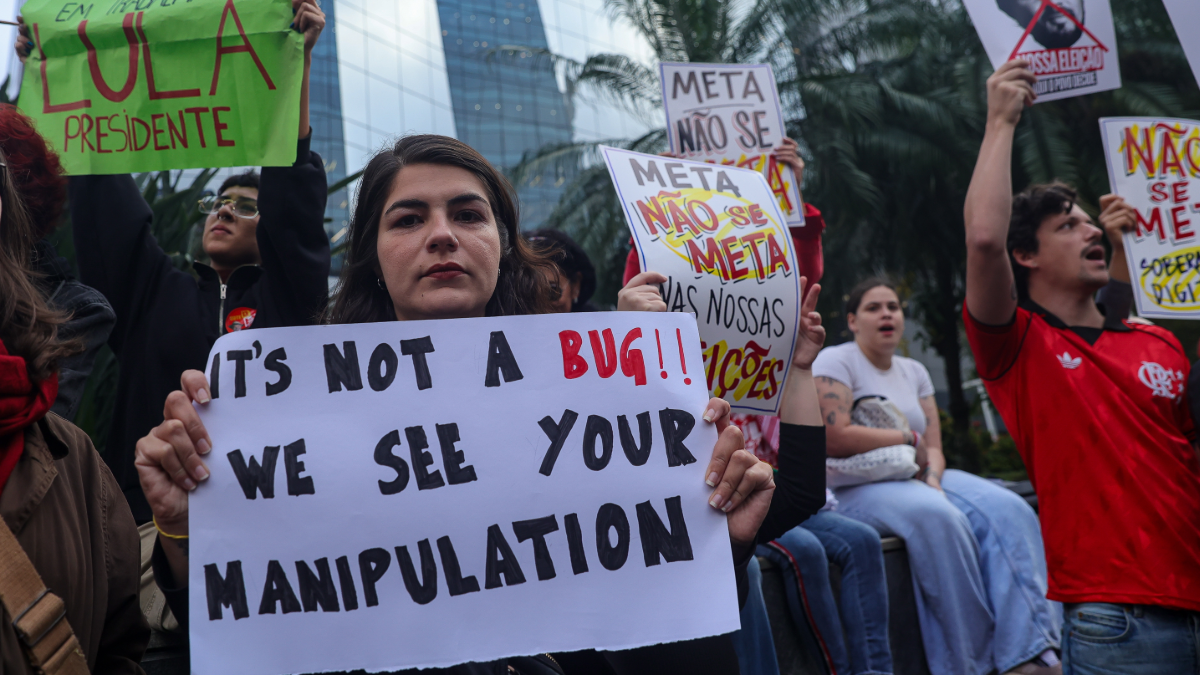
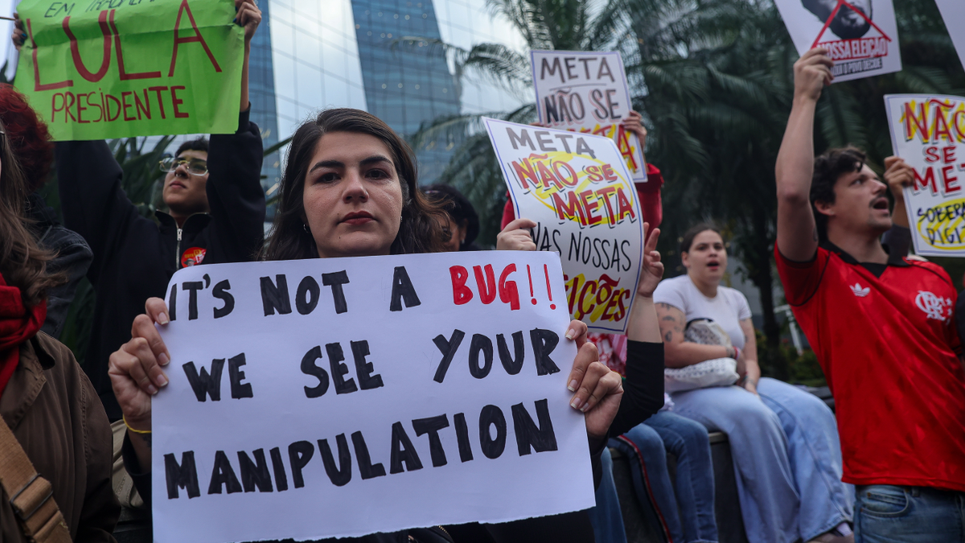
Demonstrators wear masks depicting Meta CEO Mark Zuckerberg, Brazilian presidential candidate Flavio Bolsonaro and US President Donald Trump during a protest outside Meta's headquarters in Sao Paulo, Brazil, on October 19, 2026. The protest was called over allegations that restrictions on Instagram affected the campaign of Brazilian President Luiz Inacio Lula da Silva ahead of the presidential runoff election. Meta attributed the reported issue to a technical failure and denied political bias. (Photo by Allison Sales/NurPhoto via AP)
In the past weeks, as Brazil's president, Luiz Inácio Lula da Silva, was engaged in a pitched battle with the disgraced former president Jair Bolsonaro’s son Flávio in the lead up to the country's federal election, an avalanche of troubling reports emerged about how Meta’s platforms were favoring the far-right challenger. These included discussions of the apparent limits placed on Lula’s official Instagram account, the inability of his official profile to be discovered via the platform’s search tools, and the alleged refusal of Meta’s integrated AI tools to generate pro-Lula content, while accepting prompts to produce pro-Flávio material. Leaked internal communications acknowledged that Meta was artificially preventing Lula’s campaign from boosting content due to “technical issues,” but Meta offered vague justifications for this decision. Eventually, following a petition from Lula’s campaign, the Brazilian Electoral Court issued an injunction barring the company from limiting the reach of political content posted by either candidate, threatening a daily fine of R$ 500,000 (about $100,000 USD). In the end, despite a tranche of polling predicting a Bolsonaro victory after Lula was defeated in the first round, the progressive incumbent was re-elected president on Sunday, Oct. 25.
Any conclusion on whether and how Meta acted to favor Bolsonaro — a noted ally of United States President Donald Trump and a critic of tech regulation — will need to wait for new revelations, research, or, ideally, a full investigation. In any case, as a major market for digital services, and an increasingly assertive online regulator, Brazil offers a consequential case study of how the politics of online speech governance are changing. At the center of this change is the increasing amalgamation of digital platforms and the far-right’s interests — what we have termed elsewhere “platform illiberalism.’’ It is now common to assume that Big Tech companies will side with conservative, Trumpian actors in global politics. In Brazil, this assumption became a powerful political fact in of itself, helping shape the narrative around the election and fueling forms of counter-mobilization in the second round.
Weaponizing platform governance
Since at least the Brexit referendum and the first election of Donald Trump in 2016, it has become commonplace to interrogate how digital platforms can turbocharge far-right politics. Initially, this possibility was primarily framed by policymakers and scholars as a marriage of convenience: from Facebook’s newsfeed to YouTube’s algorithmic curation of videos to watch next, the kind of outrage and anger at the heart of far-right politics was a natural fit with platform’s underlying business logics, premised on user engagement and keeping people glued to their screens.
In recent years, however, as the US-based technology industry has more explicitly aligned itself with an ascendant global far-right, we have seen platforms not just subtly reconfigure their platforms and accompanying trust and safety institutions, but also explicitly wield those institutions in an effort to boost right-wing political movements. This is what we called ‘platform illiberalism’ in an academic article where we traced the transformation of Twitter into X under the leadership of Elon Musk. Musk deliberately redesigned recommendation systems to boost his own posts, also promoting Trump, Germany’s Alice Weidel, Jair Bolsonaro in Brazil and Tommy Robinson in the UK. He also changed the platform’s moderation infrastructure to remove content from journalists, rivals and critics.
This strategy has been, to some extent, copied by other firms. Shortly after Musk’s political success in early 2025, epitomized by his role in the Trump administration, Meta announced the relaxation of restrictions on topics like immigration and gender, all but ended professional fact-checking in the US, and committed to work closely with Trump to oppose international regulation of social media.
Critics have long noted the inherently regressive tenor of Meta’s content moderation regime — digital rights researcher and activist Jillian York, for instance, has observed how the company has consistently sided with those in power, something long reported with regard to the suppression of the speech of Palestinians, Kashmiris, and Tigrayans. But Meta platforms did not seem to have yet plunged into a full blown mode of platform illiberalism, intentionally acting to sway the balance of political forces towards a particular candidate or movement, as Musk had done with X. Or have they?
Was Meta following in the footsteps of X?
There has been much discussion in the Brazilian press as to the extent to which Meta may have put its thumb on the scale during the election period. The first thing to acknowledge before answering this question is that we are still far from the level of platform observability necessary to investigate and understand if and how political interference happened (more on this shortly). This is a classic and very difficult problem facing all of us in a platform-mediated information sphere today: as the legal scholar Jonathan Zittrain wrote in 2014, ‘Facebook could decide an election without anyone finding out’ if it simply quietly displayed reminders to vote to certain segments of the population.
Besides the reports of interference, what we do know is that Meta is the company that received the most funds from this year’s electoral runoff in Brazil, over $53 million in total. Bolsonaro’s campaign spent $1.3 million, or three times the amount paid by Lula’s team. In theory, Meta would have much to gain from a Bolsonaro administration: his party is not only a bigger spender on digital advertising, but also promises a slate of deregulatory measures that would benefit them. Lula, in contrast, has pushed for a range of tech policy interventions, managing his last term to implement a couple of incremental initiatives, including on online child safety, and has consistently talked about the need of Brazil achieving digital sovereignty.
It is possible that Meta was engaging in pro-Bolsonaro activity but went slightly too far, tweaking its systems in a way that led them to visibly break and be discovered by users. Or rather that Lula’s campaign, left-leaning social media users and journalists were doing what all actors tend to do when they look like they may lose an election: make complaints based on anecdotal evidence. Meta has denied accusations that it sought to benefit one part over the other, calling the notion it meant to suppress the Lula campaign on behalf of Bolsonaro a “political narrative constructed by combining unrelated technical issues.” In any event, we of course need to remember that digital communication is only one aspect of the broader hybrid media system, and these kinds of visibility interventions would have a differential impact on certain demographics, and not necessarily the entire population.
Despite these uncertainties, what does the Brazilian episode suggest about the future of platform-state interactions in an electoral context? What can we learn from it?
The changing politics of platform governance
The first lesson is that Big Tech companies' long-contested presumption of ideological neutrality seems to be gone for good. To be clear, speech governance bias is not new, and socially marginalized users have long shouldered the brunt of platforms’ ‘mistakes’. What we saw in Brazil was an example of a political establishment vocalizing these concerns, which eventually became a focal point of Lula’s campaign. The argument that the Trump-aligned Meta corporation was meddling in Brazil to help Bolsonaro could not only be presented by Lula as a deep injustice, but also fit perfectly with one of his most powerful lines of attack during the campaign — that his rival represented the US’s imperialistic interests, not those of Brazil.
This might have also fueled the massive mobilization of Lula supporters to influence how platform visibility operates, leading to our second lesson: platform illiberalism can galvanize resistance. The main field of contestation in this regard was (ironically) Meta’s WhatsApp, where Lula’s campaign created a channel that by the end of the elections gathered over 10 million accounts. “Lula’s Army” engaged people in a form of algorithmic contestation that included strategic online searches, organically orchestrated hashtags and content sharing across different platforms, surviving different attempts from Bolsonaro’s campaign to shut it down. Beyond potential lessons for online political campaign strategy, the experience suggests that we need further research on its relation to mobilization outside of digital platforms as well (like the unprecedented voter turnout and numerous reported initiatives of solidarity across the country that sought to circumvent efforts at voter suppression).
The third lesson is far from new — but it is perhaps newly urgent: this episode illustrates the concrete peril of allowing digital platforms’ content governance regimes to operate without direct democratic transparency, particularly during elections. Despite legislative debates and judicial decisions, Brazil never managed to approve a comprehensive legal framework for platform regulation, with proper transparency obligations. That, of course, is no easy task: even in Europe, the efforts to do so via the Digital Services Act (including the much discussed Article 40 mandatory researcher data access provisions) have not prospered in a context of ample resistance from tech firms and a lack of enforcement appetite in the European Commission. Opacity serves a long term destabilizing function, allowing political actors to make unprovable claims about the electoral impact of changes to platform design and content moderation systems. While this may be inevitable to some degree, there seems to have been little improvement in ways that platforms handle important elections in the last decade.
What is currently new is that the trend of platform illiberalism means that we may need to reshape some of the foundational assumptions underpinning not just political communication work on elections, but also more generally the tenor of public-interest technology regulation. If these infrastructures cannot be regarded as neutral spaces to be studied, but as tools being wielded strategically by their politically motivated owners, where does that leave us?
Authors