In Brazil’s Runoff, Lula Faces Bolsonaro, Trump—and Big Tech
Daniel Arnaudo / Oct 23, 2026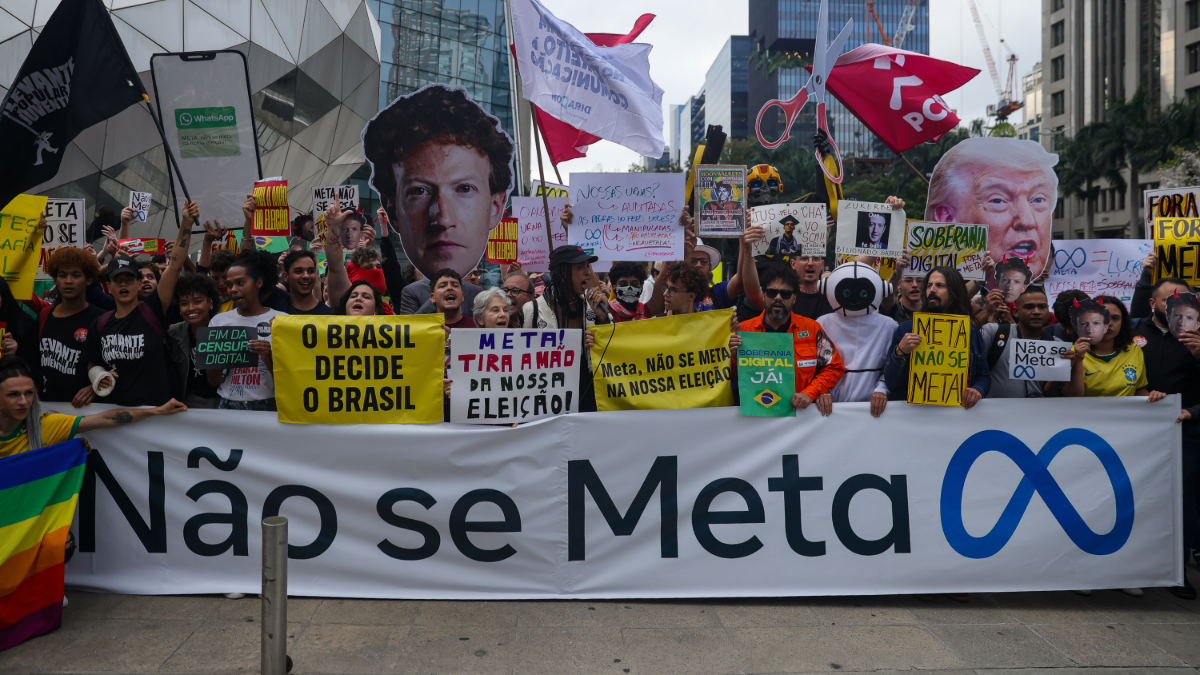
Demonstrators wear masks depicting Meta CEO Mark Zuckerberg, Brazilian presidential candidate Flavio Bolsonaro and US President Donald Trump during a protest outside Meta's headquarters in Sao Paulo, Brazil, on October 19, 2026. (Photo by Allison Sales/NurPhoto via AP)
One of the world's largest democracies and a leader in the hemisphere, Brazil is in the final days of a runoff presidential election that pits the current president and leader of the Workers’ Party (PT), Luiz Inácio Lula da Silva, against senator and Liberal Party (PL) candidate Flávio Bolsonaro, son of Jair Bolsonaro, Lula's predecessor. The hard-right Bolsonaro, bucking the polls as many of his ideological compatriots have done before, received the most votes in the first round of the election, earning 47% to Lula’s 45%. Bolsonaro's campaign also swept in a range of national and regional candidates in the first round, with the PL forming the largest bloc in the Senate and Chamber of Deputies, while winning many key governorships and other local races. The two men will face off in a second round on Sunday.
Questions about the power and influence of tech companies based in the United States have taken center stage. Meta, the owner of Facebook, Instagram and WhatsApp, has become a major focus of these concerns, formal investigations and now judicial reprimands.
Concerns about the integrity of the online information environment are compounded by fears of US government meddling in Brazilian politics. Combined with Lula's deeply antagonistic relationship with the Trump administration, his campaign has complained of interference and manipulation from the United States, a claim that comes with the weight of deep historical precedent.
With just days left before the vote, these dynamics are emerging as one of the principal campaign narratives and represent a major challenge to Brazil's democratic processes. A series of events over the past few days and weeks are testing the system and marking the edges of oversight, regulation and technological development in the field.
Meta's key role in election discourse
Meta's properties dominate the Brazilian political landscape, from Facebook posts and Instagram shorts by major candidates to omnipresent WhatsApp messages that parties use to share their messages, coordinate supporters and get out the vote.
As a result, when Meta blocked Lula's Instagram campaign account on Sept. 23, several days before the first round election and his campaign’s leadership cried foul and demanded it be reinstated, it represented a critical development. With no explanation, Meta reinstated it on Sept. 29. The campaign complained to the Superior Election Court (TSE) after the election and asked for investigation, and on Oct. 10 the TSE asked Meta to respond. It did, saying: "The allegations are simply false and not supported by the facts." Lula’s campaign disagreed, accusing Meta of meddling in the election and accusing the platform of “illegally practicing algorithmic selectivity, in the midst of a fierce presidential contest.’’
These kinds of posts and takedowns show both the reach of the social network and challenges of moderation, but there was no explanation for why this post was taken down or reinstated.
Other questionable moderation decisions have dogged Meta, most notably when it took down a viral video explainer by Fabio Porchat, one of Brazil’s most famous comedians, of a major political corruption scandal that allegedly implicates Bolsonaro and many other politicians across the spectrum. Revelando Brasil, a video account supported by a collective of news organizations, hosted the video and was blocked for several hours
CTRL+Z, a nonpartisan nonprofit focused on big tech accountability, published an investigation indicating that Meta appears to be systematically discriminating against left wing posts, based on user reports. (Tatiana Dias, a fellow at Tech Policy Press, is a founder and program director at CTRL+Z.) These reports formed the basis of a call for an investigation into what CTRL+Z together with Article 19, Conectas Direitos Humanos and Sleeping Giants Brasil, referred to as systematic bias by the company.
The TSE and the Federal Prosecution Service have also been asked by both CTRL+Z and a left-wing senator, Orlando Silva — a leader on tech legislation, including a recent bill focused on disinformation — to investigate and provide a response to the Revelando case. Prosecutors opened an investigation on Oct. 14 and asked for responses not only from Meta’s properties but also from X within five days. On Oct. 21st, prosecutors filed a civil suit against the company, seeking to levy a daily fine of R$500,000 per account taken offline and additional moral damages if Meta fails to comply. They also demanded the company take specific actions to remedy, such as ensuring more human moderation, creating a system for users to request human intervention, and using automated messages to apologize for the errors and highlight the restrictions that were made on particular users.
As in the past, Brazil’s vibrant civil society is helping to lead the way on human rights and accountability issues online. More than a decade ago, civil society groups helped shape Brazil’s Internet Bill of Rights, the Marco Civil da Internet, a 2014 law that establishes rights to privacy and access in the country’s law. Under a Superior Court ruling and a May executive decree, new rules that took effect in July make platforms liable for illegal content if they fail to act after notice, impose a duty of care on the spread of illegal content, and give the country’s data protection agency power to oversee and investigate violations. Last week, citing research by CTRL+Z and other groups, the Ministry of Justice asked the data protection agency to open a new investigation into whether Meta’s moderation decisions violate the law and consider precautionary measures. If such an investigation were opened and ultimately found fault, it could expose Meta to monetary penalties. Meta has said it does not favor any candidate.
Another Meta property, WhatsApp, is also being scrutinized for its questionable implementation of AI safeguards. Users have found, and researchers have replicated, various cases where Meta AI will generate images supporting Bolsonaro's campaign but refuse to do the same for Lula. Amid allegations of bias against Lula, the company has lacked transparency, and authorities have struggled to respond quickly in the critical election period.
The one exception is the TSE, which is one of the more proactive electoral management bodies with jurisdiction over tech companies. Earlier this month, it demanded a response from Meta within 48 hours after Lula’s campaign alleged election interference.
The investigation deepens
On Oct. 15, the TSE ordered Meta to take measures to ensure that both campaigns were being treated equally, mitigate the effects of their previous restrictions and disclose parameters for their approval and enforcement of political content. The decision noted that there was no complete remedy for the failures, but that going forward, Meta would be fined 500,000 Brazilian Reais (roughly $100,000) a day if it did not take steps to handle content equally for each candidate, ensure AI image generation criteria is equally applied, and disclose parameters for political and electoral content requests. Meta responded by saying that it would restrict AI generation for all candidates.
The court later found Meta had not complied with all of the order’s terms and threatened to double the fine, requiring further response within 24 hours. Meta responded, saying "Despite our best efforts, errors may occur, including the improper blocking of ads from authorized advertisers—precisely the type of issue that gave rise to this lawsuit. We have informed the TSE of this and will work promptly with the court and campaign teams to rectify any issues." But the company did not provide many technical details about the decisions and moderation. Flavio Bolsonaro’s campaign also joined the case, claiming they have also been discriminated against unfairly. It remains to be seen whether the justices will accept this explanation, but they could levy the fine or request further details.
These moves follow a familiar pattern of Brazilian jurisprudence, oversight and enforcement. In the past decade, Brazil has jailed Facebook executives over police investigations, blocked WhatsApp over police investigations, and forced both Twitter/X and the notoriously elusive Telegram leadership to comply with its rules or face bans.
Brazil's somewhat recent history has made it especially protective of its democratic values. Until 1985, the country was a military dictatorship, with strict controls on information and only limited voting rights. When democracy returned, many laws were instituted to prevent autocracy forever
The scandal deepened last Friday when Meta’s internal discussions were published by the Folha de São Paulo, Brazil's leading newspaper. Employees were quoted admitting that Lula’s accounts were restricted and struggling to explain why. They also noted a high chance of legal action by the Lula campaign and other actors, as the perception of interference grew. To show there had been equal treatment, Meta highlighted that posts from Bolsonaro’s campaign were blocked for using AI (though the campaign denied it had), but also admitted that searches for a temporarily banned Lula support group in WhatsApp led to results for Bolsonaro’s campaign as well as for Lula, and that searches for Lula’s name on Instagram did not always result in users seeing his page.
The company suggested that its engineers were dealing with a global data outage on Oct. 7 that lasted for around 5 hours, but the aforementioned restriction on Lula’s account lasted nearly 24 hours and happened two days later. In a statement, Meta said: “Allegations that we act to interfere in the electoral process or favor a candidacy are false and find no support in the facts... Some episodes had broad reach and affected different accounts and advertisers in different countries. We do not give preferential treatment to candidates, parties, or political positions." Meta has now banned all “social advertising” that does not come directly from campaigns, politicians and their related coalitions until the end of the second round, which could have serious impacts for civil society organizations, media and others who also have a voice in the electoral process. It shows the difficulty Meta has had in responding to demands that it moderate objectively. Even its Oversight Board criticized its moderation in the context of the Brazilian election, as well as for the US midterm elections.
Meta is in the hot seat alone among the major platforms in Brazil, because it accepts political advertising in a more unrestricted fashion. Google, LinkedIn, Snapchat, TikTok, and X all ban political ads, while Kwai offers them only in limited forms to comply with TSE regulations.
Artificial influence
Artificial intelligence is a key and growing component of the information ecosystem. Deepfakes falsely depicting Lula and Bolsonaro have circulated on social media and in private messaging apps. One depicted Lula being captured by the US like Venezuela’s former president Nicolas Maduro; another portrayed Bolsonaro endorsing candidates he didn’t. One showed an AI generated version of Jair Bolsonaro endorsing his son Flávio while under house arrest, and barred from personally making social media posts, using mobile phones or making public statements. In 2025, the major platforms courted Bolsonaro's party and assisted it with access to AI tools. While tech companies regularly engage with political parties and figures, it is possible they are also motivated by a shared interest in fighting regulation of problematic online content, as Agência Pública documented.
The TSE has instituted strong rules around the kind of content that can be propagated in an election cycle —- including content discrediting Brazil's notoriously trustworthy voting system — and has also placed restrictions on AI-enhanced content. Any content created with AI has to be labeled. This is hard to enforce. Studies testing the systems, such as one by Ekō Movement and another by Amnesty International, found that content went unlabeled, questionable responses were given to basic answers, and overall the platforms were unresponsive to feedback and criticism. Brazilians are one of the world's heaviest users of social media and increasingly AI, so these questions become not only important but existential for democracy. In this election, Brazil is testing the legal, technical, social and political systems in ways that they have never been pushed before.
Online armies
The TSE must constantly adapt to new technologies. WhatsApp is a dominant platform for election discourse, and has been for years. In 2018, Jair Bolsonaro’s campaign pushed out content on various massive groups that was forwarded and disseminated quickly. His team became famous for the use of automated systems for spreading content and coordinated messaging, nicknamed "the office of hate" when his team organized official communications after he took power until the 2022 election. This type of activity is part of the reason he and his allies ended up sanctioned and imprisoned for their role in attacks on federal buildings on Jan. 8, 2023 that mirrored the events of Jan. 6, 2021 in the US. A key component of the attempted coup was coordinating and inciting supporters to mistrust the results, oppose Lula's election and stop the transfer of power.
Since then, WhatsApp and other messengers have placed restrictions on group sizes, as well as the number of times a piece of content can be forwarded. However, WhatsApp now also has open public channels, similar to those on Telegram. These channels have content moderation challenges similar to those of social media and are bound by similar rules. One major channel of the left, "Exército do Lula" (Lula's Army), grew from 55,000 shortly after the first round to over 8 million people within weeks.
On Oct. 11, a Superior Electoral Court judge (appointed by Jair Bolsonaro) ordered the suspension of the channel for dissemination of false content. The court's inspector general then reprimanded the judge and ordered it reinstated, saying the entire court needed to review the decision and that others should have been consulted. Digital rights experts, as well as the judge, questioned why the court had so quickly moved to block the entire channel rather than specific posts in such a sensitive runoff election period. After President Lula himself joined the channel on Oct. 22, Bolsonaro’s campaign requested an investigation into whether the chat could be defined as an official campaign vehicle, which would change the rules under which it operates. The same justice who suspended the channel once again ordered Meta to provide details of how TSE mandates are being applied, how the channel is moderated, whether there is coordinated amplification, and other technical data. Google was also ordered to provide data on amplification and coordinated influence related to the channel on its platforms.
American influencers
The Trump administration is aligned with Bolsonaro and has been covertly and overtly supporting him and his father for many years, but the US president kept his support strategically under the radar. Economic tariffs on Brazilian goods, and sanctions and visa denials for Brazilian political figures — including for the judge who oversaw Jair Bolsonaro’s coup trial — have led to accusations of meddling by Lula and others. Online and offline, right-wing US influencers and political figures have been pushing narratives around Lula's alleged corruption, which are translated into Portuguese and amplified locally.. Brazil’s intelligence agency, ABIN, issued a report on this growing pressure and influence in the run up to the first round.
According to The Guardian, the Trump administration also proposed a $1 million fund to support Brazilian civil society to investigate the judicial system to counter what it calls “lawfare and censorship”. In response, Brazil's Attorney General launched an investigation into US interference just as Brazilians began to cast their votes. The political venture capital fund, Rockbridge Network, which was co-founded by US Vice President JD Vance before his political rise and that the New York Times and Reuters reported is supported by tech oligarch Peter Thiel, has also come under scrutiny. According to an investigation by Folha de São Paulo from September, Rockbridge funded Brazilian influencers, media, training for youth groups, right wing candidates and policy development—something the Lula campaign requested the TSE investigate as a campaign finance violation. Rockbridge said the Brazilian company was created, but the project "never received funding, began operations or was used for any business activity," the newspaper reported.
Sprint to the finish
All of these actions combined have cast a spotlight on US influence. They demonstrate the continuing regional and global influence of the hegemon, politically and economically — and now also through the global network and connective tissue of its apps, platforms and AI. Brazil’s struggle to protect its democratic institutions and political discourse against powerful forces — including those of Meta to silence or amplify political voices through content moderation decisions — is one that is mirrored elsewhere too, including in the US itself. Without more transparency into the underlying systems it is impossible to know the rationale for Meta’s decisions throughout this election period, but in Brazil they are experienced as obvious failures.
The election on Sunday decides who will lead the country, but a number of challenging questions have arisen from the process that will continue to reverberate: How is influence wielded in the digital space and what is acceptable in democratic societies? What role are platforms playing as stewards of civic spaces? As a bellwether for elections everywhere, we can hope that Brazil will respond to meet the moment with state of the art regulation and oversight of technology companies who hold power over our political spheres, whether purposely or not.
Authors