Europe and Canada Plot a Digital Alliance as US Ties Fray
Mark Scott / Nov 2, 2026Mark Scott is a contributing editor at Tech Policy Press.
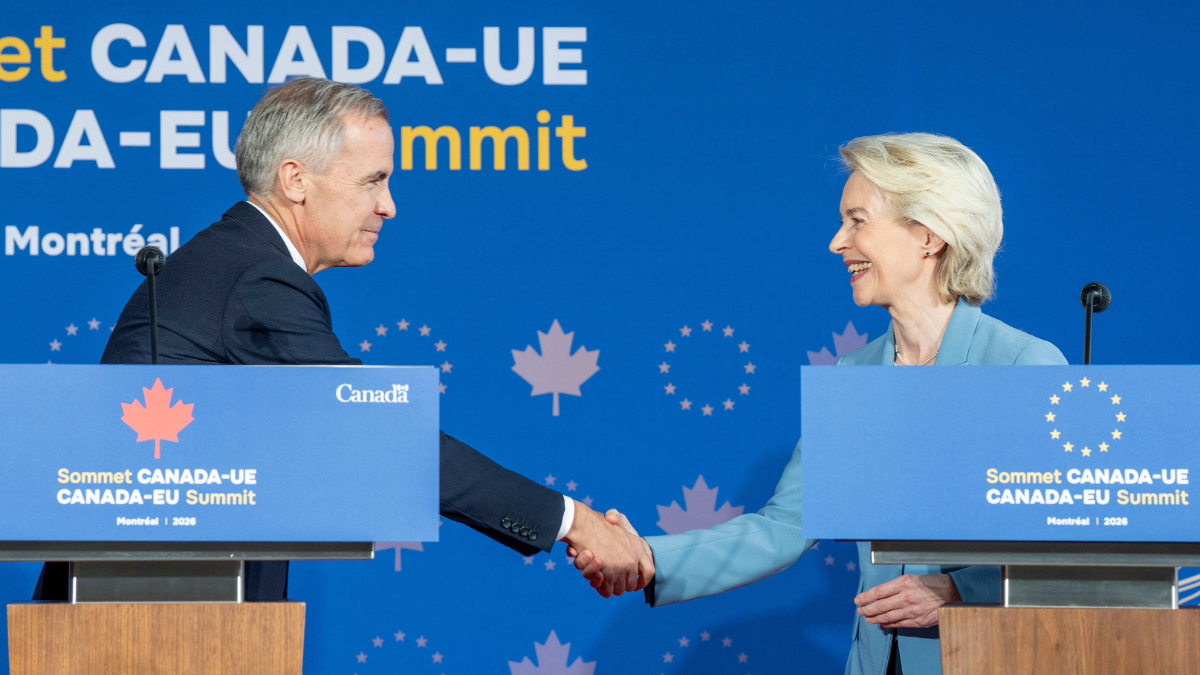
Canada’s Prime Minister Mark Carney shakes hands with European Commission President Ursula von der Leyen following their closing news conference during the EU-Canada summit in Montreal on Friday, Oct. 30, 2026. (Christinne Muschi/The Canadian Press via AP)
After the European Union signed a wide-ranging agreement with Canada on Oct. 30, Brussels did its best effort to replicate the “distracted boyfriend” meme to show the United States what it’s missing.
In this geopolitical version of the internet meme, the 27-country bloc went all in on making the case for Canada as its closest North American partner in diplomatic, economic and digital ties.
Last week, Brussels and Ottawa announced a litany of new deals and future collaborations — just as Washington’s relationship with two of its most established allies went from bad to worse. That included an EU-Canada digital trade agreement, proposed digital infrastructure investments and greater regulatory collaboration.
“Canada is by far the most European of the non-European countries,” said António Costa, president of the European Council after Mark Carney, the country’s prime minister, announced Canada was moving toward becoming the EU’s first “associate member.”
“We are building a transatlantic arch between Canada and the EU,” added the former Goldman Sachs banker.
Neither side made explicit reference to the US, though the summit’s communiqué said the EU-Canada so-called “Alliance for the Future” was in response to geopolitical tensions and economic fragmentation.
But Canada and the EU laid out a series of set-piece proposals aimed at both reinforcing Carney’s “Middle Powers” strategy and allowing Europe to expand its digital sovereignty agenda through partnerships with like-minded allies.
That included a digital trade agreement to complement the existing broader EU-Canada trade deal. The pact provides for greater cooperation on cross-border data flows, digital transactions, consumer protection and regulatory cooperation, while preserving both sides' ability to regulate their digital economies.
The agreement, on which negotiations have concluded but which has yet to enter into force, is designed to remove barriers to transatlantic digital commerce. That could make it easier for European and Canadian firms to sell digital services without facing conflicting requirements around electronic contracts, invoicing and other transactions.
The economic relationship is already substantial. Bilateral trade in digital services totaled almost €20 billion in 2025, according to data from the European Commission.
Yet Brussels and Ottawa went further. As Washington pulled back on such digital connections with Western partners, they were looking to join forces to offer their local companies and citizens a potential alternative to US-led tech.
The two sides committed, for example, to developing advanced AI infrastructure, high-performance computing facilities and cloud services — primarily aimed at expanding access to startups, smaller businesses and researchers.
Canada joined the European High Performance Computing Joint Undertaking, which pools resources to develop supercomputers and fund research into next-generation technologies. The country’s membership gives Canadian businesses access to that infrastructure and opportunities to collaborate with EU counterparts. Brussels and Ottawa want to expand local AI capabilities to reduce their current dependence on infrastructure provided by some of the largest American tech firms.
Brussels and Ottawa also laid out plans for greater regulatory cooperation covering digital identity services, AI governance rules and cybersecurity oversight. That included commitments to work toward mutual recognition of digital identities and credentials, AI safety assessments and cybersecurity arrangements.
Ahead of a series of elections planned for 2027, Brussels and Ottawa also said they would work closely to protect election integrity, strengthen the information environment and beef up cooperation around foreign information manipulation and interference.
Both also announced plans to expand internet subsea cable connectivity between Canada, Europe and Asia, as well as improved access for Canada to Europe's satellite navigation and communications systems.
“We know that we want Canada as close as possible to the European Union,” said Ursula von der Leyen, the European Commission president.
Yet as EU officials return from the two-day meeting in Montreal, much still needs to be done before the EU-Canada relationship can mirror, even at a smaller scale, the bloc’s fractious relationship with the US.
Many of the commitments announced on Oct 30 — including subsea internet cables, AI infrastructure and even Canada’s potential associate membership of the 27-country bloc — are still just proposals.
Of the tidal wave of EU-Canada technology announcements, only three had moved beyond the proposal stage. Those included negotiations on digital trade, a separate pact between respective competition authorities, and Canada’s secured participation in Europe's supercomputing program.
Brussels and Ottawa share a collective ambition to build closer ties, as well as extend those relationships with other democratic countries like Brazil, Japan and South Korea. But for that to happen, all countries must be willing to invest potentially tens of billions of dollars in critical infrastructure, as well as be willing to share regulatory and technical standards that may prove challenging to implement through domestic legislation.
For now, Europe may have eyes for Canada. But turning that initial attraction into a lasting relationship will require more than shared frustration with the US. It will depend on both sides putting their money — and regulatory autonomy — where their mouths are.
Authors