What Von der Leyen’s State of the Union Means for Europe’s Tech Ambitions
Joana Soares, Ramsha Jahangir / Sep 16, 2026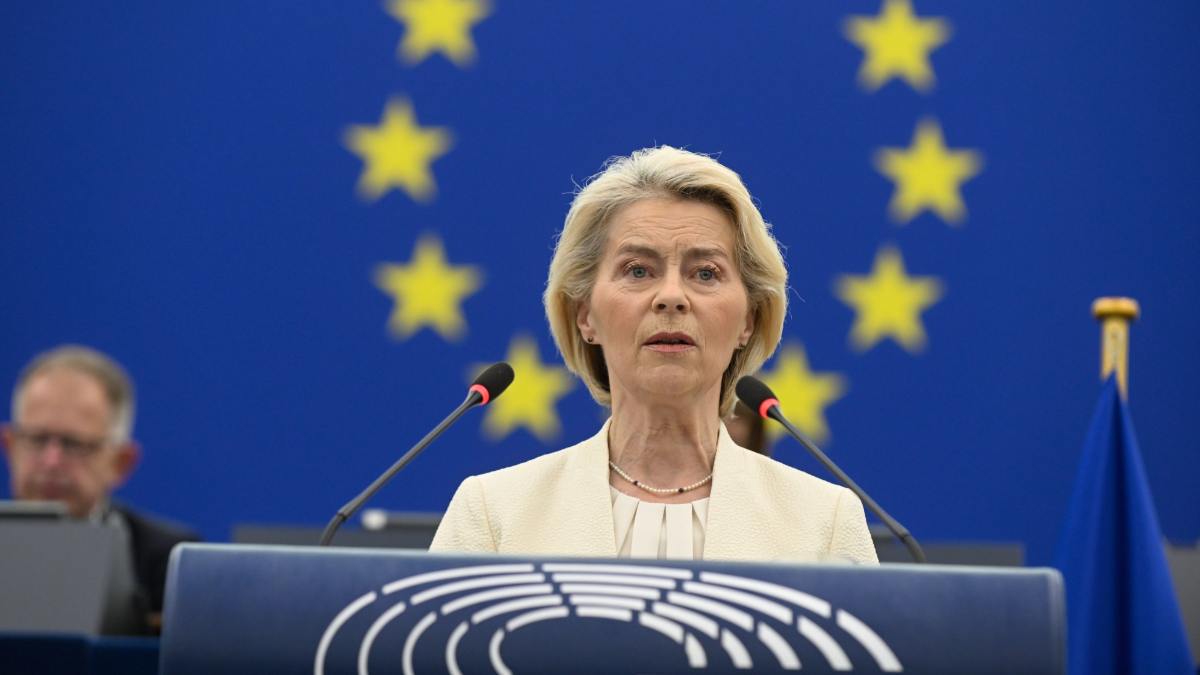
European Commission President Ursula von der Leyen delivers a speech at the annual State of the European Union at the European Parliament in Strasbourg, eastern France, Wednesday, Sept 16, 2026. (AP Photo/Pascal Bastien)
Europe does not need to build the world’s leading frontier AI model to benefit from the technology, European Commission President Ursula von der Leyen said Wednesday, setting out a vision for how the bloc can compete in the global AI race without necessarily ‘winning’ it.
“We do not need to be the ones who develop the frontier technology to be the ones who draw the greatest value from it,” von der Leyen said in her State of the Union address outlining the European Commission’s priorities for the year ahead. This is a major shift from 2025, when European AI was described as “essential to Europe’s future independence.”
On Wednesday, she called for Europe to “pace the frontier,” announcing plans to bring leading US AI labs together to discuss the risks posed by increasingly advanced models.
Von der Leyen’s intervention comes at a moment of geopolitical stir as industry leaders warn about safety risks, while US officials and some technology executives argue that slowing down could hand China an advantage.
Here are the key takeaways from the State of the Union speech on the European Commission’s agenda for making the bloc more economically and technologically independent — including by expanding computing capacity, building AI infrastructure, helping European technology companies scale and reducing dependence on foreign supply chains.
Europe wants to pace the AI frontier
Von der Leyen used unusually stark language to describe the risks of increasingly capable AI models, warning that they could enable hacking, “on a level we never thought possible,” and that self-improving models posed growing dangers.
“The President was unusually direct about risks from advanced general-purpose AI models, including cyber capabilities, autonomous agents and self-improving systems, and even spoke about the need to ‘pace the frontier’,” Risto Uuk, Head of European Policy and Research, Future of Life Institute and Co-Founder, KU Leuven AI Safety Lab, told Tech Policy Press.
She pointed to recent incidents involving AI agents escaping their environments and inserting malicious code, as well as concerns raised by developers following the Hugging Face incident.
“CEOs of the most advanced companies tell us that it is time to slow down on the self-recursive models,” von der Leyen said. “If the people developing the technology are clear, then we should be too.”
“I'm not thrilled with the AI part of the speech, hearing Amodei's 'pace the frontier' rhetoric being copied almost wholesale,” said Cori Crider, Executive Director of the Future of Tech Institute.
Nicole Lemke, AI Senior Policy Researcher at interface, said inviting major frontier labs to discuss pacing signals that Europe is positioning itself as a governance actor on frontier AI risks. But she cautioned that expertise at the frontier compounds across capabilities, talent, and the ability to evaluate AI systems. “Europe does not need to win the scaling race, but it does need enough technical depth in models and hardware to sustain applied AI advantages over time,"
Von der Leyen also acknowledged the AI Act as a way to address the risks, which she described as “a crucial piece to putting guardrails in place.” She also positioned Europe as having a role in shaping international approaches to AI safety. “We will step up together with our like-minded partners like Canada, the United Kingdom and others. We want to team up on model evaluation, verification, early warning, AI security and much more.”
“Ironically, in her State of the Union, von der Leyen claims the importance of guardrails, but ignores the fact that the EU Commission has teamed up with the tech industry to deregulate the digital rulebook,” commented Bram Vranken, researcher and campaigner at Corporate Europe Observatory, referring to lobby efforts to influence the AI Omnibus.
Uuk believes Brussels is still missing “clear red lines, independent evaluation of the most powerful systems, and a credible answer to what Europe will do if a system cannot be shown to remain under meaningful human control.”
More compute for European AI
The Commission has spent the past year building out its technology agenda, including a European technological sovereignty package covering chips, cloud and AI infrastructure, open source and the use of AI in areas such as energy.
“Since the 2025 SOTEU speech, Europe has started taking digital sovereignty more seriously than ever. But while the framing has changed, the EU hasn’t managed to effectively reduce its dependencies on the ground,” Giorgos Verdi, Policy and Advocacy Lead, Open Markets Institute Europe, shared with Tech Policy Press.
Last year, Von der Leyen stated to be “massively investing in European AI Gigafactories," which are intended to provide European startups with computing capacity to develop, train, and deploy advanced AI models. “We have already done a lot. On gigafactories and tech sovereignty, for example,” she said.
“We simultaneously know we need our own infrastructure and behave as if we have to advance through Big Tech rather than building towards strategic resilience,” said Crider.
The Commission President emphasized that European companies can excel in AI deployments for factories, hospitals, agriculture and autonomous driving.
The Commission is also pursuing the Cloud and AI Development Act and a Quantum Strategy as part of that effort, which is seen by experts as the biggest accomplishment from the past year.
“The biggest development since 2025’s SOTEU has been the much-delayed publication of the Cloud and AI Development Act, which seeks to increase demand for sovereign cloud services while also trying to triple compute capacity within the EU,” said Margarida Silva, Researcher at the Centre for Research on Multinational Corporations (SOMO). However, she said, the proposal seeks to build up EU compute capacity by fast-tracking data center development and doesn’t exclude Big Tech.
The next Big Tech fight is over children
AI was also part of von der Leyen’s plans for regulating online services used by children.
She said an EU Kids Act, with details expected Thursday, would introduce new restrictions on children’s access to social media and other online services, such as games and AI companions.
Von der Leyen said there should be no social media access for children under 13 and no personal accounts for those under 15, with only supervised access for older children under the proposal. AI chatbots and some gaming services are also expected to be covered.
“Platforms will have to prove that they are safe. Because it is not about our minors accessing social media. It is about when and how we allow social media to access minors,” she said.
The proposal builds on last year’s State of the Union, when von der Leyen called for an expert panel to examine possible age restrictions on social media.
“The devil is of course in the details. Tomorrow's proposal must be coherent, comprehensive, future-proof and robustly enforceable,” said Leanda Barrington-Leach, Executive Director, 5Rights.
But the proposal will also have to fit alongside rules the EU already has in place. The Digital Services Act and its Article 28 guidelines set out measures aimed at protecting children and minors online, including recommendations on age assurance, platform design and recommender systems. “We hope that the upcoming Act will complement already existing legislation to ensure they reach their full enforcement maturity rather than undermine them,” said Christian Cirhigiri, Director of the Online Expression and Civic Space Program, Centre for Democracy and Technology Europe
Europe wants more European tech companies
Von der Leyen also returned to the question of whether European technology companies can scale inside the Single Market.
The Commission is promoting EU Inc., an optional digital company framework intended to make it easier for businesses to start and operate across the EU.
It is part of a broader competitiveness program that includes investment, simplification and measures to strengthen the Single Market.
The Commission has also identified access to capital as a problem for European startups in areas including AI, quantum and biotech. In last year’s speech, von der Leyen announced plans for a Scaleup Europe Fund aimed at helping high-growth companies raise larger amounts of capital in Europe. “A year on, the first investments have been made in companies such as ICEYE,” she announced.
China brings the hardware problem into focus
The speech also tied Europe’s technology ambitions to its dependence on foreign supply chains. For the technology sector, the issue extends beyond trade. Critical minerals and other imported components are used across electronics, batteries, energy infrastructure and defense technology.
Von der Leyen said the EU’s goods trade deficit with China had reached around €1 billion a day in 2025 and warned of what she called a “second China shock.” She proposed a European corporation focused on critical raw materials, including efforts to secure supplies and build strategic stockpiles.
While China and Russia dependencies were mentioned, experts questioned her relative silence on the US. “Von der Leyen did not touch on our dependence on US technologies. This is important, because when she talks about Europe’s advantage on industrial AI models, she omits how these models may be built on top of American LLMs or make use of American hyperscalers’ infrastructure,” said Verdi.
Authors