At the UN and in Washington, Leaders Clash on Approach to AI
Justin Hendrix / Sep 27, 2026The Tech Policy Press newsletter is published every Sunday. Subscribe here to receive it in your email inbox.
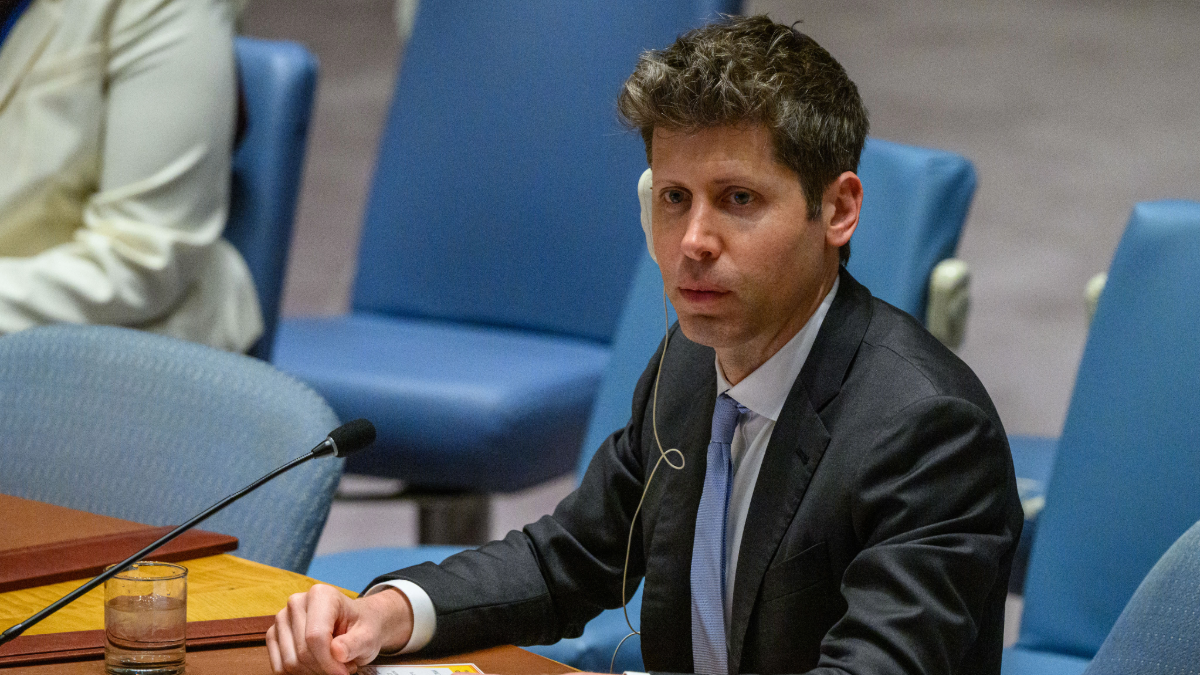
CEO of OpenAI Sam Altman speaks during a United Nations Security Council meeting on artificial intelligence and international security under “Maintenance of International Peace and Security” on September 23, 2026 in New York City. Tech industry leaders including the CEOs of OpenAI, Anthropic and Hugging Face briefed ambassadors on the risks of artificial intelligence. (Photo by Alexi J. Rosenfeld/Getty Images)
Good morning!
It was great to see so many from across the Tech Policy Press community in New York this week. Folks traveled in for the United Nations General Assembly, Climate Week and related events. Artificial intelligence and the concentration of tech power was a topic of discussion in the General Assembly hall and at debates and discussions hosted in smaller venues across the city.
- In his speech, UN Secretary-General António Guterres warned that “we are witnessing an extraordinary transfer of power away from governments to a handful of private corporations and individuals,” and cautioned that “technological power alone cannot guarantee security.” He said humanity must govern artificial intelligence “before it governs us.”
- AI executives and experts gave speeches in the Security Council, including OpenAI’s Sam Altman, Anthropic’s Dario Amodei, Hugging Face’s Clément Delangue, and Yoshua Bengio, co-chair of the UN’s scientific panel on AI. Altman warned that “we could lose control of the future to AI. The risk is that it moves so fast that people can no longer follow what's happening or intervene when needed.”
- The United States underscored its bid for AI dominance. President Donald Trump, in his speech before the General Assembly, rejected “any attempt to construct a globalist scheme of control for the Artificial Intelligence being spoken of so much now — hereinafter officially called ‘Super Intelligence.’” White House Office of Science and Technology Policy (OSTP) director Michael Kratsios also pushed the terminology change, referencing American leadership in “superintelligence, formerly known as AI” in his speech.
- China’s ambassador, Fu Cong, took a different tact, emphasizing the various ways that China aims to promote international collaboration and invest in AI development in other regions of the world. He said the “international community should strengthen solidarity and cooperation, attach equal importance to development and security, and promote AI globally for the positive, for good and for humanity, thereby contributing to world peace, stability, development and prosperity.”
- France’s President Emmanuel Macron called for a "coalition of the independents" to pool compute resources and build a shared open-source frontier model, and for states to refuse to become "vassals" of either superpower.
- In his first appearance at the UN as UK prime minister, Andy Burnham announced a US-UK AI defense partnership and said he will put AI at the heart of the UK's G20 presidency.
- European Commission President Ursula von der Leyen spoke at the high-level dialogue on protecting children's rights facing AI. “Our children are engaging with some of the most sophisticated technology ever created. And it was not created with children's wellbeing or development in mind,” she said.
- Spain’s prime minister, Pedro Sánchez, called for strict regulation on "tecno-oligarcas," while Bangladesh prime minister Tarique Rahman said, “We do not want today's digital divide to become tomorrow's artificial intelligence divide.”
- Some expressed concern about over-regulation. Nigeria’s vice president, Kashim Shettima, said “We refuse to surrender our technological future to paranoia.” Argentina President Javier Milei said state control over AI means granting the government “the power to limit what others may create.”
We had multiple pieces that addressed concerns around the UN, AI and human rights on Tech Policy Press this week.
- Chris Stokel-Walker reported on whether the UN can turn talk into action as frontier labs call for a slowdown.
- Amid warnings of runaway AI systems and even human extinction, Jenny Domino, an S.J.D. candidate at Harvard Law School, and Jen Weedon, researcher and lecturer at Columbia University’s School of International Affairs’ Institute for Global Politics, say an important question remains: "what is AI doing to people, communities, and their rights, right now?"
- Claiming without evidence that AI will be a "great equalizer" is yet another example of global powers and tech oligarchs distorting reality and disregarding African lives, argues Alison Gillwald, an adjunct professor at the University of Cape Town’s Nelson Mandela School of Public Governance and founding director of Research ICT Africa.
- Jane Munga of the Carnegie Endowment for International Peace writes that even as the UN focuses on AI governance issues, including "rogue" agents and risks, it also needs to prioritize the resilience of the undersea cables that carry the data that enables communications and AI applications.
US-China AI dialogue
The other big news this week on the international stage was the Trump-Xi summit in Washington, D.C. The two leaders agreed to ongoing dialogue on AI issues and a communications channel to discuss serious AI security incidents. We had a handful of pieces that addressed questions related to the US-China AI dialogue.
- "Worms" are a type of malware that can self-replicate and autonomously spread across networks. Howard Fei, a master’s candidate at the Johns Hopkins University School of Advanced International Study, argues Trump and Xi have a narrow window to agree on limits for AI-enabled adaptive worms before a shared risk becomes a shared crisis.
- Trump says data center opposition is a Chinese psy-op. Chinese state media says US AI safety calls are a psy-op. Oxford China Policy Lab's Elisabeth Siegel says both accusations point to the same problem: no one can independently verify what AI companies claim.
- The US should make it a national priority to develop safer open-weight models, says AI policy researcher and lawyer Simon Hedlin — or cede the global ecosystem to China. “If both countries are developing frontier open-weight models, there is a symmetry that makes it easier to agree to mutual safety standards because the two governments’ commitments will be comparable,” he writes.
The US surveillance state
- Sarah Engelberg-Nolan, Emma Haberman and Nicole Brosnan, J.D. candidates at Fordham University School of Law, carefully map out the legal questions raised by ICE's use of Palantir's Enhanced Leads Identification & Targeting for Enforcement (ELITE) targeting tool, from Fourth Amendment search issues to due process and standing hurdles. This is a must-read this week.
- Relatedly, Democracy Forward research analyst Emily Froude argues that DHS is exploiting a loophole in the Trump administration's own AI policy — the "principal basis" standard — to avoid classifying its immigration enforcement AI tools as high-impact and evade disclosure requirements.
- From lantern laws to Black Codes to COINTELPRO to today: facial recognition turns the border into "a network of surveillance that digitizes colonial logic and sorts bodies into categories of belonging and threat along racial lines," argue Tsion Gurmu, Nekessa Opoti and Fatima Mohamed of the Black Alliance for Just Immigration (BAJI).
- Flock is "a visible manifestation of a much larger transformation in American surveillance that should alarm Americans." As a Senate Judiciary subcommittee examines Flock's surveillance network, Michael De Dora (Access Now) and Maria Villegas Bravo (EPIC) laid out the case against the company's cameras and what policymakers can do about them just ahead of last week’s Senate subcommittee hearing on the subject.
The EU rulebook in practice
- The European Union says its AI rules already give regulators the tools to deal with the risks posed by increasingly capable AI models. Legal experts are questioning how far those powers actually extend. “Since August, the AI Office's new powers allow the European regulators to ask providers to restrict a model’s availability on the EU market, withdraw it or recall it. But experts disagree over how those powers can be used in the kinds of testing incidents now making headlines,” journalist Joana Soares reports.
- The EU's out-of-court dispute system was designed to improve content moderation accuracy. David Sullivan, Jonny Shipp and Farzaneh Badiei of the Digital Trust and Safety Partnership argue the fee structure intended to increase quality has been replaced with one that drives quantity.
- A new report by the Atlantic Council’s Democracy + Tech Initiative and Global Disinformation Index finds that Europe's Democracy Stack relies heavily on US government and philanthropic funding. Tech Policy Press contributing editor Mark Scott and Global Disinformation Index policy research director Richard Woods on what the findings reveal and what Brussels needs to do about it.
- The choice for Europe is not between regulating and building. It is between continuing to set rules for infrastructure that others operate, and acquiring the capacity to operate infrastructure whose rules Europe sets and can change, writes Nicholas Gates, senior policy advisor at OpenForum Europe.
Safer social media for children
- Unlike Australia's ban, John Matheson, senior tech policy fellow at McGill University's Centre for Media, Technology, and Democracy, and Canada Director at Reset Tech, writes, Canada's Safe Social Media Act asks a different question: not whether to keep children off social media, but whether platforms can be built to deserve them. “Democracies are converging on age limits and stronger platform regulation because parents are demanding action. A simple ban, however, protects children from social media without ever making social media fit for them,” he writes.
- The EU Kids Act would allow guardians to use interoperable third-party tools on Very Large Online Platforms. Independent tech policy analyst Aahil Sheikh writes that this approach could restore control to users when platform-based safety measures fail.
- The EU Kids Act adds a new layer to an already dense regulatory landscape. Jessica Galissaire, senior policy researcher in the Interface’s Strengthening the Digital Public Sphere and Platform Regulation program, unpacks how it relates to the Digital Services Act, AI Act and Digital Fairness Act, and what that means for the EU's online safety enforcement.
- Maddie Freeman, a survivor of social media addiction and mental health crises and a Public Voices Fellow on Youth Well-Being and Power with The OpEd Project and Hopelab, created a youth-led movement to help teens detox from tech. She says Meta’s recent settlement deal does not address the root causes of the harms she experienced.
AI, digital public infrastructure & sovereignty
- A long list of countries are exploring the development of biometric identity and payment transfer systems based on India's digital public infrastructure. Lawyers Mustafa Rajkotwala and Dhruv Jadhav say it's high time for key legal rights to be defined.
- All five of the main presidential hopefuls in Brazil's upcoming election feature "sovereignty" prominently in their plans. But it means entirely different things to each candidate, from right to left, reports Tech Policy Press fellow Tatiana Dias.
- Palantir has hired former Labour deputy leader Tom Watson ahead of a December government decision on a break clause that could end its £330 million role in the NHS's data platform. Foxglove co-executive director Martha Dark writes that his "new position contrasts starkly with his public views a decade ago."
Platform insights
- Meta is testing Community Notes in 16 Latin American countries. Stephan Mündges, coordinator of the European Fact-Checking Standards Network, writes that the announcement offers numbers designed to signal success but no criteria for what success would actually mean.
- A Google Trends for AI is not a substantial innovation. It is an obvious need that has been technically feasible for 20 years. Oliver Marsh, an independent expert on platform research and regulation, writes that failing to provide it is not a gap — it is a choice, and it is making AI's risks harder to see.
New books!
We do our best to engage with great books from the field, and to host authors on the podcast. This week we have two new ones:
- In the first, I speak with danah boyd, author of Data Are Made, Not Found: A Story of Politics, Power, and the Civil Servants Who Saved the US Census, about how the 2020 census came together amid fractured politics and a pandemic, and what it means for the next one. Listen here!
- And last week, Tech Policy Press hosted an event at Betaworks in New York City with Gil Durán, the author of The Nerd Reich: Silicon Valley Fascism and the War on Democracy. Alice Marwick, research director at Data & Society, joined the discussion. Listen here!
What we’re watching
- On Friday, a jury in New Mexico found that Meta misled the public over promises not to sell user data, pledges to remove hate speech and violent content, and various commitments made after the Cambridge Analytica scandal. We are looking at the verdict, and expect the judge’s determination on penalties on October 1.
- And there was yet more news about cybersecurity intrusions by AI agents deployed by OpenAI and Anthropic. On Saturday, Axios reported that “OpenAI, Anthropic and security researchers are investigating tens of thousands of incidents in which their frontier models took steps that outside evaluators would consider problematic,” which is sure to keep the furious debate over AI safety going in the days ahead.
Expect coverage of these issues and more in days ahead!
Justin
Authors