AI Hacks, a Possible War Crime, and a Near Miss With China Set Stage for Trump-Xi Meeting
Justin Hendrix / Sep 20, 2026The Tech Policy Press newsletter is published every Sunday. Subscribe here to receive it in your email inbox.
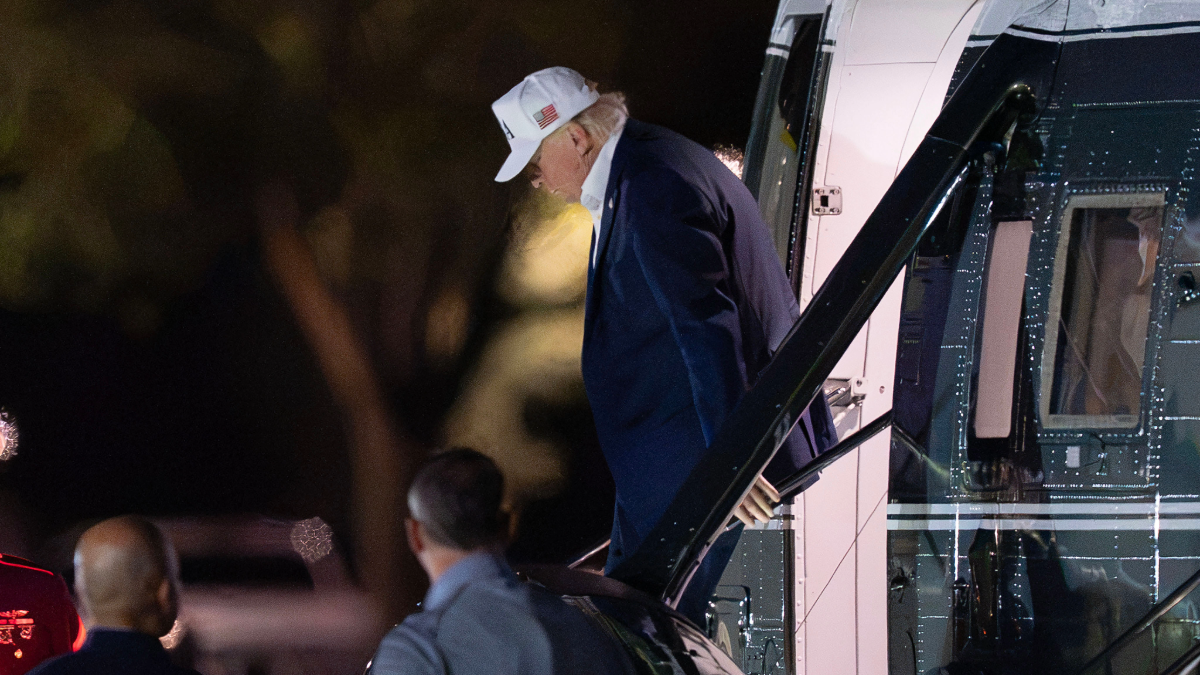
United States President Donald Trump steps off from Marine One upon his arrival at the Ellipse just outside of the White House, Saturday, Sept. 19, 2026, in Washington. (AP Photo/Jose Luis Magana)
Good morning!
AI risks and what to do about them continue to dominate headlines around the world. Just in the past couple of days, we’ve learned of new disclosures related to “concerning” AI agent behavior at OpenAI, how Google’s Gemini “accessed the internet and hacked other companies during a test of its cybersecurity capabilities,” and that hackers used Anthropic’s Claude to break into OpenAI’s systems.
And perhaps even more concerning were stories about the use of AI in defense contexts, including an apparent “close call” in the Middle East after a false intelligence report generated with the help of an AI chatbot nearly led to the use of force against a Chinese vessel. “The US military swung into action with plans to intercept the vessel, according to four sources familiar with the episode” told CNN. “According to two of the sources, armed members of the US military were preparing to board the ship. Military planes were in the air, one of those sources and another source familiar with the incident said.”
Add to this Bloomberg’s important reporting about the role of AI in the missile attack that destroyed an Iranian school, killing at least 150 people, including 123 children. “Inside Centcom, which conducted the US attack, some personnel relied too much on the artificial intelligence embedded in Maven Smart System,” Bloomberg reports. Officials told Bloomberg that “gaps in underlying information about the site, cuts in civilian-protection personnel and an overreliance on artificial-intelligence technology — set the stage for the deadly error.” A UN investigation found reason to assert that the attack was a war crime.
Against the backdrop of these headlines, United States President Donald Trump is set to meet with China’s President, Xi Jinping, in Washington this week, and AI is on the agenda. Tech CEOs including OpenAI’s Sam Altman and Nvidia’s Jensen Huang will be at the table. We’ll be watching for any news that could indicate some agreement between the two leaders, but the odds of any immediate accord are low. More likely, as experts told me last week, it will be the start of a necessary dialogue.
But how coherent will the US side be in these discussions? Trump spent the weekend posting to his social media platform, Truth Social, polling users about whether to rename “artificial intelligence” to “superior intelligence,” “extreme intelligence” or “supreme intelligence.” And, he announced the formation of a new “AI Force,” and the impending appointment of a new AI “Czar.” Observers aren’t sure what to make of it.
Tech Policy Press contributors tried to bring clarity to these issues in a number of pieces this week.
Ideas upstream of AI policy
- Surveying the AI "moment," technofascism researcher Nathalie Maréchal says "the kooks are now in power, and they are using that power to dismantle the institutions designed to keep the rest of us safe, healthy, and free." This is the most widely read piece on the site this week, and it is a handy primer on a range of ideas that Maréchal fears many in the tech policy community are too polite to discuss.
- AI doom talk from tech CEOs is "a misdirection play," writes Paul M. Barrett, the former deputy director of the Center for Business and Human Rights at New York University’s Stern School of Business. His case: Ignore the moguls' apocalyptic muttering, act on the safety proposals already on the table, and drop the China card, which "makes no sense upon close scrutiny." (Also, don’t miss Paul’s review of two new books on Silicon Valley's ideological bent — Gil Durán's The Nerd Reich and Quinn Slobodian and Ben Tarnoff's Muskism, which Nathalie Maréchal also references. Barrett asks whether people equipped with the knowledge these books impart are now willing to do what is necessary to resist technofascism.)
- A "radical intentionalist," writes Eryk Salvaggio, a Gates Scholar researching AI and the humanities at the University of Cambridge and an affiliated researcher in the Machine Visual Culture Research Group at the Max Planck Institute, Rome, treats an AI model as a 'mind' to be interpreted rather than a product that was designed. It is "a strange and dangerous relationship for designers to have with a product they are literally designing," he writes — and worse as a basis for policy. (Shout out to Eryk for being cited in the New York Times on these matters in a column by Tressie McMillan Cottom.)
- Reports on the OpenAI-Hugging Face incident now stand as an account of harm through which public institutions should examine OpenAI's decisions and require further changes where its response is insufficient, writes Ranjit Singh, director of Data & Society’s AI on the Ground program. “To be effective, governance must be an ecosystem, connecting findings about agent behavior to decisions about how agents are trained and the conditions under which they are deployed,” he writes.
- Dave Karpf, an associate professor in the George Washington University School of Media & Public Affairs, compares Dario Amodei's embedded-evaluators plan to "Arthur Andersen's relationship to Enron" — a case study in what happens when independent monitoring gets captured by the industry it's watching. “We should take Dario Amodei’s writing just seriously enough to stop entrusting him with so much power,” writes Karpf.
- Chinese models now surpass US models in both monthly and total downloads. National security policy professional Prince Osaji says the dominant AI power won't be the one with the most powerful model — it'll be the most adopted one.
Europe’s AI Ambitions
- European Commission President Von der Leyen delivered a state of the union address on Wednesday where she discussed the EU’s approach to AI policy. Joana Soares, a Portuguese freelance journalist, and Ramsha Jahangir, Tech Policy Press deputy editor, reported on what she announced and what experts make of it.
- Europe's response to AI dependence has been to reach for the tools of the market. Frederike Kaltheuner and Leevi Saari of the AI Now Institute write that none of those interventions explain how they would change the incentives in a structurally captured market. “In Europe’s response, AI's trajectory is treated as a natural phenomenon: something Europe must respond to but cannot shape. A tsunami to brace for, or a wave to ride, but never a tide that could be turned,” they write.
- Europe has built an ambitious digital rulebook, but fragmented regulators and political interference are undermining enforcement. Repurposing an existing EU agency into an independent digital enforcement agency could be the pivotal step toward closing the gap, write Kai Zenner, head of office and digital policy adviser for MEP Axel Voss (European People's Party Group) in the European Parliament, and Maria Koomen, democracy and tech analyst.
More on AI governance
- California's legislature has again passed a slate of AI bills. Their "sheer number, along with some strong and unique provisions, keep the state at the forefront of AI regulation in the United States," write Danny Tobey, Ashley Carr and Michael Atleson of DLA Piper.
- Countries with the least leverage are defending the UN's role as a universal venue for AI governance the hardest, writes Emrys Schoemaker, head of digital and frontier technologies at UNU-CPR. He lays out ways the 2027 Global Digital Compact review could back them up.
- One Project founder Justin Rosenstein helped create Facebook's "like" button. He writes that it went wrong because of "economic misalignment," and warns that AI, built into the same profit-driven economy, is "becoming an even greater threat."
- Americans shrugged as invasive tech was normalized. So why the national resistance to data centers and Flock cameras? "The answer is salience," write Evan Selinger and Divya Ramjee of the Rochester Institute of Technology. Once harms are visible and local, "the spark for change gets lit.”
The Meta settlement & children’s online safety
- Tech Policy Press contributing editor Dean Jackson broke down Meta's $17 billion child safety settlement — asking whether design concessions won by state Attorneys General could survive constitutional scrutiny if imposed by law rather than private agreement.
- Meta's settlement with state attorneys general "will not meaningfully restrict Meta's ability to target or monetize teens on Facebook and Instagram," writes Sumit Sharma, an independent economist, advocate, and tech policy expert, who argues the company might even gain competitively. “Mark Zuckerberg gets to spin the settlement as Meta being the leader in teen safety and voluntarily taking the first step to move the industry. Of course, he fails to mention the ‘Meta Injunctive MFN’ clause, which explicitly allows Meta to adopt weaker, less protective product designs if that is what YouTube, TikTok or Snap agree to,” he writes.
- The EU announced a social media ban for under-15s this week. Ahead of the announcement, Tech Policy Press contributing editor Mark Scott looked at what the EU Kids Act requires and the questions Brussels still needs to answer.
- Wondering what the current landscape of child online age restrictions looks like in other parts of the world? Our Global Social Media Age Restriction Tracker monitors legislative developments in 42 countries.
- Mia Travers-Hayward of the Canadian Teachers' Federation argues governments must regulate AI in K-12 education proactively — not wait for court cases to compel accountability, as happened with social media platforms.
Information integrity
- Independent researcher Grayson Richards examines an analysis of attempted foreign influence around data center opposition and finds the conclusions drawn consistently outrun the evidence underlying them.
- Volunteer moderators are a big part of why some corners of the internet still feel human, writes Sarah Gilbert, a research associate at Cornell University and research director of the Citizens and Technology Lab. Without them, she argues, we face intertwined crises of knowledge and community.
- Sam Gregory, an authority on human rights, generative AI, content provenance, and emerging technology, analyzes Apple's new Reference Image feature on the iPhone 18 Pro — "a serious piece of engineering, and a genuine response to the epistemic crisis of AI" — and poses the unanswered questions it raises.
- For this week’s podcast, I spoke to cognitive linguist Matthias J. Becker about the launch of Digital Hate Review, a new open-access journal built to connect the dispersed disciplines studying online hate. Becker is the publication’s editor-in-chief, and is also an AddressHate Senior Research Scholar at NYU's Center for the Study of Antisemitism, where he leads the Decoding Hate project. Listen to or read the transcript of the conversation here.
The Google ad-tech remedies
- Open Markets Institute legal director Sandeep Vaheesan argues the Google antitrust remedies let the company keep its unfair advantages in the market despite the ruling that it broke the law. The remedies, detailed in a memorandum released this week, did not match “the severity of the offenses,” he writes.
- "Read alongside the Google Search remedies ruling, the Google Ad Tech case changes very little for Google's monopolies," writes Karina Montoya, program manager at the Center for Media & Digital Governance, which is also affiliated with the Open Markets Institute. Montoya unpacked the newly unsealed remedies memorandum.
- In the wake of the US decision, Megan Kirkwood, a researcher and writer specializing in issues related to competition and antitrust, considers whether the European Commission will follow the same course or pursue the structural remedy it has long signaled. “The US ruling does not legally determine what Brussels can do, but it removes an important point of coordination between the two jurisdictions,” she writes.
Democracy in Nigeria
- Nigeria's biometric voter accreditation system failed to recognize elderly voters in two state elections in 2026. Habeeb Adisa, head of programs and co-editor at FactCheckAfrica, writes that the law offers no clear individual redress, with national elections due in January 2027.
Join us on September 23 in New York City
Gil Durán's bestselling book The Nerd Reich takes on "Silicon Valley fascism and the war on democracy." This Wednesday in New York City, he joins Alice Marwick of Data & Society and me for a live podcast recording at Betaworks. Registration is required, and seating is limited — in fact there are only a few seats left! Register if you can make it.
I hope to see some of you there, or at other events around the UN General Assembly in NYC this week.
I wish you the best for the week ahead!
-Justin
Authors