At Ireland’s AI Summit, Tech Industry Dominates as Civil Society Sits Out
Liz Carolan / Oct 9, 2026Liz Carolan is a Tech Policy Press fellow.
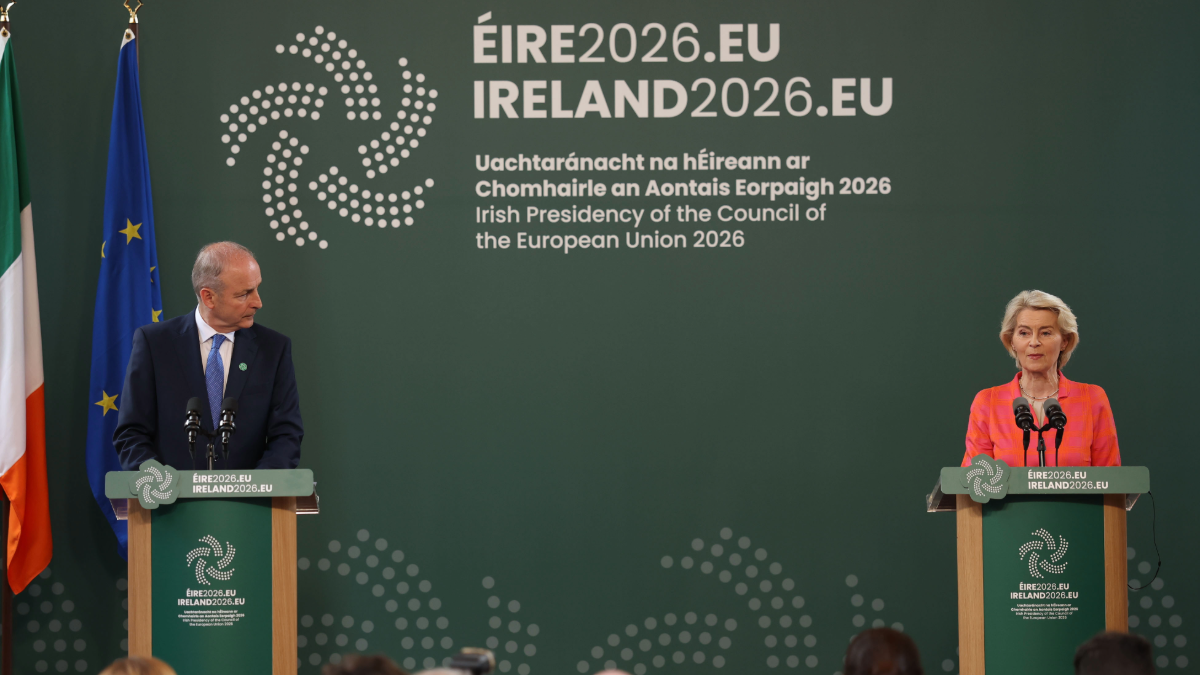
Taoiseach Micheal Martin and European Commission President Ursula von der speaking during a press conference in the Main Quadrangle at University College Cork, as Ireland begins its presidency of the EU Council. Photo: Liam McBurney/PA Wire IRISH (Press Association via AP Images)
As Europe enters the final stages of negotiating the Digital Omnibus, Ireland is preparing to welcome the world’s top technology executives to an exclusive AI summit in Dublin next week. Ireland is currently chairing the final stages of negotiations over the package of measures designed to “simplify” Europe’s rulebook.
The one-day International AI Summit will take place at the Royal Dublin Society, a cavernous, historic venue a few hundred meters from the US Embassy. It will be attended by at least three European Commissioners, four Irish Ministers, and an undisclosed number of European officials. Prominent speaking slots at the event will feature US AI firms Google, Microsoft and OpenAI, with Meta, IBM, Intel, Nvidia, Amazon, Anthropic and AMD also represented on panels, alongside major European-founded firms like Stripe, SAP and Mistral.
The summit has been positioned as a centerpiece of Ireland’s Presidency of the Council of the European Union, the six-month rotating chairmanship of the body that represents member-state governments. It comes as the European Union is modifying its regulations to increase global competitiveness, a process it calls “simplification,” while also looking to strengthen economic and digital sovereignty by supporting the growth of European rivals to US and Chinese industries.
These priorities are converging in the final stages of the negotiations over Digital Omnibus, which Ireland is chairing as holder of the Council Presidency. This package of proposed changes would amend parts of Europe’s digital rulebook, including the GDPR. Critics have described this as deregulation.
Industry dominates the summit agenda
European Commission Executive Vice President Henna Virkkunen is set to open the summit, alongside Irish Taoiseach (Prime Minister) Micheál Martin. Virkkunen will arrive in Dublin having set out a position on AI regulation at odds with the US.
Last month, she said the Commission would keep pursuing an international agreement on AI safety and security despite US resistance, and the EU has backed a Finnish- and Norwegian-led initiative for an international body to monitor AI safety. Meanwhile, the White House has pushed back against AI regulation and announced a voluntary safety accord with six US AI and chip companies, five of which will be represented on stage in Dublin.
The agenda shows that industry speakers dominate the summit’s agenda. A panel called “AI Transforming Health: From Discovery to Patient Care” does not include health authorities or patient representatives, instead featuring three pharmaceutical companies, Johnson & Johnson, Novartis and Sanofi, alongside Nuritas, an Irish firm that uses AI to discover peptides.
Tech Policy Press analysis found that 82% of speaking slots on the official agenda, 37 of 45, are executives representing companies or business groups. The remaining eight slots go to three European Commissioners, the Taoiseach and three Irish Government ministers, and a single trade union representative. No civil society organizations appear on the agenda, and no academics are listed among its speakers.
The trade unionist was a late addition. In July, Irish trade unions publicly criticized the lack of worker representation at the summit, including on its planned panel on AI in the workplace. Summit organizers subsequently added a representative of the Communications Workers' Union (CWU) to the program, where they will share a 10-minute slot, "The Changing World of Work", with employers' group Technology Ireland.
Competing visions on AI
The tone of the summit contrasts with broader debates happening around AI, some of which will be held at independently organized events happening in the days around the event. The Centre for Digital Ethics is hosting a “complementary public-interest conversation” alongside the summit that will focus “not simply on what AI can do or how quickly it can be deployed, but on the human values, institutions and ways of life that technological progress should ultimately serve.”
Another event, “Workers' AI Counter Summit,” aims to be “far more representative of the real experiences of AI on workers and communities than the government's flagship event,” organizer John Bohan of the CWU Union told Tech Policy Press. That event is explicitly critical of the “mainstream narratives on AI,” with Bohan saying debates about AI are “massively one-sided in favor of corporate interests.” That two-day event will feature groups including SOMO, ARTICLE 19, 7amleh and Oxfam.
The Counter Summit organizers also criticized the Irish government’s approach to tech firms, telling Tech Policy Press that its “industrial policy approach” has been to “pander to the needs of the tech giants.” Critics attribute that pandering to pressure to retain US tech firms that dominate Irish economic and fiscal policy. Just two tech firms — Microsoft and Apple — made up about 40% of Ireland’s total corporate tax receipts last year. This allowed the government to announce a “giveaway” 2027 budget this week with income tax cuts, social welfare increases, and subsidies on home energy costs. Yet the official budgetary watchdog, the Irish Fiscal Advisory Council, issued stark warnings in response that these giveaways entrench dependency on “high-risk corporation tax”, amid fear that Ireland will become less attractive to US firms as valuable tax schemes run out by 2030.
About 1,500 people are expected to attend the invitation-only summit next Wednesday, and the guest list has not been made public. Several events on the margins suggest officials from across the bloc will attend, including the EU's Digital Diplomacy Network, which brings together member states' digital ambassadors and is holding an informal meeting in Dublin the day after the summit.
It is believed that the invite list is managed by the hosts, Ireland’s economic development ministry, together with the Department of Foreign Affairs (DFA). The DFA is coordinating the presidency, a process involving complex security concerns for an estimated 250 events, with press accreditation centrally managed for the six-month period. Tech Policy Press has heard from a number of civil society and media groups who have struggled to get on the list.
The Irish Government has spent months preparing for the summit, which it sees as an opportunity to bring together the tech industry its economy relies on and that Europe hopes to foster and grow, with the European policymakers it plays a central role in stewarding. But while officials have kept tight control of the agenda and guest list, events outside the venue may intrude on the day.
Public sector unions have called a one-day strike that coincides with the summit, demanding pay increases funded from the surplus tax revenues generated by Ireland's foreign direct investment. On a day designed to showcase Ireland's relationship with the tech industry, workers seeking a share of its proceeds may prove harder to keep off the agenda.
Authors