Another Commission for Global AI Governance. How Can It Deliver for Africa?
Jane Munga / Jul 28, 2026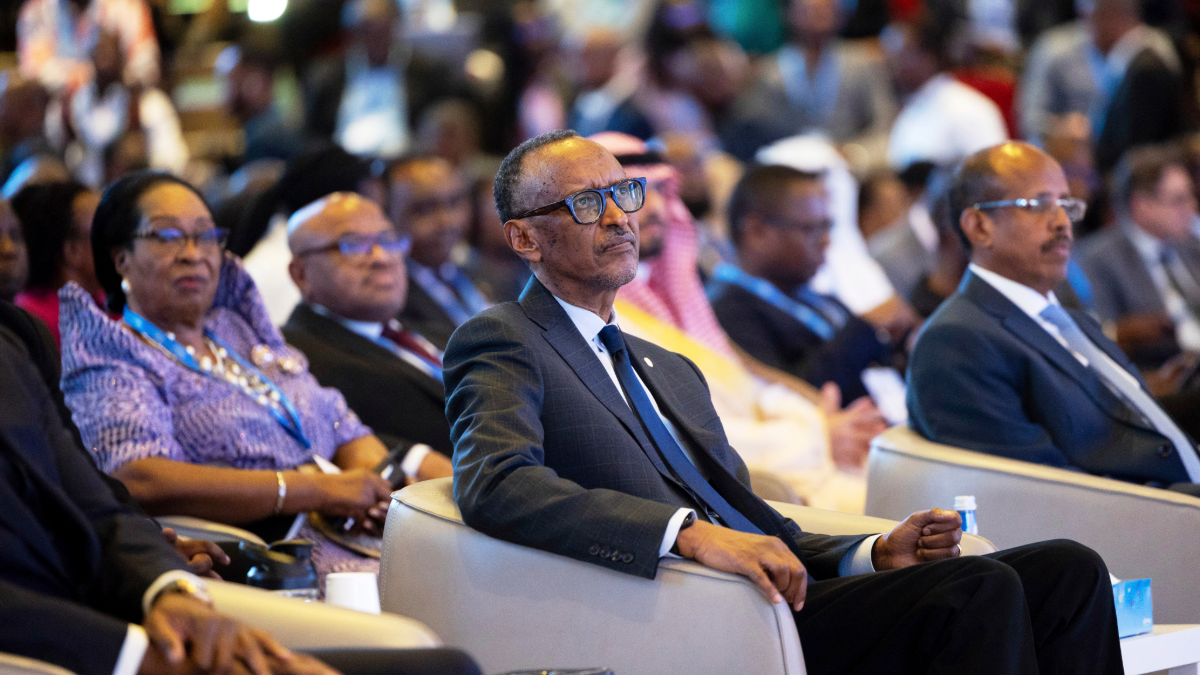
Rwanda's President Paul Kagame listens during the first-ever Global AI Summit for Africa where more than 1,000 policymakers, business leaders, and interest groups gathered in Kigali, Rwanda, Thursday, April 3, 2025. (AP Photo/Yuhi Irakiza)
On July 2, the International Telecommunication Union (ITU), the United Nations specialized agency for digital technologies, launched the AI for Good Global Commission in Geneva. It arrives at a moment when AI is reshaping how societies work, learn and govern, yet AI diffusion remains unevenly distributed. The multistakeholder body, with forty members from government, business and international organizations, has a singular mission: to identify practical "pathways to strengthen trust, support responsible innovation, and enhance human capability." That task must now be translated into tangible solutions to real-world challenges, such as widening access to AI enabled services in critical areas of health and education at a pace that matches AI's evolution.
The AI for Good Global Commission arrives amid a crowded field of global AI governance bodies and convenings. These include the UN Global Dialogue on AI Governance, established in 2025, the Independent International Scientific Panel on Artificial Intelligence (IISPAI), announced in February 2026, both prescribed by the Global Digital Compact of 2024, and the World Summit on the Information Society (WSIS), the ITU’s digital cooperation forum. All four met earlier this month in Geneva on the sidelines of the AI for Good Global Summit 2026, each with its own, but similar, agenda on global AI governance and cooperation. There is no one-size-fits-all approach to AI governance, but with agendas closely overlapping, the question for the Commission is what it can deliver that the other bodies cannot.
The new Commission builds on the concept of the Broadband Commission for Sustainable Development (BCSD), which helped shape global priorities for connectivity and digital inclusion. Its predecessor offers both a template and a lesson. Over fifteen years, the BCSD issued more than seventy policy recommendations across fifteen State of Broadband reports and seeded lasting initiatives, such as the UNICEF-ITU Giga school-connectivity project. Yet when it concluded in 2025, the BCSD had missed several of its more ambitious advocacy targets. Target 3, "get everyone online," remains unmet, and nowhere more so than in Africa, where ITU statistics show just 36 percent of people use the internet. The lesson here is that advocacy does not always translate into target attainment.
A new commission now seeks to expand AI trust, use and impact across the global AI landscape. It will have to do so strategically, and in a way that complements the other UN AI governance initiatives noted earlier. How it will do so in practice remains to be seen. Regardless, the new body, like the others, offers regions of the Global South such as Africa new possibilities, in particular practical pathways to deploy AI at scale, shape policy and ensure the participation of developing countries.
The body does offer some uniqueness, seen in its membership and chairmanship: its co-chair is President Paul Kagame of Rwanda, and its members include the African Union's Commissioner for Infrastructure and Energy and the digital ministers of Namibia, Nigeria and Togo, giving Africa the largest contingent of policymakers in the Commission. The Commission also includes an African-owned company, the MTN Group, alongside others such as Vodafone and Orange Group that have large operations on the continent. This composition gives the Commission a distinct opportunity to shape practical pathways for AI governance that are especially relevant for Africa, and it creates an opening for its African members to coordinate around shared continental priorities in setting the Commission's agenda.
What should practical pathways look like, particularly for Africa?
The continent's own strategic documents on AI offer a place to begin. The AU Continental Artificial Intelligence Strategy and the Africa Declaration on Artificial Intelligence outline Africa's AI priorities. The AU AI strategy focuses on building AI capabilities, governance for AI, stimulating investment and fostering cooperation, with interventions to support the building of AI use cases in the priority sectors of agriculture, health, education and climate change. The Africa Declaration strengthens this agenda by going a step further, articulating seven priorities to build the core AI capabilities needed to deploy the technology at scale: talent, data ecosystems, compute and digital infrastructure, innovation and market development, investment, governance, and institutional coordination. The same priorities are reflected in national AI policies and strategies being developed by African governments. These documents therefore become critical starting points for the Commission in setting practical pathways as they reflect the continent’s own priorities and capture local realities. Five issues, however, are critical to address.
The first is closing the AI divide itself. The AU strategy notes that an AI divide exists between and within countries and across the globe. The gap is stark: Africa holds under 1 percent of world data center capacity, and only 5 percent of its AI talent can access the compute they need. Closing this gap requires building the necessary capabilities. These range from sustained investment in infrastructure—such as data centers, cloud—to large sets of quality data, AI education and skills, media and information literacy, and research and innovation. Closing this gap will be crucial to delivering applications in health, agriculture and education and delivering on the AI impact agenda for the Commission—"accelerating the use of AI to address global challenges.”
Beyond the AI divide are two related divides that cannot be overstated. Internet connectivity is the entry point to the digital economy, yet the continent has the lowest share of internet users. Affordable, reliable and clean energy is another. Digital technology and AI require electricity for everything from charging mobile phones to running telecom towers and data centers. The continent has some of the lowest electricity access rates: the World Bank estimates that only 53 percent of people in Sub-Saharan Africa have access to electricity. Closing these two gaps will be necessary preconditions—without connectivity and power, the AI industry will falter.
The second issue is mobilizing the financial resources to build AI. The Africa Declaration on Artificial Intelligence set out a $60 billion Africa AI Fund to invest in developing and expanding AI infrastructure, which to date is yet to take off. Additionally, the African Development Bank puts Africa’s annual infrastructure financing shortfall at $68 billion to $100 billion. The Commission, with its large private sector membership, presents a unique opportunity to mobilize private equity and blended financing instruments to build AI across developing regions.
The third issue is governance of AI. As advanced AI systems develop, they require the adoption of new governance frameworks (regulations and standards) and coordination between countries and between the private and public sectors. The new Commission provides a platform for promoting standards and for working with other global organizations that are setting standards on AI. African countries are beginning to see the need to move beyond AI policies and strategies to hard laws on AI. Nigeria, for example, is one of the first movers and is developing an AI law to ensure that AI is developed and used in a manner that is ethical and safe, and that promotes economic growth while protecting the rights and freedoms of individuals.
The fourth and is urgently needed, is supporting the development of AI use cases, especially in the four areas highlighted by the AU, though different countries highlight their own priorities. Developing AI use cases requires building multiple capabilities within African countries, from infrastructure to data, but most critical should be the inclusion of the continent's youth as builders. Africa is the world's youngest continent, yet its economies cannot absorb the talent they produce in formal employment. This will require developing new economic pathways to provide new streams of income and demands building skills through programs such as Ethiopia's 5 Million Coders Initiative to build market-viable innovations. In Africa, youth unemployment continues to generate political pressure in many countries, with Gen Z protests acting as flares of discontent. Building innovation and the necessary market structures for AI innovation becomes paramount, and this is where the rich private sector resource in the Commission can be of particular help, an asset to the continent.
A fifth issue comes from the risks and harms emerging with AI diffusion. AI risks have in the recent past become a global concern and are increasingly documented, including in the International AI Safety Report and in the preliminary report of the IISPAI, launched a few days before the Geneva convenings. These risks include labor market disruptions, the rapid advancement of AI without the ability to measure or govern it, and uneven distribution of AI development concentrating capability in a handful of countries, raising concerns that diffusion may reproduce the concentration it is meant to address, as it relies on the same firms and infrastructures that produce it. Additionally, this leaves regions like Africa dependent on models that exclude their languages and do not reflect their realities. Harms are also on the rise and include the exploitation of AI workers and data annotators, state surveillance using technology to track down government critics, and more recently cybersecurity incidents related to agentic AI.
These are all issues the Commission should tackle within its focus area of "AI trust," through its own mechanisms of convening, examining and advocating, and through interlocution with other AI bodies. An area of opportunity is how it can interface with IISPAI. The Panel was established by UN General Assembly resolution 79/325, to issue evidence-based scientific assessments of the opportunities, risks and impacts of AI through an annual policy-relevant but non-prescriptive summary report. That same resolution encourages UN specialized agencies, the ITU among them, to take the IISPAI's contributions into account in their capacity-building work. That is precisely where the Commission can add value: taking the annual report's catalogue of opportunities and risks, with this year's preliminary report already out, and defining practical pathways that inform the responses and interventions needed for trusted AI deployment and diffusion.
The AI for Good Global Commission has launched into a crowded field of AI governance. Its inaugural meetings will be crucial in setting an agenda that differentiates it as a body of action, one that channels its work toward tangible benefits not just in Africa but across the globe. The BCSD showed that elevating an issue is not the same as closing a gap. This new Commission must therefore do both, elevate the issues and drive the policy action required. And urgency matters, as AI continues to evolve, new risks emerge and gaps widen. Practical pathways that strengthen trust, support innovation and enhance human capability are needed sooner rather than later, particularly for the youth.
Authors