Who Participates in Politics on Social Media, and Why?
Tim Bernard / Oct 9, 2026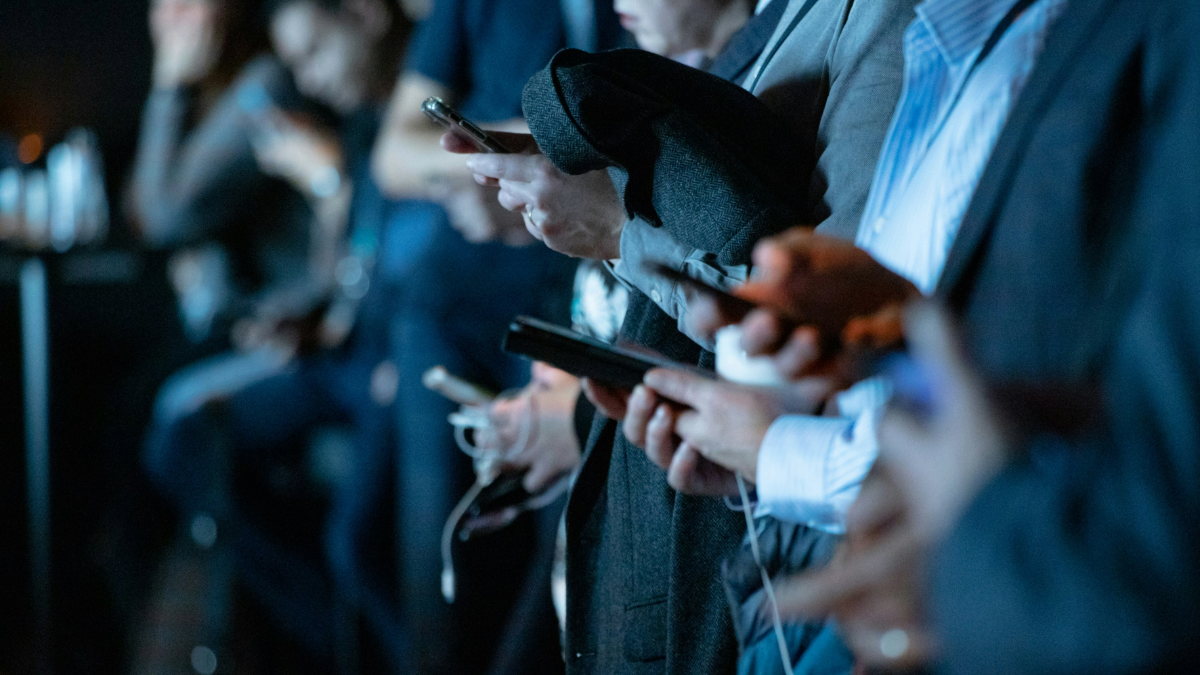
Photo by camilo jimenez on Unsplash
A central question of the last decade is what the emergence of social media as a primary locus of communication has meant for political discourse across the world. What social movements owe their existence and power to social media? What are the affordances and mechanisms by which they are able to spread? Is the public becoming more informed through social media, or led astray by misinformation? And whose voices are and are not heard on these platforms?
A recently published paper explores one discrete but important piece of this puzzle: the relationship between encountering political content on social media, being better informed on current affairs, and participating in political discourse on social media.
In “A new window to the world? Associations between political social media content, political knowledge and participation on social media,” Cato Waeterloos of Hasselt University in Belgium conducted an empirical study to interrogate a posited theoretical framework. In this model, users who are exposed to political posts on social media show increased participation in this online discourse via the “mediating mechanism” of having increased their knowledge about the issues.
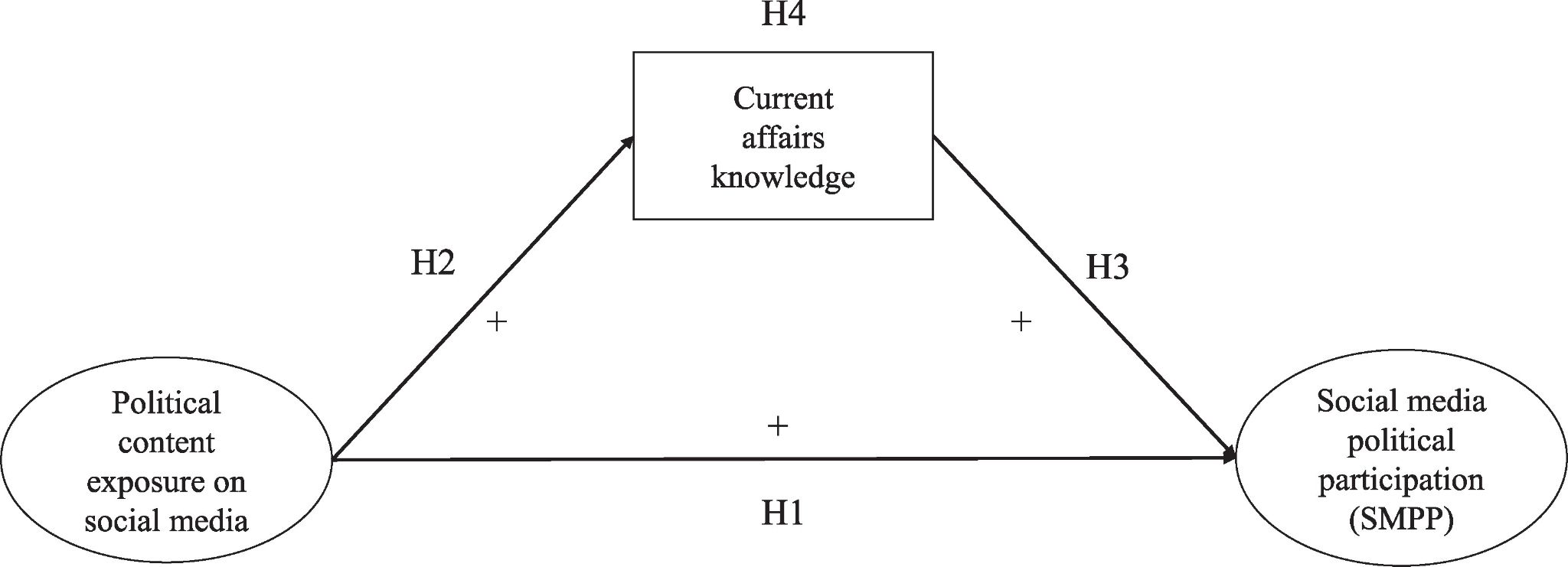
Figure 1. Theoretical model.
Waeterloos fine-tuned her approach to studying this set of relationships by zeroing in on the kinds of political content common on social media, the salient knowledge that this is likely to improve, and participatory activities common on social media. She went beyond hard news about institutions and politicians in defining political content, including “lifestyle-oriented political topics” like climate activism and gender equality. This broadened the concepts included, but knowledge about those concepts was also narrowed to “knowledge about recent political and societal events” in keeping with the way that social media prioritizes live issues over knowledge of history and longstanding systems. Finally, social media political participation was taken to include both original posting and “low-threshold actions,” like sharing and indicating event attendance, which can also be significant when viewed through the author’s political socialization lens.
Study and findings
Waeterloos surveyed 2,520 individuals in Flanders, Belgium, in December 2023. The subjects were asked to estimate how many times they saw information on social media about six specific political and societal topics which had been identified as commonly present on the platforms in the previous three months. They were then quizzed with eight multiple-choice questions about local and international political stories. Finally, social media political participation (SMPP) was assessed using a measure previously developed by the author and collaborators, where the subjects were asked how often they had participated in each of five engagement activities (posting, sharing, etc.) over the last year. The study also measured control variables including political interest and socioeconomic status.
The findings supported the author’s hypothesis that exposure to political content would be positively associated with both SMPP and higher levels of current affairs knowledge (H1 and H2, as labeled on the diagram above). This suggests that, when the metrics are dialed in for the type of political discourse most often occurring on social media, people may well be learning (true things!) about current events from the content on the platforms.
However, the results did not support Waeterloos’s other hypotheses: higher current events knowledge was, in fact, negatively associated with SMPP. This is inconsistent with the broader premise that learning about politics on social media leads to increased active political engagement online (H3) because it increases knowledge about the issues (H4). Rather, it indicates that “people who objectively know more about current affairs are actually less likely to express themselves politically on social media” and therefore that those less well-informed are more likely to contribute to the discourse.
Explaining the mismatch
The author suggests three possible explanations for this mismatch. All three are rooted in academic literature and have some intuitive appeal for those attuned to the nature — and problems — of online discourse.
Waeterloos first suggests that some people, despite being informed about the issues, are still reticent to speak out, perhaps because they are fearful of the enduring nature of their contribution and the online culture of “discursive accountability practices.” Curiously, she links this to the subjects’ possible awareness of their lack of background context on political topics, as the study only assessed current affairs knowledge. While this is one possibility, these fears may reasonably persist even for those well-versed in the history and likely implications of events; online retribution can reach any user who says something unpopular with any faction, even if their expertise is unimpeachable.
Related to this is the second proposed explanation: that SMPP is not associated with objective knowledge about political issues, but rather with subjective knowledge. Overconfident voices may in fact dominate on social media, and this might deter some objectively knowledgeable users from engaging in shared discourse. If this is true, Waeterloos tellingly observes, it would cast doubt on “certain normative assumptions in democratic theory, which classically assume informed and knowledgeable citizens to be the ones participating in politics.”
The final suggestion is that “issue publics” are common online: small groups with deep knowledge and interest in a particular topic. If enough of the social media discussion of political issues occurs in these settings, then, even if the theoretical model were basically sound, broad current affairs knowledge would not be the correct factor to measure.
Limitations
It is important to note that this is not a causal study, and so the findings could only align or not align with the proposed model, not prove or disprove it. Although the survey was constructed based on data, and the exposure topics matched the knowledge questions, there may still be problems with the reliability of responses (did they really see the content?) and the presence of the specific facts in the content that was encountered. There may also be significant differences between people who seek out political content on social media and those who encounter it incidentally.
In addition to these factors that were mentioned in the paper, empirical academic studies of this type on social media are often limited in other ways. The research did ask subjects which platforms they use to ensure that this was not a confounding factor. However, the findings were published two and a half years after the data was collected. In that time, as several scholars have noted, the participatory nature of social media has seen a significant transformation, along with some of its key affordances.
Social media is also dependent on the underlying culture of the users, a fact underscored by a 2024 survey showing that views diverged widely between countries on the question of if social media is good or bad for democracy. The subjects of this study all lived in one linguistically distinctive area of a single small country, and it is not clear that the culture of political discussion on social media would be the same in other places.
Despite some skepticism from both academic and popular quarters, this study gave a ray of hope that people do indeed learn true facts about current events from content on social media. However, it also showed that a straightforward model where citizens first become politically educated and then step up to become knowledgeable political actors on social media may be flawed. Sadly, what flows from the “window to the world” may not be the most well-founded contributions.
Waeterloos gives many worthwhile suggestions for further study to better understand how and why people participate in political activity on social media. While our knowledge in this arena no doubt remains incomplete, those involved in product and policy work within and outside of platforms may already look to this work to inspire proposals to improve democratic mechanisms online. What are the cultures, affordances, or elements of algorithmic design that might underlie the apparent negative relationship between knowledge and participation, and how can we change these to incentivize and amplify the most well-informed voices for the benefit of all?

Authors