What Trump Did and Didn’t Say About AI in the State of the Union
Zachey Kliger / Feb 27, 2026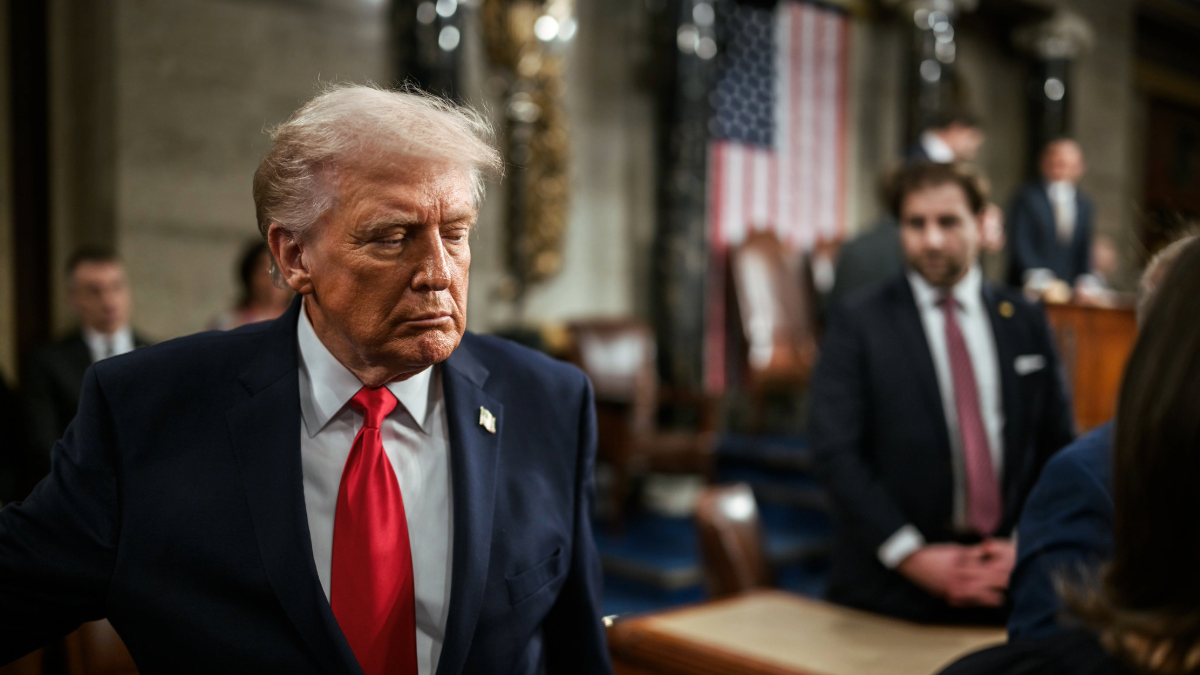
President Donald Trump delivers his State of the Union address, Tuesday, February 24, 2026, on the House floor of the US Capitol in Washington, D.C. (Official White House photo by Daniel Torok)
United States President Donald Trump’s record-breaking 107-minute State of the Union address referenced artificial intelligence only three times, two of them in passing.
- Trump announced a “ratepayer protection pledge” meant to create an obligation for major tech companies to cover the power needs of their new AI data centers.
- He highlighted First Lady Melania Trump’s support for “AI legislation,” a reference to her advocacy for the TAKE IT DOWN Act, a law targeting AI-generated deepfakes and nonconsensual explicit images.
- He made a passing reference to the Presidential AI Challenge, a nationwide competition for K-12 students and educators to use AI tools to solve a community challenge.
Here’s a look at what Trump specifically said about data centers and the context in which it lands, and what he didn’t say about other public concerns around AI.
Making data centers pay for electricity costs
Trump announced that his administration had negotiated a “ratepayer protection pledge” with major tech companies, obliging them to build their own power plants for new data centers:
Tonight, I’m pleased to announce that I have negotiated the new “ratepayer protection pledge.” We’re telling the major tech companies that they have the obligation to provide for their own power needs. They can build their own power plants as part of their factory, so that no one’s prices will go up. This is a unique strategy never used in this country before. We have an old grid. It could never handle the kind of numbers, the amount of electricity that’s needed. So I’m telling them they can build their own plant. They’re going to produce their own electricity. It will ensure the company’s ability to get electricity, while at the same time, lowering prices of electricity for you.
Trump’s “ratepayer protection pledge” lands in the middle of a growing backlash against data center build-out.
Across the country, governments at the state and local level are demanding more from data center developers, introducing measures to offset their costs to communities even as some cities and towns enact moratoria on their construction. In December, more than 230 national, state, and local groups signed a letter to Congress calling for a nationwide moratorium on new data centers, citing unsustainable energy and water use and rising utility costs for families and small businesses.
American voters aren’t uniformly opposed to data centers, but support is highly local. Recent polling by Politico suggests:
- People are more open to data centers in the abstract than in their own backyard
- Only 17% expect data centers to matter in this year’s elections (though that jumps to 30% for people living within a mile of a data center)
- 57% think data centers will eventually become a campaign issue where they live.
Another recent poll by the firm Echelon Insights suggests more substantial resistance. But perhaps the biggest takeaway from recent polling is there is a large swath of indifferent or undecided voters on this issue: another POLITICO poll found 37% of voters would support new data center development, while 28% would oppose it and 36% remain on the fence. Interestingly, many see “new jobs” as the main benefit—even though in the long term, data centers are not big job creators.
Still, the issue is already influencing the outcome of elections. In New Jersey and Virginia, Democrats Mikie Sherrill and Abigail Spanberger won gubernatorial races in part by promising tougher data center regulation. In Georgia, Democrats flipped two statewide utility regulatory seats after running on putting guardrails around data center growth.
The political factions on this issue are still fluid. Progressives and moderate Democrats appear to be split on whether to pause new construction, and some Republicans are also calling for stricter rules on AI infrastructure:
- Sen. Bernie Sanders, I-Vt., has called for a federal moratorium on AI data center construction, warning about runaway expansion and huge energy loads.
- Florida Gov. Ron DeSantis, R, has become a vocal critic, unveiling a “bill of rights” last year aimed at protecting residents from data center impacts.
- In states seeing rapid build-out, leaders are trying to split the difference. Pennsylvania Gov. Josh Shapiro, D, a likely 2028 contender, has proposed new safeguards for ratepayers and resources, while still backing new construction.
“This is a political bomb waiting to go off,” said Jared Leopold, a Democratic strategist and co-founder of the climate group Evergreen Action. “You’ve seen data centers go from a third-tier issue to a top-tier issue in politics in the span of a year.”
Reaction to Trump’s pledge
Corporations, many of which had already made similar promises, were quick to support the President’s announcement. Microsoft quickly praised the pledge, while other major AI firms, including Google and Anthropic, rolled out their own pledges ahead of the speech.
Experts, though, questioned how much the pledge really addresses the full costs of data center build-out.
“Most of today’s cost pressure is coming from transmission, distribution, and system readiness, not energy supply,” Brandon Owens, a grid expert and founder of AIxEnergy, wrote in an email to POLITICO. “Those costs remain even if a data center self-supplies generation.”
“There’s a lot of ways that these can cause increased rates that are outside of just paying for the very obvious, direct interconnection and potential new generation costs,” said Catherine Casomar, co-founder of the Better Data Center Project. “As to how those costs are ultimately distributed among millions of ratepayers, those details are hashed out by utilities and state regulators—not the White House and tech companies.”
Ari Peskoe, director of the Electricity Law Initiative at Harvard Law School, argues that the pledge is aimed at the wrong actors – focusing on data center developers rather than the utilities and grid operators who shape rates and infrastructure.
Other advocates doubt Big Tech’s incentives altogether.
“Let’s be honest: Big Tech isn’t going to do anything for the benefit of anyone but itself,” wrote Mitch Jones, managing director of policy and litigation at Food & Water Watch. “And with the Trump administration’s complete unwillingness to hold corporations accountable for any number of harmful impacts on society, it’s imperative we halt new data center construction now.”
Sen. Mark Kelly, D-Ariz., echoed the skepticism in a post on X: “A handshake agreement with Big Tech over data center costs isn’t good enough. Americans need a guarantee that energy prices won’t soar and communities have a say.”
Looking ahead
In the speech, Trump didn’t name the specific companies that signed the “ratepayer protection pledge,” or spell out how it would be enforced. According to press reports, the White House plans to host companies next week to formalize the effort. Secretary of Energy Chris Wright said after the address that the administration had reached agreements with all the “brand-name” AI companies.
It’s also unclear how much this pledge will actually change existing behavior. Major firms were already moving toward “bring your own power” models or at least claiming to cover their full energy costs:
- PJM Interconnection, the country’s largest grid operator, recently proposed that big new power users either bring new generation with them or curb usage when the grid is stressed.
- Google says it already covers its own data center energy costs.
- Meta has similarly said it pays the full cost of the electricity used by its data centers so it isn’t passed on to consumers.
Of course, corporate claims about “covering” their energy use should not be taken at face value.
Finally, even if the pledge works as advertised and shields local ratepayers from higher electric bills, it leaves big issues untouched: air and noise pollution, water depletion, land use conflicts, and the risk of stranded projects if local resistance grows. And it doesn’t grapple with the downstream impacts of accelerating AI more broadly – from job displacement and environmental strain to expanded surveillance and an information ecosystem saturated with AI slop.
What Trump did not say
Americans are uneasy about an AI-dominant future. That makes it worth noting what Trump’s speech didn’t touch on, especially around kids, jobs, and rules for industry.
Protecting kids
While Trump highlighted the TAKE IT DOWN Act and the K-12 AI Challenge, he didn’t propose any new measures to address broader AI-related risks to children—one of the few issues that unites voters across the spectrum:
- 78% of Trump voters want tech companies held liable for harms to children, according to the Institute for Family Studies.
- Among women 50+, 90% are concerned about the lack of national AI standards to protect kids, and 70% say they’re very concerned, based on a poll from Fabrizio Ward.
Members of both parties have been sounding the alarm:
- A bipartisan Senate bill, the Guard Act (sponsored by Sens. Josh Hawley, R-Mo., and Richard Blumenthal, D-Conn.), would bar companies from providing AI chatbot “companions” to minors.
- In a recent hearing, Sen. Ted Cruz, R-Texas, argued that heavy device use in schools, even for learning, is fueling a teen mental health crisis and undermining academic outcomes.
Worry over jobs
Public anxiety about AI and jobs is intense – and remains largely unaddressed by Trump’s AI policy. A recent YouGov poll found:
- Only 7% of Americans think AI will increase the number of jobs
- 63% think AI will reduce jobs in the US.
An Edelman report similarly found that about two-thirds of low-income Americans expect to be left behind by generative AI rather than benefit from it.
This is a ripe area for concrete policy. Lawmakers who can talk honestly about job loss and back it up with specific plans have room to connect with voters. There are bills that would address concerns, including the Workforce of the Future Act, which directs the Secretaries of Labor, Commerce, and Education to analyze AI’s impact on the economy and authorizes $90 million in grants for training workers most at risk of displacement; and the Investing in American Workers Act, which aims to help workers gain skills for an AI-driven economy, including through incentives for employer-funded training.
Industry guardrails
Polling is consistent on one point: Americans want laws, not just voluntary pledges, to govern AI. In a recent Gallup survey, 80% of Americans said they want rules for AI, even if that slows the technology’s development. Voters aren’t asking for more executive orders or handshake agreements with tech companies; they’re looking for clear, enforceable guardrails written into statute.
So far, however, the Trump administration has shown little real appetite for supporting comprehensive AI legislation. The gap between public demand for hard rules and the White House’s focus on voluntary commitments is significant.
The policies Trump highlighted in the State of the Union are not trivial: the ratepayer pledge nods to real tensions around AI infrastructure; the TAKE IT DOWN Act offers long‑overdue protections against image‑based abuse; and the Presidential AI Challenge signals that AI fluency matters for the next generation. But set against public anxiety over jobs, child safety, and the absence of hard rules for industry, his brief AI remarks feel more like branding than a governing agenda.
The political opportunity—and risk—now lies with whoever is willing to move beyond voluntary pledges and feel-good contests to make concrete, enforceable choices about how AI will be built, paid for, and constrained in American life.
Authors