What France’s Under-15 Social Media Ban Means for Europe
Jessica Galissaire / Jul 24, 2026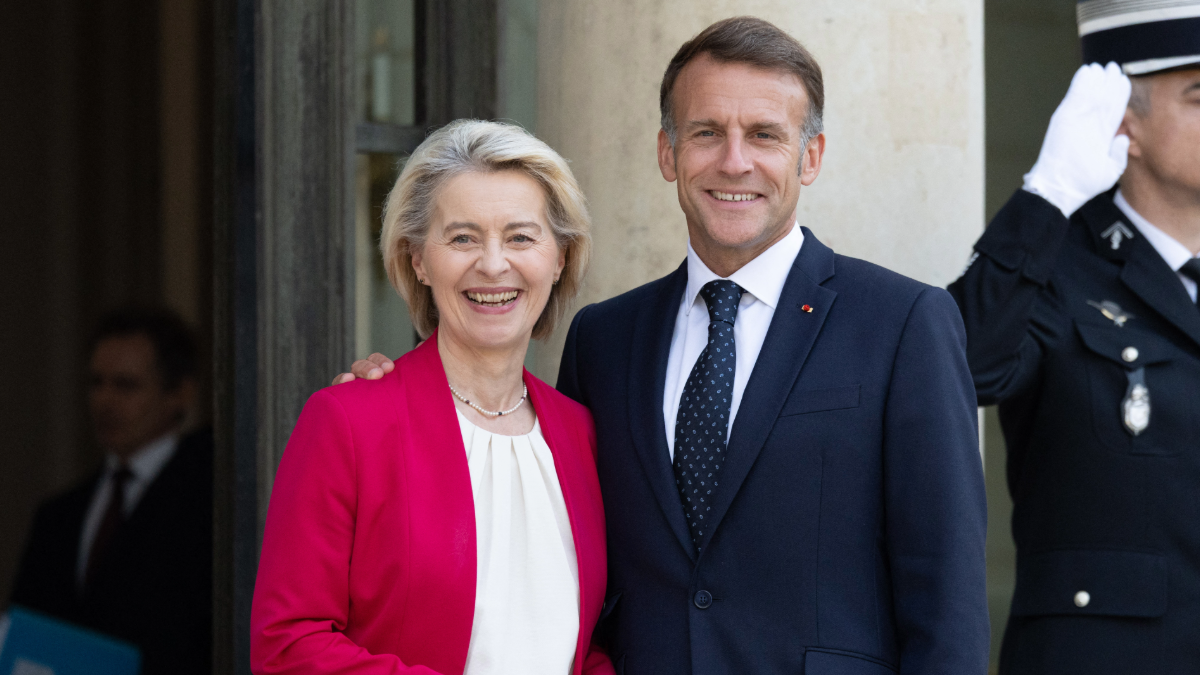
French President Emmanuel Macron welcomes European Commission President Ursula von der Leyen before a meeting at The Elysee Presidential Palace in Paris on July 22, 2026. Photo by Raphael Lafargue/Abaca/Sipa USA(Sipa via AP Images)
“Access to an online social networking service provided by an online platform is prohibited for children under the age of fifteen.” By enacting those words into law on Tuesday, July 21, the French Parliament became the first legislative body in the European Union (EU) to adopt a bill forbidding children under a certain age from accessing social media platforms. Since then, reactions have abounded, some praising the French initiative, others condemning it.
But going beyond the political fanfare, what does the ban entail exactly? Who will enforce it? And above all, how will it fit with a much-expected EU-level initiative?
What France has actually adopted and how it changed
France’s adopted bill is the result of multiple wrestling matches between the country’s two legislative houses on the one hand, and between the French legislators and the European Commission on the other hand.
Tabled by Member of the National Assembly Laure Miller in November 2025, the original proposal stated that “[p]roviders of online social networking services operating in France shall refuse to register minors under the age of fifteen.” It also required these service providers to block access for all under-18s between 10.00 pm and 8.00 am, and to use age verification methods that would be in line with the technical guidelines elaborated by Arcom, France’s regulatory authority for audiovisual and digital communication. Financial penalties in case of non-compliance could reach up to 3% of the given platform’s global turnover.
However, in its advisory opinion of January 2026, the Conseil d’État – France’s highest administrative court – warned lawmakers that requiring social media platforms to deny access to minors under 15 could be seen as conflicting with the EU Digital Services Act (DSA), since Member States may not impose obligations on online platforms that go beyond the ones the DSA already foresees. In an attempt to circumvent that hurdle, MP Miller changed the wording of her bill so that the obligations would fall on minors themselves instead of platforms.
However, the Conseil d’État also noted that the bill didn’t strike a fair balance between the best interests of the child and children’s fundamental rights, since neither the blanket ban nor the night-time curfew appeared necessary or proportionate. The National Assembly only partially took this observation into account, by getting rid of the curfew provisions but keeping the blanket ban for all social media platforms. The Senate, however, addressed the Conseil’s feedback more thoroughly. The version of the bill it adopted on March 31 – the one notified to the European Commission – let go of the blanket ban and introduced a blacklist of services that may not be accessed under 15. As for accessing non-blacklisted services, minors below that age would need parental consent.
In its detailed opinion of July 6, the European Commission did not expressly conclude that the under-15 restriction, the blacklist or age verification requirements are inherently incompatible with EU law. However, it objected to the bill’s enforcement architecture, noting that it would create a parallel national supervision and cooperation regime that overlaps with – and therefore breaches – the DSA’s harmonized enforcement framework. In its comments, the Commission also observed that although framed as a prohibition applying to minors, the bill could effectively require platforms to verify age and collect and authenticate parental consent, which may collide with parts of the DSA.
Following this blow from Brussels, and in a complete U-turn, French legislators stripped their bill of the blacklist approach to come back to the original blanket ban. They also removed the provisions entrusting Arcom with enforcement powers. This is the bill that became law on July 21.
What the law leaves open
In the end, the bill was so stripped of its substance that its final form resembles a shadow of its original. Crucially, it is especially defined by grey areas and uncertainty.
What we know is the law contains a ban that seems to rest on children themselves. The list of what we don’t know is much longer. The law may – or may not – indirectly require social media platforms to put in place age verification solutions and guardrails to prevent underage users from accessing their services. It mentions neither a specific enforcement mechanism nor sanctions in case of non-compliance.
What happens if targeted platforms don’t comply? It’s difficult to say. By putting an obligation on users, French lawmakers aim to reconcile their main objective (forcing social media platforms to verify their users’ age) with the DSA – which prevents national regulators from enforcing that obligation on them. Still, the European Commission might consider that, since the bill indirectly implies that platforms must prevent access to children under 15, it clashes with the DSA. For now, EU officials have refrained from commenting on whether the French initiative is compatible with the existing European framework.
The bill’s relationship with the EU’s competencies and structures is still less clear. Some observers interpret it as “entrusting the European Commission with overseeing its implementation.” Still, it is hard to imagine a world in which the European Commission would let Member States adopt their own age limits to access social media platforms, then take on the responsibility of potentially overseeing the implementation of these virtually 27 different regimes.
Another, more plausible, interpretation would be that French authorities report any breach of its law to the European Commission, which then may use these notified breaches as part of its own investigations. This could perfectly fit, for instance, into the investigations currently under way concerning Meta’s platforms, Facebook and Instagram, and TikTok. However, this doesn’t sound like a major improvement from the current cooperation framework the DSA provides.
More importantly, it seems like French lawmakers have learned little from the Australian experience. Research published in the British Medical Journal indeed shows that in Australia, where a social media ban for under-16s is in place since December 2025, more than 85% of underage users are circumventing that measure.
One can legitimately expect the same to happen in France. The likelihood is high that France’s age restriction law ends up, in large part, ignored. Add to this the fact that the legislation does not address platforms’ harmful features, and France risks ending up with a largely symbolic law that shifts responsibility onto children and parents, while allowing platforms – and their harmful designs – to continue operating unchanged.
What the EU could do differently
There is, however, one thing the French initiative achieved: putting political pressure on the EU to take action. By taking on this legislative process and convincing the vast majority of EU countries to do the same, French decision-makers pushed European Commission President Ursula von der Leyen herself to take the matter into her own hands.
On July 13, the Co-chairs of the Special Panel advising her on online child safety delivered their report. Besides recommending a ban under 13 – which, notably, is already what should be in place if platforms actually implemented their own terms and conditions –, the report gives center stage to safety by design. That is, addressing the digital services’ designs and features by imposing limits on infinite scroll, autoplay, push notifications, and problematic recommender systems. Interestingly, it also proposes to shift the burden of proof to online services providers: until they demonstrate that their services are safe for minors, age restrictions should apply. Which is exactly what the French bill fails to achieve.
In its upcoming proposal, expected in September, will the Commission go for this “product safety approach,” which is slowly but surely gaining traction in Brussels? It remains unclear But the coming months will definitely show whether Europe has learned from the French experience – or whether the political appeal of a headline-grabbing ban will once again prevail over evidence, enforceability and meaningful platform accountability.
Authors