What Are the Politics of a Platform? The Case of X
Jonathan Stray / Feb 25, 2026
Elon Musk, center, attends a memorial for conservative activist Charlie Kirk, Sunday, Sept. 21, 2025, at State Farm Stadium in Glendale, Ariz. (AP Photo/John Locher)
In the 20th century, people worried about publishing magnates controlling the media. In the 21st century, people worry about tech billionaires controlling social media platforms. Certainly, the owners of the platforms have many tools available to them to shape discourse, including but not limited to design, algorithms, content moderation, monetization and other economic incentives. And, they have more visibility than anyone else into how these various dynamics interact.
Although people have long made claims that Facebook, Google, TikTok, Reddit, YouTube and others have a political bent — usually from both sides — X is a particularly compelling object of study. Elon Musk has shaped the platform in significant ways to satisfy his own interests. But what can we observe about how his interventions, or lack thereof, have favored one set of politics over another? This is a surprisingly difficult question to answer from the outside, but attempting to do so may help us get at important questions about where bias may emerge that we can ask about all platforms.
This is what I hope to do in a series of three posts over the next few weeks. I want to dig into questions of bias and transparency, and to start to think more clearly about what “fair” platform politics could actually mean. This is a big enough topic that it requires multiple posts.
- In part one, this post, we’ll take up the claim that all the liberals have left X, and look at what is known about the current composition of the user base.
- In part two, we’ll look at how content moderation has changed, and whether there really is more hate speech on X than before Musk purchased it.
- In part three, we’ll investigate claims that X’s algorithm is biased to favor the right.
The best data we have suggests that the user base on X remains slightly left-leaning post-Musk, but active posters skew more to the right. There might now be more hate speech and other offensive material posted, but whether users are seeing it more or not is an open question. There is evidence that right-ish accounts get more algorithmic distribution and exposure, but this is likely due to user behavior: there are fewer but larger right wing accounts and right wing users are more engaged. My guess is that Musk is actually not putting his thumb on the algorithmic scales — but we can’t know for sure, and you can feel free to disagree with my conclusion after I lay out the scant evidence in this and future posts.
We desperately need both standards and transparency around the politics of platforms if we are to build social media that encourage trust and healthier political debate. More definitive answers to all of these questions will require both better definitions of fairness and better access to platform data, such as through the provisions for researcher access under Europe’s Digital Services Act.
Before Musk acquired it, Twitter’s users were more liberal; now it’s about even on X
When it comes to the political composition of X users, luckily there is historical data. The Neely Social Media Index, an ongoing survey of user experiences on many platforms, shows that before Musk’s takeover, Twitter had predominantly Democrat users in the US:
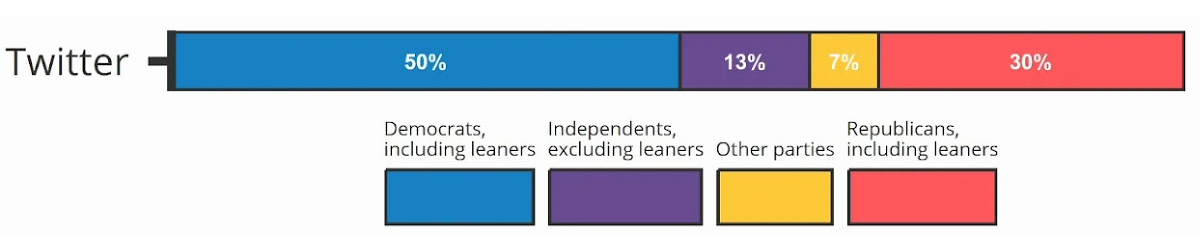
Political composition of Twitter users, spring 2023 (Neely Index)
But by time of the 2024 election, the user base had become much more evenly balanced.
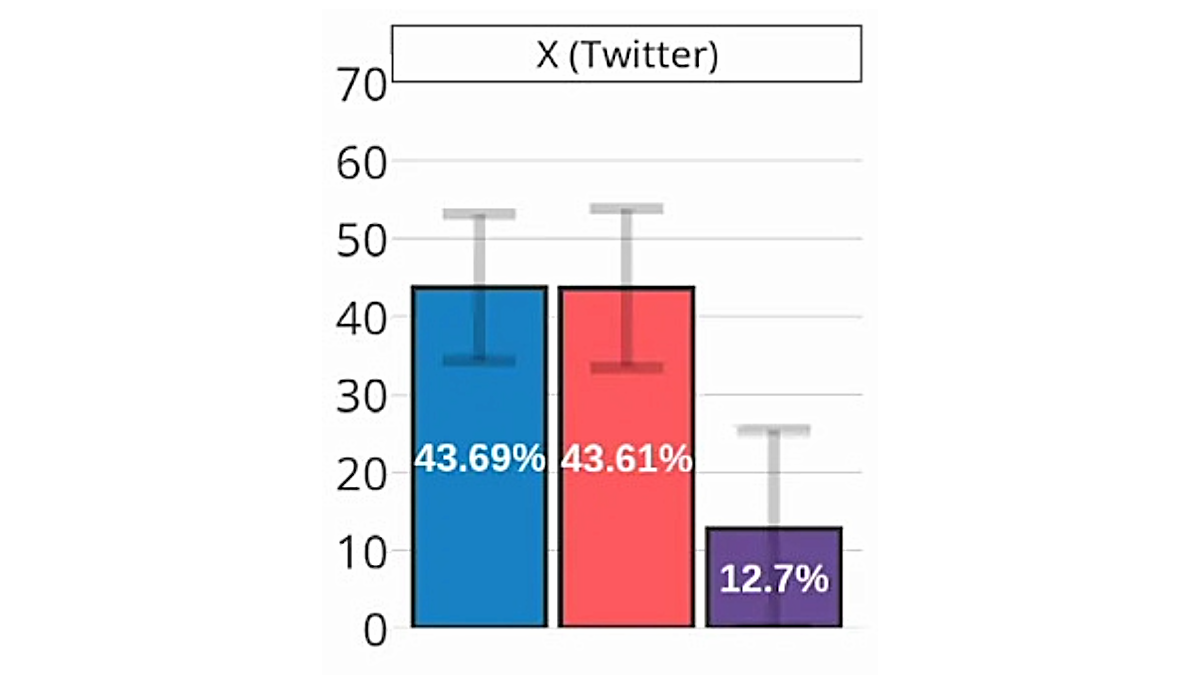
Harris vs. Trump voters among x/Twitter users, fall 2024 (Neely Index)
A recent study by Petter Törnberg shows the same story on pretty much every platform. Nearly all platforms have become more Republican, but they’re still mostly slightly Democrat.
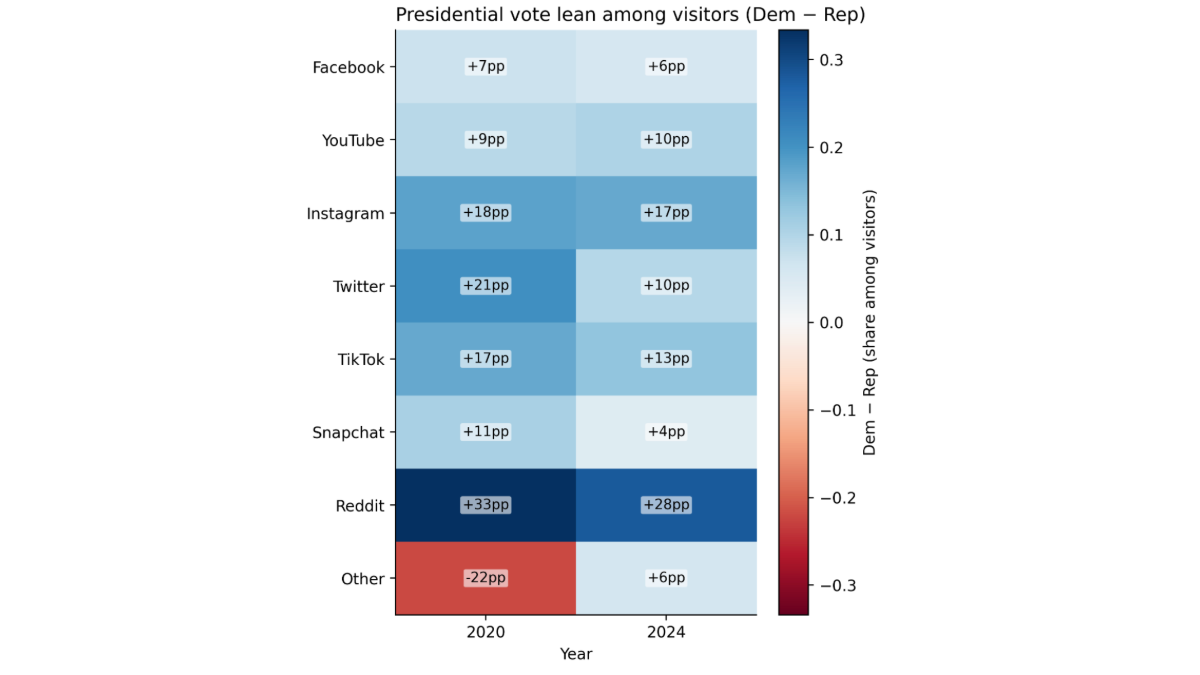
Democratic–Republican vote lean (percentage-point difference) among social media site visitors, 2020 and 2024 (Petter Törnberg)
That bottom red bar labeled “Other” is due to the alternative sites (Gab, Parler, Truth Social) which, in 2020, leaned right.
This may be surprising to some people on the Blue side, especially those who have sparred with Red users for many years. Yet right up to the present, most social media users remain liberal-ish. This corresponds, very broadly speaking, with the era of liberal cultural hegemony that emerged perhaps in the early 2000s, and definitely by 2014.
Active posters have become more conservative
Most users post only rarely (see the famous 90-9-1 rule) so even if the X user base is still quite balanced, one side might post more often than the other. This means the demographics above don’t account for the valence of the content on X. And indeed, self-identified Democrats used to post more than Republicans, but the reverse is now true. Left leaners used to post 45% more often than right leaning posters, now they post 5% less.
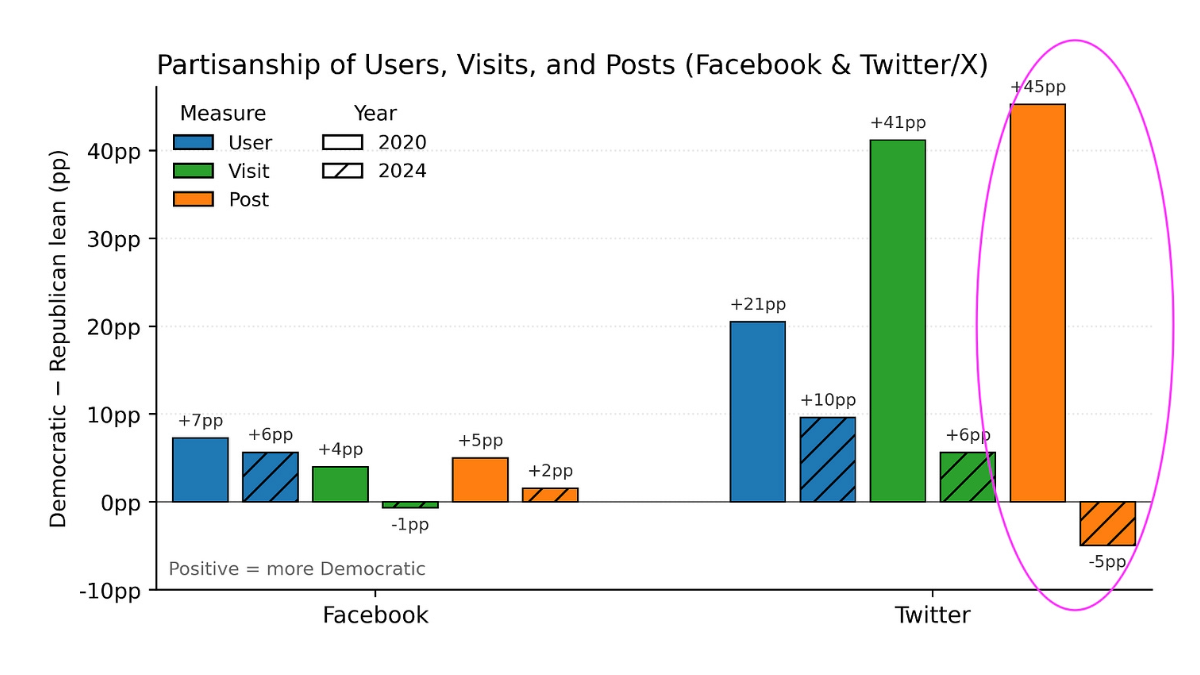
Shift in partisan composition of users, visits, and posts on Facebook and Twitter/X, 2020–2024. Users remain more left leaning, but less so (blue bars). Left leaners used to post 45% more often than right leaning users, now they post 5% less (orange bars). (Petter Törnberg)
This suggests that, on average, users will see more right leaning posts than left leaning posts on X. One thing you will definitely see, however, is that more politically extreme users post more often; this hasn’t changed from 2020 to 2024.
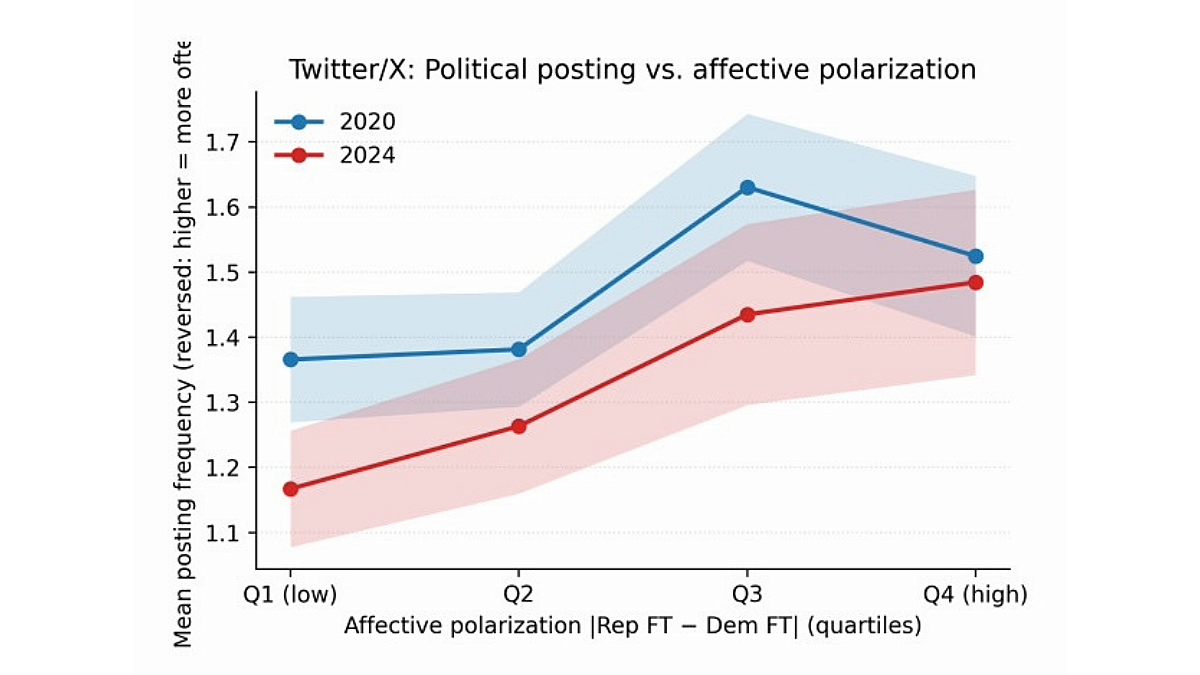
How often Twitter/X users post vs. how polarized they are, 2020 and 2024. (Petter Törnberg)
Slant of news sources remained stable
In my newsletter, the Better Conflict Bulletin, we’ve mentioned this before, but it’s worth revisiting this unique data set. Coincidentally, a group of researchers was conducting a long-term study on the political ideology of news content posted to Twitter around the same time as Musk’s acquisition.
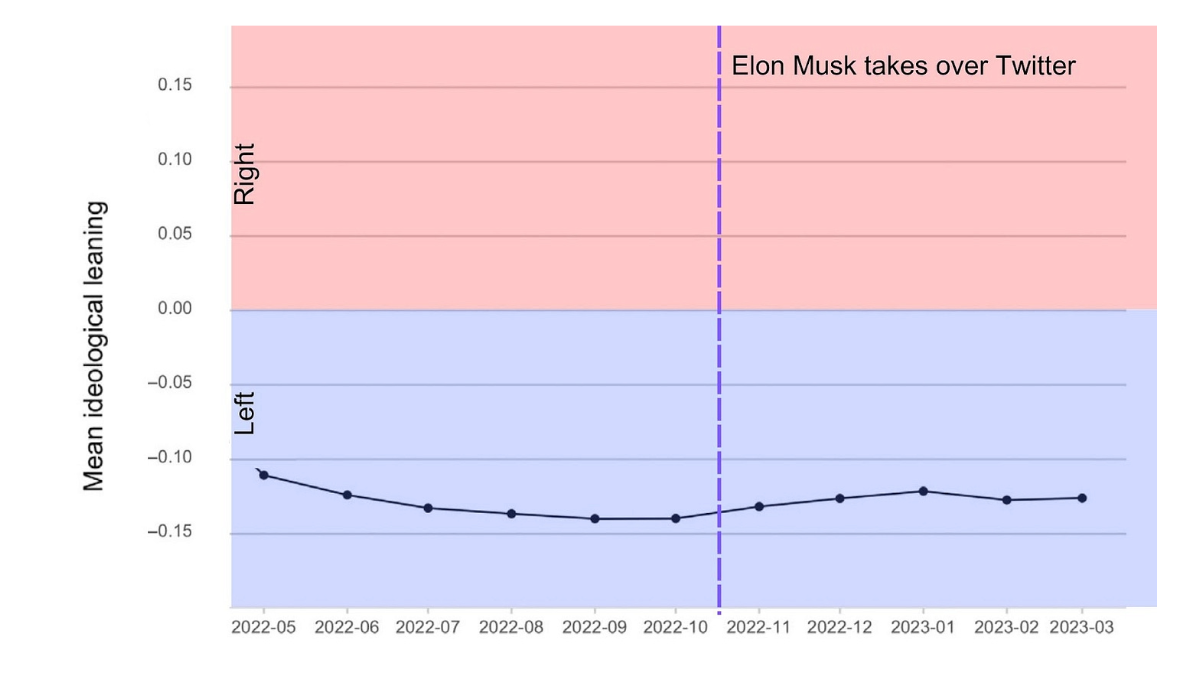
Ideological leaning of news content seen by a sample of Twitter users, as scored by Media Bias Fact Check labels. Adapted from Freelon et al.
Analyzing personalized Twitter feeds of 900 participants, the study found the average ideological leaning was slightly left of center both before and after the purchase. This leaning was scored according to Media Bias Fact Check (MBFC) ratings of over 3,400 news sites. Notably, this slight Blue bias was unchanged six months after Musk took over Twitter.
“Fact quality” was also generally high, with 90% of content rated “mixed” or “high,” again according to MBFC ratings. While news site quality scores are by nature somewhat subjective and certainly contentious, this study – like most – found that the news that users actually see is mostly from credible sources.
Unfortunately, this is the best data we have on this topic. The study ended because Twitter cut off API access in April of 2023, and there has been no comparable followup using alternatives like bots or scraping. Also, “news” is a pretty small percentage of what people actually see on social media, 10.5% in this study. There might be political biases in other content or in later news posts, but this is all we know for now.
The user story
Conventional wisdom is that Twitter/X went right post-Musk. In terms of who is on the platform and what they’re doing, this is correct — to a point.
Like most platforms, liberal users were dominant on the platform for a long time (about a 20 percentage point gap of Democrats over Republican). Today, the platform is very nearly evenly balanced in terms of political demographics. However, not all users are equally active. Formerly, liberal users posted much more, now conservative users are slightly more active. This could be because many liberal users now rarely or never visit the platform, but have not deleted their accounts.
This means that the content on X has become more right leaning in general. Probably. It depends on what these right leaning posters are posting. We only have data for six months after the transition, but there didn’t seem to be any real shift in the political leanings of news articles shared on the platform. Other types of posts, of course, likely moved rightwards.
In short, the story is not that X lost all its more left leaning users, but that they began to use the platform less.
Yet a platform is more than its users. Next week, we’ll look at whether and how X’s moderation has changed, both in policy and substance, and whether claims that it is hosting more hate speech than in the past are supported by the available evidence. And in the final part of this series, I’ll take up the difficult question of what a “fair” algorithm might be.
Authors