US Congress Targets ‘Pig-Butchering’ Scams as Cybercrime Outpaces Policy
Fiona Kelliher / Feb 2, 2026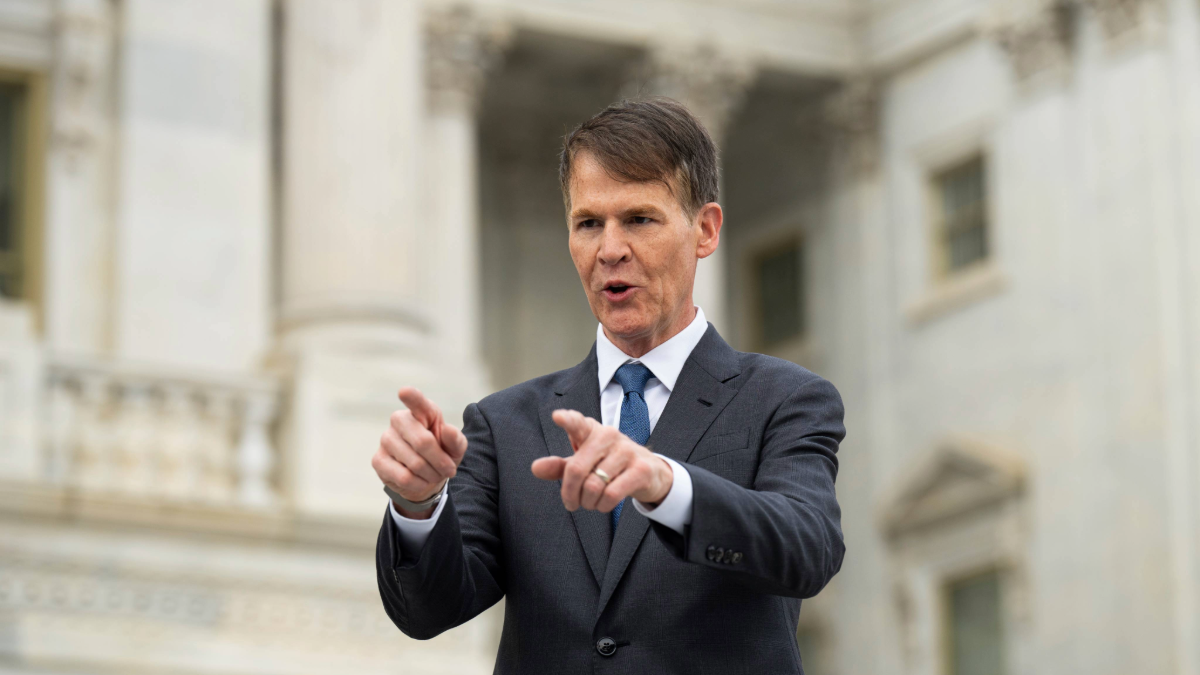
Rep. Jefferson Shreve (R-IN) on the House steps after freshman members of Congress posed for their class photo at the United States Capitol on Friday, November 15, 2024. (Bill Clark/CQ Roll Call via AP Images)
A slate of new anti-cyberscam bills has emerged in the United States Senate and House in the last few months, seeking to curb transnational "pig-butchering" scam syndicates targeting Americans.
Pig-butchering scams — a term referring to extracting more and more profits from a victim before cutting them off — are on the rise in the US as Chinese-led crackdowns force Southeast Asia-based syndicates to diversify their victim base away from China. The Treasury estimates that Americans lost $10 billion in 2024 alone, a 66 percent increase over 2023.
The legislation comes amid US Treasury sanctions against the alleged cyberscamming and human trafficking conglomerate Prince Group, as well as various Cambodian and Myanmar tycoons.
But even with at least five bills in the works, Washington faces an uphill battle as scam syndicates become more professionalized and incorporate artificial intelligence tools. At the same time, while the bills have tended to implicate the Chinese state as the industry’s primary culprit, they offer a lighter touch when it comes to the tech platforms and cryptocurrency exchanges that play key roles in the scamming ecosystem.
Among the most comprehensive bills is H.R.5490, the Dismantle Foreign Scam Syndicates Act, which would establish an interagency task force under the Secretary of State to lead a “whole-of-government effort” against the industry. A host of federal agencies, including the Departments of Justice, Homeland Security and Treasury, would be tasked with creating a national anti-scam strategy, coordinating with law enforcement and the private sector, bringing pressure on foreign governments and sharing data with allies.
The bill garnered a strong show of bipartisan support during a House Foreign Affairs Committee meeting in December, with itssponsor, Congressman Jefferson Shreve (R-IN), calling it “fundamentally nonpartisan” given the “staggering” impact of pig-butchering scams on Americans.
“Quite honestly, it’s the kind of thing I wish we spent more time in Congress working on — things that really affect all our constituents,” said Congressman Joaquin Castro (D-TX) during the meeting.
Legislators also appear united around the China hawkishness embedded in several of the bills. Shreve’s bill calls for investigating China’s “involvement in the origin and perpetuation of online scam operations” and responding to its “complicity in and instrumentalization” of the industry. Two of the other bills go further; one that passed the Senate last December claims that many compounds “spread PRC propaganda,” while another argues the Chinese Communist Party’s “involvement in TOC networks presents an urgent national security threat.”
That language echoes testimony that Jason Tower, a senior expert at the Global Initiative against Transnational Organized Crime, gave to Congress in March last year, discussing the role that Chinese state-owned construction companies played in building Myanmar’s infamous Shwe Kokko scam center. Philippine officials have also said scam centers showed evidence of being used for Chinese espionage near an air force base to which the US has access.
“All of this points to there being some involvement of the Chinese state, and that’s really where you have a push within the US government to look at that angle and better understand exactly what is going on here,” Tower told Tech Policy Press.
Not all experts agree. Mark Bo, a researcher and author of the book Scam: Inside Southeast Asia's Cybercrime Compounds, told Tech Policy Press that “very little evidence has been presented to prove coordination between the Chinese state and the broader scam industry.” Bo warned that legislation intent upon targeting China’s so-called “guiding hand” could distract from pursuing systems that enable the flow of scam proceeds, including banks, crypto and corporate service providers.
Rather than receiving the go-ahead from the state, “Chinese operators moved out of China precisely because the environment was too risky,” Bo said.
Indeed, China has engaged in a highly publicized crackdown against scamming in recent years, ranging from extraditing kingpins to performing high-profile rescues to domestic awareness campaigns.
Many of these tactics are unavailable to the US. Despite the Biden administration’s limited re-engagement in Southeast Asia, China’s influence remains far deeper, particularly in Cambodia and Myanmar.
That leverage has allowed China to make big geopolitical leaps in its anti-scam efforts, such as emboldening a trio of ethnic armed organizations to topple clans running scams along its border with Myanmar, sentencing scam perpetrators to death and sending an anti-scam czar to lead crackdowns in Thailand, Myanmar and Cambodia.
Another challenge for US lawmakers is scammers’ increasing professionalization compared to when the industry first took root. Syndicates rely on industrial-scale money laundering services to move profits, with the more successful compounds running highly disciplined hierarchies to avoid deaths of trafficking victims or other incidents that invite law enforcement scrutiny.
AI is meanwhile enabling more effective deepfakes and phishing schemes, expanding the arsenal beyond typical love scams or investment frauds. A recent report from Chainalysis showed that AI-assisted scams were 4.5 times more profitable than traditional scams in 2025, with “increasing convergence” across scam types.
Yet only one of the bills being considered mentions AI. And so far, lawmakers have largely left the role of tech and crypto platforms unaddressed, aside from calling to partner and data-share with them — despite evidence showing some are used to facilitate scamming.
Telegram has become scammers’ central marketplace for buying and selling illicit technology, data and money laundering services that keep the scam industry running. Meta, meanwhile, estimated about 10 percent of its 2024 revenue — $16 billion — to stem from scam ads, Reuters reporting has shown. Meta’s safety staff approximated that its platforms were involved in a third of all successful scams in the US.
Historically, Section 230 of the Communications Decency Act has given tech platforms immunity from information shared by users, helping them to avoid liability for illicit uses.
“Meta, Telegram, Tether, Binance — all of these companies are running criminally dependent business models with statutory impunity,” said Jacob Sims, a scam researcher and fellow at Harvard University’s Asia Center. “All of these firms are materially and knowingly benefiting from criminal activity on their platform, and they don’t face any real consequences from that.”
Future US anti-scam efforts should crack down on these firms, Sims said, but exactly what that looks like depends on the company: While Requiring Meta to verify its advertisements would be a start, Google, which recently endorsed several scam-related bills and sued cybercriminals for a mass phishing operation, may prove more cooperative.
In a statement to Tech Policy Press, Shreve’s office said the bill promotes cooperation with crypto and tech firms without excusing misconduct or ruling out tougher accountability. “We need faster coordination across DOJ, Treasury, State, and international partners to target scam compounds, to freeze assets, and prosecute the people running these operations,” Shreve said. “On the private-sector side, platforms should move faster on takedowns, verification, and preserving evidence.”
One bill, H.R. 5877, the Combatting Money Laundering in Cyber Crime Act, takes a more direct approach to tracking scam funds through crypto. The legislation would expand the United States Secret Service’s authority to investigate digital transactions and extend reporting requirements for the Financial Crimes Enforcement Network, a bureau of the US Treasury that combats money laundering.
Still, a recent discussion at the House Committee on Financial Services hit apotential nerve in anti-scam legislation: How far Republicans in the current political climate may be willing to go in regulating an industry that has both enriched and been championed by US President Donald Trump.
Trump is involved in multiple crypto ventures, including the platform World Liberty Financial, as his family’s crypto holdings have grown to more than 20 percent of their total wealth, according to Bloomberg. He has pardoned several controversial crypto figures for money laundering, most notably the billionaire Binance owner Changpeng Zhao.
Congressman Warren Davidson (R-OH) said during the meeting that he supported the bill but that “we need to overtly protect decentralized finance.”
“There’s a lot of lawfare that has been used by previous administrations to try to kill this industry, and I hope we don’t see that abuse continue here,” he added. Sims said he wasn’t yet seeing pushback from lawmakers on holding crypto or tech platforms to account, but noted that the debate remains in its early stages.
Authors