Trump’s Crackdown on Dissent is Targeting Signal—and Zines
Jenna Ruddock / Jun 26, 2026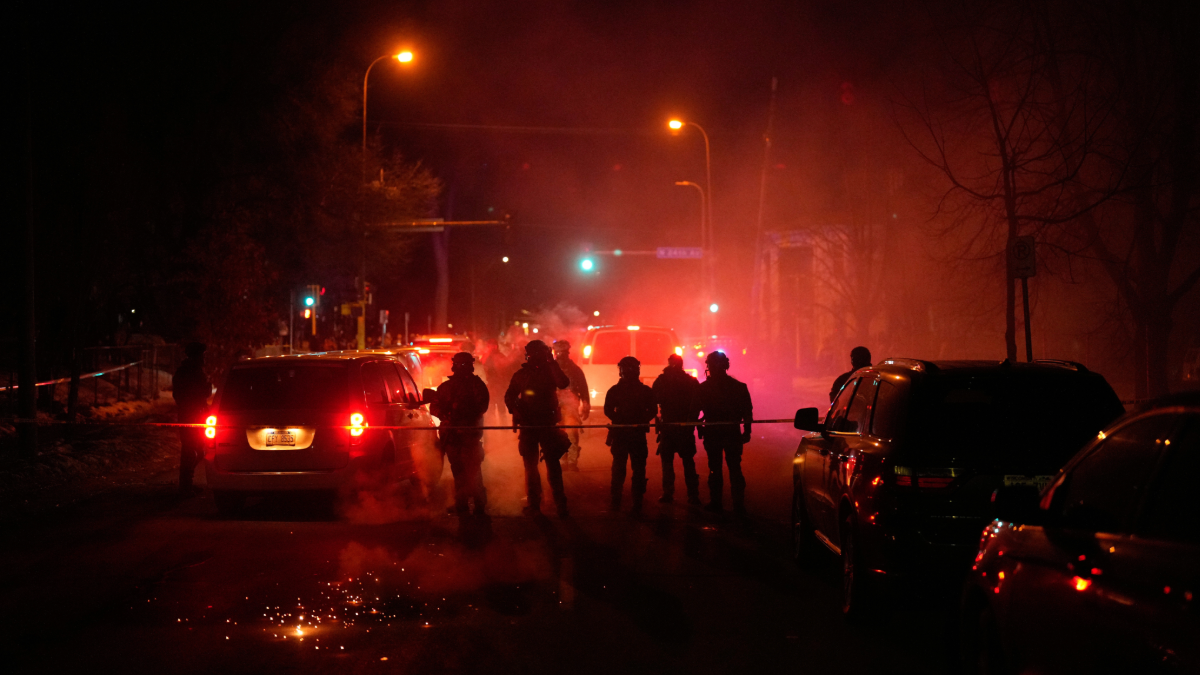
Tear gas surrounds federal law enforcement officers as they leave a scene after a shooting on Wednesday, Jan. 14, 2026, in Minneapolis. (AP Photo/John Locher, File)
Last week, the US Department of Justice (DOJ) indicted fifteen people in Minnesota on conspiracy charges stemming from local community organizing efforts during “Operation Metro Surge”—a federal assault on the Twin Cities that followed escalating, racist attacks by President Donald Trump targeting the area’s Somali community late last year.
By the time the Trump administration announced the end of Operation Metro Surge in February—a contested characterization as abductions and harassment by federal agents continued—ICE and Border Patrol agents had shot and killed two people, poet Renee Good and intensive care nurse Alex Pretti. Federal agents had forced a naturalized citizen out of his home in subfreezing temperatures wearing nothing but shorts and a blanket, in an arrest that is now being investigated as a kidnapping. Parents and kids were ambushed on the way to and from school pickup, with school administrators scrambling to make sure their students weren’t left without caregivers.
A report recently released by Human Rights Watch describes the violence wrought by Operation Metro Surge as “a wide range of human rights violations.” These included not only the use of excessive force in the streets—with federal agents smashing car windows and deploying chemical munitions in neighborhoods—but also “inhuman and degrading conditions” in detention facilities, including restricted access to food, health care, and legal counsel. The report also details federal agents harassing and intimidating community observers—including multiple cases of agents driving to people’s homes and stopping to take photographs while making sure the residents were watching.
All of this is described throughout the indictment as, simply, federal agents “performing their official duties.”
In those same pages, rapid-response community organizing efforts are cast as pillars of a sweeping conspiracy—with a particular focus on efforts to gather information on federal agents’ activities and to share that information widely.
Don’t watch the watchers
As Human Rights Watch documents, throughout the siege in Minnesota, ICE and Border Patrol agents systematically worked to avoid identification, from covering their faces and not wearing identifying badges to covering or using fake license plates on their vehicles. These practices have been so common nationwide that multiple states passed bans on federal agents wearing masks.
The public has few tools comparable to the sprawling surveillance apparatus and legal investigatory powers of the federal government—particularly when the government is invested in protecting officers engaging in violence and likely civil and human rights violations. But in the Twin Cities and across the country, communities have responded with the tools available: the now-iconic whistles. Word of mouth. Crowd-sourced maps. Spreadsheets. Group chats.
In other words: information-sharing. Efforts to keep people aware of and safe from the well-documented violence federal agents perpetrated. Efforts now cited as evidence of a criminal conspiracy.
Extremely standard anti-surveillance precautions are also listed among the core elements of the alleged conspiracy: collecting phones and smart watches before holding closed-door meetings, using the popular encrypted messaging app Signal, and otherwise “practicing ‘operational security’ or ‘OPSEC.’”
The Trump administration has consistently claimed that efforts to organize against ICE and Border Patrol operations—and efforts to document federal agents’ activities in public, in particular—amount to offenses ranging from obstruction of justice to domestic terrorism. Former Attorney General Pam Bondi, in remarks about the developer behind one app crowdsourcing information about ICE raids, said “he better watch out, because that’s not a protected speech.” Both the Department of Homeland Security (DHS) and DOJ have attempted to subpoena information about people running ICE watch accounts on social media.
This relentless insistence that the constitutionally protected activity of observing and reporting on the public activities of federal agents remains particularly jarring when considered alongside ICE and Border Patrol’s aggressive pattern of surveillance, intimidation, and harassment targeting reporters, community observers, and bystanders alike.
In February, the ACLU of Minnesota updated its lawsuit challenging federal agents’ activities in Minneapolis by filing dozens of declarations that—like the recently-released Human Rights Watch report—describe ICE and Border Patrol agents following protestors to their homes, or arresting community observers for recording their activities. A similar lawsuit has been filed in Maine. People have reported federal agents documenting their license plates, taking photos of their faces, addressing them by name, and claiming to add them to a “nice little database” of domestic terrorists.
This week, a poll worker in Syracuse was visited at work by ICE agents threatening the possibility of prosecution over social media posts critical of ICE.
The attempted criminalization of anti-surveillance measures is similarly alarming as DHS continues to expand its already invasive surveillance apparatus, from deploying facial recognition via mobile apps to buying access to mobile phone location data through commercial data brokers.
The end game is criminalizing dissent
Efforts to sweep a broad swath of extremely routine organizing activities under the vague umbrella of conspiracy charges are not new – and have largely failed in court.
Just weeks before the Minnesota indictment was filed, federal prosecutors were forced to drop charges against the “Broadview Six”—organizers, including a local congressional candidate, who had been indicted on conspiracy charges following protests against “Operation Midway Blitz” in Chicago.
Both the Chicago and the Minnesota indictments mirror conspiracy charges filed against dozens of people in Atlanta involved in opposing the construction of “Cop City,” a militarized police training campus being built in the middle of one of the city’s “largest remaining green spaces.” Evidence cited by Georgia prosecutors included distributing flyers, organizing a bail fund, and possessing zines critical of capitalism and the government. Those charges were dropped last December.
The underlying logic of these prosecutions involves criminalizing any organizing activities connected to direct action—despite (or perhaps because of) the fact that direct action has been a core tactic of every major social movement in US history, from the Greensboro sit-ins during the Civil Rights Movement to “die-ins” on the steps of the Centers for Disease Control (CDC) headquarters during the AIDS crisis.
At the same time, these prosecutions have explicitly sought to undermine core First Amendment protections for speech and association. Like the Stop Cop City indictments in Atlanta, the recent Minnesota indictment repeatedly cites as evidence simple communications of ideology: wearing shirts or patches; declaring a belief in anti-fascism, in particular, but also anti-authoritarianism, anti-capitalism, and anarchism; and publishing newsletters or zines.
Recently, the Trump administration secured multiple draconian convictions on similar charges against anti-ICE protestors in Prairieland, Texas. Touted as the first case to test the viability of the Trump administration’s designation-by-executive-order of “Antifa” as a “domestic terrorist organization,” the government’s allegations focused heavily on the protestors’ political beliefs to justify terrorism-related charges. Two defendants, Elizabeth and Ines Soto, were charged with “providing material support to terrorists” for printing anarchist zines. This week, Elizabeth Soto was sentenced to 50 years in federal prison. Another defendant, Daniel “Des” Sanchez, was charged with transporting “Antifa materials”: a box of pamphlets and zines described as having “anti-law enforcement, anti-government, and anti-Trump sentiments.” Sanchez was sentenced to 30 years in federal prison.
The Prairieland prosecutors similarly emphasized basic anti-surveillance practices, like using encrypting messaging apps, as evidence of criminal intent.
Refusing the chill
As the Trump administration’s crackdown on dissent escalates, it’s critical to recognize that indictments are not just legal documents—they’re also messaging tools, often targeting small groups of people as a chilling example for movements at large. And the message is clear: the administration wants to deter not only specific types of protest, like direct action, but also any organizing efforts that effectively interrupt the administration’s agenda.
But using Signal is not evidence of a criminal conspiracy just because federal prosecutors in Minnesota claim it is. Printing and distributing political pamphlets and zines is still protected by the First Amendment, even if the contents of those pamphlets speak to the long list of ideologies the Trump administration is attempting to criminalize, like anti-fascism, anti-capitalism, and “extremism on migration, race, and gender.” Observing and reporting on law enforcement agents’ public activities is also still a constitutional right.
These efforts will only succeed if they do, in fact, deter people from exercising their constitutional rights, from organizing to protect their communities, and from speaking out against abuses of power, against fascism, and against state-sponsored violence in its many forms. Crackdowns on dissent aren’t a reflection of power—they’re a projection of power.
And they’re a projection we have a collective obligation to refuse.
Authors