Trump Abandons 'FDA for AI' Proposal
James Görgen / May 22, 2026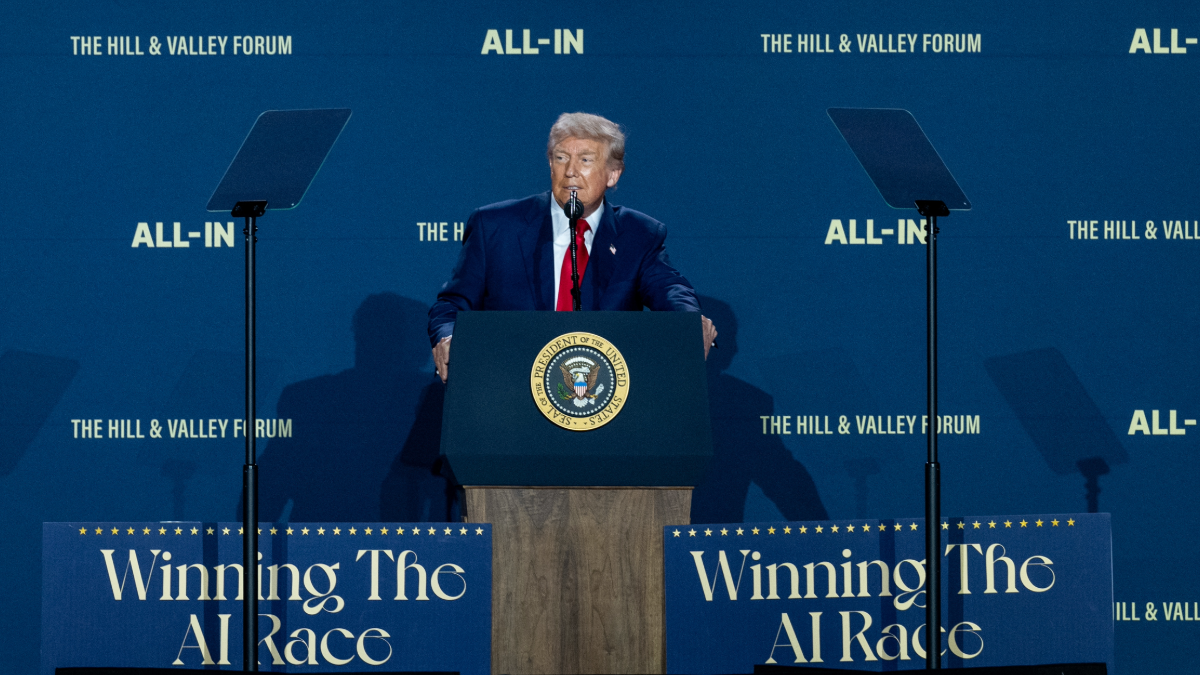
July 23, 2025—US President Donald Trump announces his AI Action Plan and signs executive orders at an event hosted by the All‑In Podcast and the Hill & Valley Forum. Source: White House
On Thursday morning, Bloomberg, the Washington Post, Reuters, and Axios were preparing readers for the same event: President Donald Trump would sign an executive order on artificial intelligence and cybersecurity that afternoon. The White House had sent invitations. Executives from the leading laboratories had been told to attend.
By early afternoon, the ceremony had been postponed.
“I didn’t like certain aspects of it. I postponed it,” Trump told reporters at an unrelated Oval Office event. Then came the substantive concern: “We’re leading China, we’re leading everybody, and I don’t want to do anything that’s going to get in the way of that lead.” The order, he worried, “could have been a blocker.”
What Trump did not mention was the chain of calls that preceded the decision. Between Wednesday night and Thursday morning, according to reporting in the Washington Post, Mark Zuckerberg, Elon Musk, and David Sacks each spoke with the President. The order, a source familiar with the conversations told Axios, was “just something doomers wanted.”
By the time the executives summoned to the Oval Office — many based in California and given little advance notice to plan travel to Washington — were preparing to fly, the document they had been invited to witness was already being withdrawn. Yet the President’s rationale for pulling the order rested on a characterization that the text itself did not fully support. Trump had called the order a "blocker." The leaked draft to POLITICO showed otherwise.
The order was voluntary. Companies would not have been required to submit models for inspection. The Treasury Department would convene a “clearinghouse” with AI laboratories to share cybersecurity vulnerabilities. Agencies would hire more cyber staff. The sharpest regulatory provision was that the government would receive pre-launch access to “covered frontier models” for 90 days.
The draft went even further in emphasizing its voluntary nature: A clause expressly forbade the order from being read to “authorize the creation of a mandatory governmental licensing, preclearance, or permitting requirement...” Voluntariness was not the default; it was the rule.
The draft did contain one mandatory provision. It directed the Attorney General to enforce the Computer Fraud and Abuse Act against anyone who “utilizes AI to illegally access or damage a computer without authorization.” The asymmetry was striking, with criminal liability for end-users who misuse the technology, but voluntary compliance for the companies that build it.
This was the document Trump canceled an hour before signing, on the grounds that it might slow innovation. The FDA analogy that Kevin Hassett, the National Economic Council director, had publicly used three weeks earlier to describe the framework collapses under scrutiny on contact with that decision. The FDA, or Food and Drug Administration, does not pull approval frameworks off the calendar because they might inconvenience pharmaceutical companies. Its legitimacy depends on the fact that it cannot.
What the Trump Administration produced this week is something else.
The spies, not scientists
The deepest break with the FDA model is not the postponement but the choice of regulator. The leaked draft gave the National Security Agency (NSA) the power to conduct classified evaluations of frontier models; the Office of the National Cyber Director, CISA, and NIST — which houses CAISI — would have helped define which models fell inside the perimeter. The civilian regulator, in this configuration, would have been left to draw the boundary; the spies would have done the testing inside it. Earlier reporting in the New York Times and Nextgov suggested even more ambitious intelligence-community roles were under discussion before the draft was finalized.
The Washington Post documented the turf war directly: Spy agencies and Commerce are at odds over who controls model evaluation. CAISI has nominally conducted 40 pre-deployment evaluations and announced agreements with Google DeepMind, Microsoft, and xAI on 5 May, then deleted the details from its website within days. The administration’s own AI Action Plan from July of last year assigned significant responsibilities to CAISI. But reporting suggests it is being gradually stripped of authority, with the substantive evaluation work migrating to agencies whose proceedings are exempt from FOIA requests, whose evaluations cannot be published, and whose mandates are, by statute, to protect the United States — not the safety of users elsewhere.
This is the substitution the FDA analogy obscures. The FDA is a civilian regulator. Its rules are subject to public notice and comment, its decisions can be challenged in court, and its evaluations are publicly available. The intelligence community operates under the opposite defaults. Classification is the norm, disclosure the exception, and accountability runs through congressional intelligence committees rather than to the public affected by the technology.
Rep. Jim Himes (D-Conn.), the ranking Democrat on the House Intelligence Committee, told Nextgov last week that it would be “insane” for US intelligence agencies not to have early access to advanced AI models. A bipartisan consensus appears to be already forming — and it answers a question almost no one is asking. A model handed first to the NSA for classified evaluation, then released commercially with capabilities the agency already understands, but the public does not, is not a model that has passed safety review. It is a model that has been integrated into one country’s intelligence apparatus before reaching anyone else.
An FDA for AI’s missing mandate
The political volatility layered on top of this is its own story. When Hassett invoked the FDA on Fox Business, David Sacks — who departed his role as AI and crypto czar in March but still co-chairs the President’s Council of Advisors on Science and Technology — told the same network that the real issue was not what American laboratories were doing but that “Chinese models and other models that other actors could train are going to have advanced cyber capabilities within the next six months.”
In his framing, the proper response was to harden American systems, not constrain American companies. Susie Wiles, the White House chief of staff who had personally met with Anthropic CEO Dario Amodei weeks earlier, reportedly tamped down Hassett’s comments inside the administration. Even after the draft was rewritten to forbid mandatory licensing, Sacks told a senior White House official he remained worried the voluntary reviews might one day become mandatory anyway.
The canceled executive order was the compromise between these factions: Wiles, Bessent, and Cairncross, seeing in Mythos a national security emergency; Sacks and his venture-capital allies, seeing a competitive asset that needed protection from the regulatory instincts of its own government.
What the week revealed is that despite the paused executive order, the architecture is being built — an intelligence-community-led evaluation, a sidelined civilian regulator, a paused executive order — does not require a signed document to operate. CAISI is reportedly already forming an interagency task force to conduct classified evaluations. Anthropic’s CEO has met with officials in the West Wing despite his company being designated a Pentagon “supply chain risk.”
This is the architecture that prevailed on Thursday. The faction that had been losing the internal debate for five weeks reasserted itself in a single overnight burst of phone calls — the deregulation case carried not by the cabinet officials negotiating around the conference table but by men with direct personal lines to the President. The Meta CEO who has spent the last two years repositioning his company as the leading defender of “open-source” frontier AI, the X owner whose own laboratory stood to gain from the order’s collapse, and a former AI czar whose tenure had been defined by opposition to safety-oriented frameworks. None of them held office during the negotiations they overturned. None of them needed to.
Indeed, there is a temptation to read Trump’s postponement as a victory for openness. The opposite is true. The order’s failure does not return AI governance to deliberation; it returns it to the closed-door process that produced the rejected draft. The same intelligence agencies will continue their evaluations. The same CEOs will continue their West Wing meetings. And the same companies — whose lobbying disclosures have set successive records, with Anthropic’s Q1 figure rising from $360,000 in early 2025 to $1.6 million in early 2026 — will remain the only external voices in the room.
This is the architecture Hassett, with apparent sincerity, called an FDA for AI. The FDA was created by Congress, operates under public statute, and is accountable to citizens whose health it is mandated to protect. What is being built in Washington has no such founding act. It was assembled through OPM hiring announcements, deleted website updates, classified evaluations, and an executive order pulled hours before signature.
Its standards will nevertheless travel outward — calibrated for users in São Paulo, Mumbai, or Lagos who were never consulted, by a process that has just demonstrated it cannot finish its own sentence. The question is no longer whether the United States will regulate frontier AI. It already does. The question is whether the institutions doing it will ever be subject to any review beyond the one canceled hours before it was supposed to begin.
Authors