There is No Universal Election Integrity Playbook for Platforms
Alexander Corbeil, Leah Ferentinos / Nov 2, 2026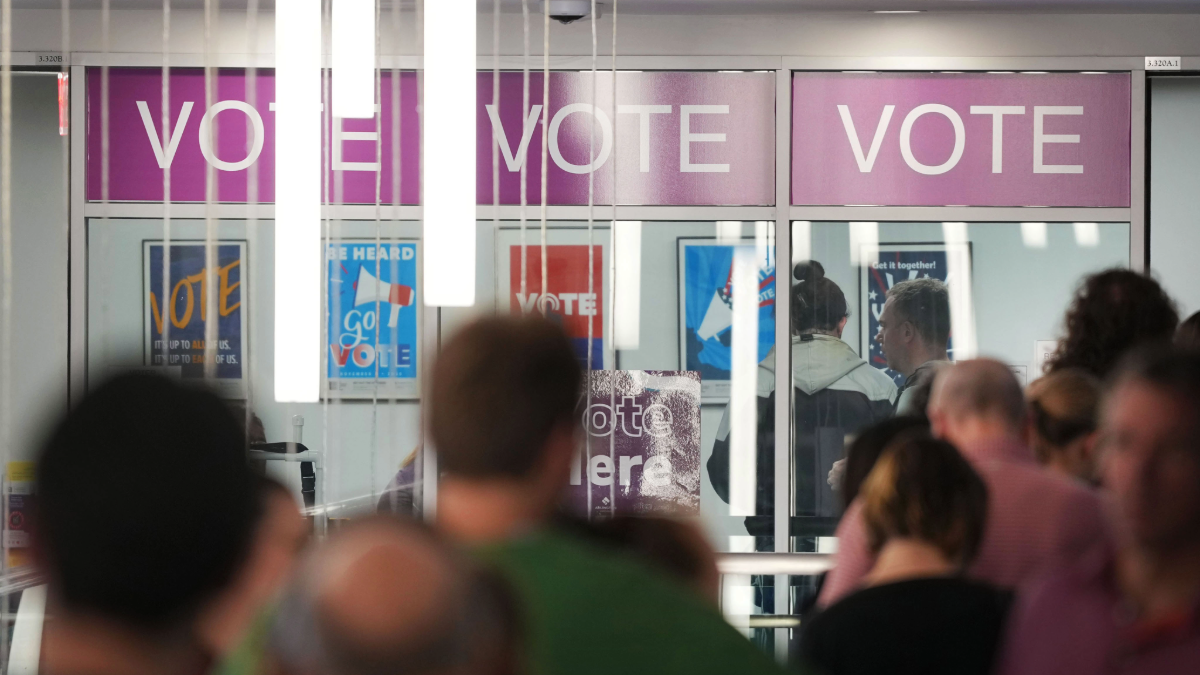
Citizens visit a venue for early voting for the midterm election in Virginia on October 30, 2026. (The Yomiuri Shimbun via AP Images)
Much of the debate about election integrity on social media focuses on harmful claims: what misinformation is spreading, where it’s appearing, how far it travelled, and whether platforms are doing enough to stop it. This approach understandably focuses attention on the content itself and the potential impact on democratic processes.
But the same misleading claim can behave very differently depending on where it appears. A recommendation-driven video feed distributes information differently from a social graph-based network, a private messaging service, or a livestreaming platform. Each gives its users different tools for creating, amplifying, contextualizing, monetizing, and responding to political information.
Election integrity is not only a content policy problem; it’s also a product design problem. Before asking what election-related content a platform should prohibit, election integrity teams should examine the architecture of the product itself. This includes how information moves, how users interact, where authority and credibility lie, and which affordances can be exploited.
A framework for understanding platform affordances
When assessing election integrity risks, it’s important to distinguish between a platform affordance and the harm that may result from its use. An affordance is a capability, opportunity, or constraint created by product design. Five dimensions are particularly relevant to election integrity: distribution, or how information reaches users; content; the formats a product enables; interaction, how users respond to and reshape content; identity, how credibility and accountability are established; and monetization, how attention can become financial support.
These features aren’t harmful by themselves. They shape the incentives, opportunities, and pathways through which harms can emerge. The same affordance can support legitimate political participation in one context while creating an avenue for manipulation in another. Election integrity teams should ask not just what content their policies prohibit, but how political information is created, distributed, and acted upon through the product. Those affordances don’t operate independently. Different combinations produce different platform architectures, concentrating risk, authority, and opportunities for intervention.Various platform architectures create different pathways for political information to spread and therefore require different approaches to election integrity. Three broad models illustrate how architecture redistributes election integrity risk, although many platforms combine elements of each. Recommendation systems can distribute content well beyond established follower networks, making the speed and scale of algorithmic amplification particularly important to detection and response. Social graph systems place greater weight on established accounts and relationships, making networks, influence, and trusted intermediaries more important. Open or federated systems distribute some governance functions across services or moderation layers, creating additional intervention points but also greater challenges for consistency and coordination.
None of these architectures is inherently more or less safe. They redistribute risk, authority, and responsibility. Election integrity programs need to be designed around the architecture they govern rather than assuming that interventions effective on one type of platform will transfer cleanly to another.
Affordances and political context
Affordances also interact with the political and institutional environments in which they sit. A recommendation system can help voters encounter accurate information about how to vote while also amplifying misleading procedural claims. Where election rules vary across jurisdictions, information that’s accurate in one place may be misleading in another. Local threats matter, too. Features that support participation or transparency may create different risks where candidates and election workers face elevated harassment or violence. Platform architecture shapes risk, but electoral rules, institutional trust, political norms, and local threats manifest it.
The 2024 US presidential election demonstrates how the same election integrity problem can be distributed through different platform architectures. On October 31, 2024, a video appearing to show a voting machine in Kentucky switching a vote from Donald Trump to Kamala Harris circulated on TikTok, where it reached 6.1 million views. Election officials investigated and found no evidence of vote switching. The device printed a paper ballot that voters could review before casting their vote, and the voter ultimately submitted a ballot reflecting her intended selections after all. Officials described the episode as isolated and found no other reported problems with the county’s ballot marking devices.
As the video moved across platforms, different affordances shaped its reach and interpretation. On X, influential accounts supplied their own framing. Podcaster and pundit Joe Rogan reposted the clip and asked whether it showed a broken machine or election fraud, drawing millions of views. Versions also circulated on Facebook and Instagram in English and Spanish, including posts presenting the incident as evidence of broader election interference. By November 1, 2024, the allegation had reached Meta’s microblogging service, Threads; with versions later appearing in Portuguese, Greek, German, Vietnamese, and French. The video remained the same, but recommendation systems, influential accounts, and social networks created distinct pathways through which users encountered and interpreted it.
The 2026 US election cycle also shows how new content production affordances can complicate election integrity. In Texas, Republican Senate candidate Ken Paxton released an AI-generated ad depicting Democratic opponent James Talarico reading and writing in a fictional “King James (Talarico) Bible.” The ad used an AI-created likeness of Talarico in a montage combining authentic remarks with missing context and words he had not used. A small disclaimer identified some video content as AI-generated, but the format demonstrates how campaigns can use generative tools to depict opponents saying or doing things that never occurred. The challenge is not only whether synthetic content is disclosed. Realistic looking content can also make authentic political speech harder to distinguish from fabricated media.
Separately, researchers linked an AI-generated disinformation video targeting Talarico to the Russian Storm-1516 influence operation. The original X post attracted little attention until larger verified accounts amplified it 12 hours later. It then received more than 850,000 views. X removed the original, but copies continue to circulate online. Together, these cases illustrate two uses of the same content affordance – domestic political advertising and foreign influence — and demonstrate why election integrity programs must consider both how political content is manufactured and how distribution systems give it reach.
These examples reveal a tension in election integrity work: responses must be tailored to individual platforms, even as threats move between them. Different services can play complementary roles in amplification, coordination, fundraising, private communication, or the circulation of synthetic media. Content may originate in one environment, gain credibility through influential accounts in another, and then be translated, remixed, or moved into less visible spaces. The relevant reference point is often the broader information ecosystem rather than a single platform.
Cross-platform coordination doesn’t require uniform enforcement. Platforms can build shared awareness of emerging narratives, synthetic media, coordinated tactics, or threats while applying different interventions based on their architecture and policies. One service may focus on recommendation or distribution, another on influential accounts or network behavior, and another on provenance or labeling. Shared situational awareness can exist with platform specific thresholds and enforcement choices.
What election integrity programs can do differently
Election integrity programs should respond to these differences in platform architecture in three ways.
First, start with the product, not the policy. Before deciding what content to prohibit or how to enforce against it, trust and safety teams should map how political information moves through the platform. This includes how users discover content, interact with one another, establish credibility, and move between online communities. Policies should respond to the environment the product creates rather than assume the rules that have been developed elsewhere will necessarily transfer cleanly.
Second, build platform-specific threat models. Recommendation, social graph, and open or federated systems create different opportunities for amplification, interaction, coordination, and intervention. Effective election integrity planning should identify which affordances are most susceptible to misuse, how those vulnerabilities interact with the political context, and where the platform has meaningful opportunities to intervene.
Third, treat enforcement as one part of a larger system. Election integrity requires coordination across policy, product, detection, engineering, operations, communications, public policy, and external partnerships. Because election-related activity can move between services, platforms should, where appropriate, share information about emerging threats and tactics with other platforms, election authorities, researchers, and civil society. That coordination should improve collective awareness of the threat environment without assuming that every platform should respond in the same way.
The same principles should guide policymakers and researchers evaluating platform preparedness. The central question shouldn’t simply be, “What misinformation might appear here?” It should be: “What does this product make it unusually easy to do, and unusually difficult to prevent?”
Authors