The Pope Found Babel in AI. Here's What Rabbis Saw
Jules Polonetsky, Omer Tene / Jul 8, 2026Jules Polonetsky and Omer Tene are editors of the Cambridge Handbook of Consumer Privacy.
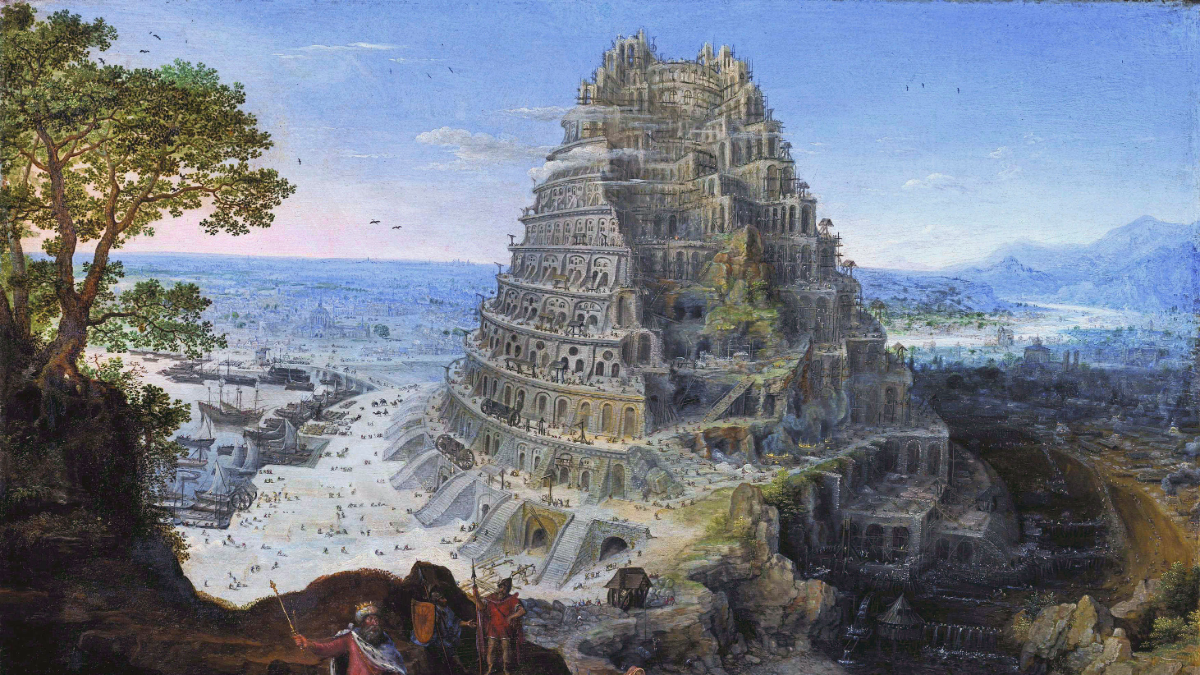
The Tower of Babel by Lucas van Valckenborch, 1595. Wikimedia Commons
The oldest story we have about technology is a cautionary tale. The book of Genesis tells us that in the plain of Shinar, the whole earth had one language and one set of words. The people said to one another: come, let us build a city and a tower with its top in the heavens, and let us make a name for ourselves, lest we be scattered. So they baked bricks and burned them hard, and they began to build. And God came down to see the city and the tower, and confused their speech, so that no one could understand his neighbor. The work stopped. The people scattered. The place was called Babel (Genesis 11:1-9).
Pope Leo XIV reached for that same story in his first encyclical, Magnifica Humanitas, to frame the emergence of artificial intelligence as a choice between two acts of construction: building another Tower of Babel, or rebuilding the walls of Jerusalem alongside Nehemiah. It is a striking choice of metaphor from a new pope who chose his name to echo the church's response to the last great technological rupture, the industrial age, under Pope Leo XIII. Whether or not you share his faith, the metaphor is worth taking seriously, because today’s engineers racing to build artificial general intelligence (“AGI”) are, knowingly or not, building at Shinar again.
But Babel is read differently from inside Judaism than in the Christian frame the Pope brings to it. Read closely, alongside the rabbis who have argued over it for two thousand years, the tale grows sharper and stranger than the commonplace warning against hubris it has become. The rabbis drew multiple lessons from Shinar, and several map precisely onto the dangers we are now again courting.
First, Babel is the story of what happens when people are objectified to achieve a higher goal.
Here the Jewish midrash is sharper than the verses themselves. In Pirkei d'Rabbi Eliezer, the rabbis imagine the tower grown so tall that hauling a single brick to the top took a full year. When a worker fell from the scaffolding and died, no one paused. When a brick fell and shattered, the builders sat down and wept, because a brick would take a year to replace, and a man would not. When the brick matters more than the man, you are building Babel.
That image describes our economy with uncomfortable precision. AI is already reshaping the labor market, automating tasks once done by paralegals, coders, translators, illustrators and entry-level office workers, and the displacement is widely expected to widen as the systems improve. The technology can make firms remarkably productive while treating the people who once did that work as line items to be optimized away. It also describes the harder edges of where this technology could be heading: autonomous weapons that select their own targets, surveillance systems that make privacy a quaint memory, and the live, unresolved fights over how far AI's makers should go in serving the security state. The recent friction between Anthropic and the Pentagon over military uses is a preview of a permanent negotiation: who gets to decide when the apparatus is allowed to break the man for the sake of the brick.
Pope Leo gestures at this as idolatry. Responding to the encyclical, the writer Yuval Levin presses the point further through Psalm 115. It speaks of idols who are made to look human but cannot partake of human life: “they have mouths but cannot speak, eyes but cannot see.” (Psalm 115:5). The Psalm's chilling conclusion is that those who make such idols, and those who trust in them, become like them. That is the real hazard of building an intelligence that shares, or exceeds, human intelligence, but not other essential human traits such as feeling, compassion, empathy, pain and love. We risk teaching ourselves to be the kind of thing we are building, to treat speech as output, judgment as computation and persons as data. The idol does not have to come alive to diminish us. We only have to bow to it.
Second, Babel is a story about the concentration of power.
The builders' stated fear is being “scattered over the face of all the earth,” which is to say, their project is an act of forced centralization, one city, one name, one direction for everyone. The medieval commentator Nachmanides saw this clearly: Babel inverts the original blessing to spread out and fill the earth. The encyclical's alternative, Nehemiah's wall, is its opposite in structure as much as in spirit, not one tower under one name, but many gates, with each family responsible for its own section.
Here too, the Pope’s analogy lands with real force. The capacity to build advanced AI is concentrating with extraordinary speed: in effect, two governments, a half-dozen companies and a handful of individuals now hold most of the compute, capital and talent that will shape the technology, and through it, much of the economy, society and public square. No prior general-purpose technology has had its commanding heights held by so few. A single tower, with everyone's name subordinated to a very small number of names, is not a stable arrangement for a species.
Rabbi Jonathan Sacks (The Dignity of Difference, pp. 51-52) read Babel as the first biblical critique of empire: the attempt to impose one order, one language and one name on human plurality. On that reading, the emergence of distinct nations and tongues is not a curse but rather the moral architecture of creation. Plurality is not what went wrong after Babel; it is what was meant to be in the first place. The scattering, in other words, was not a punishment but a redirection, a refusal to let one order claim the whole future.
The instinct ran so deep it shaped the law itself: in the Sanhedrin, ancient Israel's high court, a unanimous guilty verdict in a capital case acquitted the defendant rather than condemning him (Sanhedrin 17a). A court in which no one dissented was presumed to have stopped thinking, and its certainty was treated as a defect.
Law and democratic institutions, not engineers, should hold final authority over AI. But that authority should make us wary of the dream of a single global framework for AI, one ethical vocabulary, drawn largely from Western values, imposed on a world whose needs and aspirations vary enormously. The priorities for AI in India or across Africa are not Silicon Valley's. Europe is straining to reconcile its rights-driven instincts with the weight of its own regulatory regime. And the United States is in the midst of its own reckoning as accelerationists meet fierce local pushback from communities worried about lost jobs and environmental costs. That AI rules are now forming across jurisdictions, and that the nations, regulators and approaches behind them differ, is not regulatory failure. It may be our last safeguard against any one company, country, or self-annointed priesthood of engineers defining the human future for the rest of us.
Third, Babel is the story of a world that stopped making sense.
And yet plurality carries its own peril, the third and subtlest lesson of Babel. The scattering that protects us from one tower can also tip into something darker: a world so multiplied and complex that it stops making sense. If the sin of Babel was concentration, its punishment was incoherence, the moment shared meaning dissolved, cooperation gave way to chaos and no one could follow what anyone else was saying or building. Before the tower, everyone spoke one language; afterward, no one could understand anyone else. We tend to read this as a divine punishment for our hubris, but it is also a description of what happens when a system grows past the comprehension of the people inside it.
The biblical text says that God acted “so that one man could not understand his neighbor's speech.” The midrash Rashi cites dramatizes what that actually looked like on the scaffolding: one builder would ask his partner for an axe; the partner, hearing the same sounds differently, would hand him a shovel instead (Genesis Rabbah 38:10). The worker, enraged, would attack him. Cooperation dissolves into violence the moment shared meaning is gone. This is the most underrated risk of building machines more capable than ourselves. The danger is not only misalignment, an AGI that pursues goals we never intended. It is also that the institutions, markets and infrastructures such systems design and run could become genuinely unintelligible to us: optimized, efficient, but completely opaque. You cannot explain the bond market to an ant. We are at risk of becoming the ants: living inside structures built for us by intelligences we cannot follow, in a language we no longer share. A world we cannot understand is a world we cannot govern, correct or meaningfully consent to. A world without due process, justice or (humanly legible) reason. The confusion of tongues would not be a curse imposed from above. It would be a side effect of our own ambition .
Pope Leo frames the choice as Babel or Jerusalem. The rabbis read the warning as yielding three lessons. Beware the project that values the brick above the man. Beware the tower that gathers every name into one. And beware the system that grows past our understanding. The builders at Shinar failed on all three counts, and the text has never let us forget it. We are about to learn whether we can build something nearer the heavens than anything before it without repeating their mistake. The oldest story we have already tells us how it goes if we do.
Authors