The Metaverse is Dead. Long Live the Hype.
Martin Wählisch / Nov 18, 2026This post is part of a series on Hype Studies appearing on Tech Policy Press in 2026. More from the series is here.

The Meta Quest 3 mixed reality headset demonstrated at the Fira Gran Via during the Mobile World Congress (MWC) in Barcelona, Spain, on March 5, 2026. (Photo by Joan Cros/NurPhoto via AP)
Every few years, the immersive computing field holds a funeral for itself and returns under a fancier name. Virtual reality (VR) gave way in the headlines to “virtual worlds.” Virtual worlds were later folded into “the metaverse.” The metaverse is now being disassembled into spatial computing, digital twins, augmented reality (AR), extended reality (XR), AI-generated worlds, and smart glasses.
This does not mean that each label describes the same technology. VR creates simulated environments, AR overlays digital information on physical surroundings, XR encompasses a broader range of immersive technologies, and the term virtual worlds describes distinct shared digital spaces. The metaverse promised to combine them into a persistent, social, interoperable, and economically significant whole, but is now going out of fashion.
The term’s vagueness made it useful similarly to the uncontroversial ‘thingness’ of AI, which is actually part of its usefulness and outlives its past popularity. It bundles headsets, real-time 3D engines, avatars, digital property, workplace software, gaming, and creator economies into one investable future. Many actors could recognize their interests in it. And now, when the promise becomes harder to defend because of declining interest and attention, the same flexibility makes retreat easy.
Rebranding helps sustain technological hype. It allows organizations to renew promises and attract support while carrying forward expertise, investments, and ambitions built under earlier labels. Who checks whether the earlier promises were kept?
The word is not the thing
The metaverse story is often narrated as a single bubble that began when Facebook renamed itself Meta in 2021 and ended when generative AI captured public attention, but earlier virtual-world projects had already followed a similar course.
In 2007, Gartner, the technology research and advisory firm behind the influential “Hype Cycle” framework, predicted that by the end of 2011, 80 percent of active internet users and Fortune 500 companies would have a presence in a virtual world. That future did not arrive. But Second Life, a shared online world where users interact through avatars and create and trade digital goods, did not disappear. At its twentieth anniversary in 2023, its operator reported roughly 750,000 monthly active users and a functioning creator economy. The prediction failed in scale, but not in every detail. Gartner overestimated how widely virtual worlds would be adopted, yet Second Life showed that they could sustain communities and a functioning economy. Is the metaverse irresistibly resilient, despite losing the glamor of hype?
The next revival began with the Oculus Rift, a virtual reality headset designed for immersive gaming, which raised $2.4 million on Kickstarter in 2012. Facebook bought Oculus for about $2 billion in 2014, calling virtual reality a candidate for the next social and communications platform. Seven years later in 2021, Facebook, Inc. changed its parent company name to Meta Platforms, Inc. and a field of older technologies acquired a new center of gravity — the hype about the metaverse at its peak! It was like when parents name their kids after promising football players, or after the most prominent political leaders.
The most important ingredient of success is to make a new label gain force through repetition. Hype gathers momentum as the same promise is repeated across industries, public institutions, and everyday conversations, from local settings to global debates. We saw a similar inflation when the term “metaverse” became a corporate buzzword and even a slogan connected to world peace at the United Nations — a turn of events probably beyond Neal Stephenson’s imagination when he originally coined the term in his 1992 sci-fi novel Snow Crash.
This is why hype is more than an inaccurate forecast. Scholarship on the sociology of expectations shows that promises can persuade organizations to commit money and staff. Shared expectations attract allies, legitimize spending, and define new professional roles. Between 2021 and 2023, the expectation of an imminent metaverse helped redirect corporate investment, attract developers and shape discussions about the future of the internet.
As Andreu Belsunces Gonçalves and Jascha Bareis argue in the opening article of this series, hype is political: it shapes whose visions of the future gain support and whose interests they serve. The emerging field of Critical Hype Studies similarly examines how hype makes certain futures appear possible and worthy of funding while narrowing the space for alternatives. What happens to that power of hype when prominence loses credibility? Rebranding can give existing projects renewed access to attention, money, and political support without requiring their backers to account for earlier promises. I think this is why hype investigations require following those actors and commitments across successive labels, even after public attention has moved on.

Buzz Aldrin, left, and Erisa Hines of NASA’s Jet Propulsion Laboratory try Microsoft HoloLens at the Kennedy Space Center, Sept. 18, 2016. Photo: NASA/Charles Babir. Public domain via Wikimedia Commons.
A hype coalition goes global
The metaverse boom did not remain a Silicon Valley story. South Korea adopted a pan-government strategy to build platforms, talent, firms, and ethical principles in 2022. That same year, China set a goal of selling more than 25 million virtual reality terminals and an industry worth more than 350 billion yuan by 2026, then described the metaverse as a new growth pole for the digital economy. In 2023, the European Commission made virtual worlds part of its Web 4.0 strategy.
An OECD review published in 2026 identified 53 immersive-technology policies across 23 countries and the European Union. About 70 percent had been introduced since 2020. Most sought to accelerate research, commercialization, or adoption. Few directly addressed privacy and digital security risks, particularly where immersive systems draw inferences from behavioral or biometric data.
The world did not merely talk about the metaverse; it organized around it. Governments set aside funding for research and business development, making virtual worlds a priority in their technology strategies. Companies acquired specialist teams and intellectual property, including patents and software. Researchers built careers and programs around questions of immersive interaction, virtual economies, and digital identity. Standards bodies began working on common technical rules so that devices and services could work together. These are the material deposits of hype: funding, teams, and technical standards can survive a change of name.
Immersive technology policy
Most government policies on immersive tech promote it. Few address its risks.
An OECD review published Feb. 6, 2026, catalogued 53 national and sub-national policies on virtual reality, augmented reality, digital twins and virtual worlds across 23 countries and the European Union. About two-thirds of them, 36, date from 2020 or later. Each flag below links to the policy.
Policies by year announced or enacted
Each flag is one policy and links to its sourceGuidance or principles2020 or laterFirst column: 1977 and 1997
Show all 53 policies with links to each
Filter the list
- 2022
- 2020
- 2010
- 2017
- 2022
- 2022
- 2023
- 2023
- 2021
- 2023
- 2024
- 2023
- 1997
- 2013
- 2016
- 2019
- 2020
- 2020
- 2015
- 2023
- 2025
- 2023
- 2016
- 2021
- 2020
- 2021
- 2024
- 2017
- 2024
- 2019
- 2020
- 2021
- 2021
- 2022
- 2022
- 2023
- 2024
- 2021
- 2021
- 2021
- 2022
- 2022
- 2022
- 2010
- 2012
- 2019
- 2024
- 2022
- 2013
- 2018
- 2018
- 1977
- 2022
How to read this
Policies, names and years are as listed in Annex A of the OECD report; years are when each policy was announced or enacted. Some are broad programs, such as the CHIPS and Science Act or Horizon Europe, that the OECD included because they name immersive technologies. The OECD sorts policies into five approaches but does not assign each one in the annex; this chart marks only the three it identifies as guidance or policy principles. The report's Table 1 also tallies two French initiatives under France 2030 that are not in the annex's list of 53; they are not shown here.
Each policy links to the source the OECD cited, checked Nov. 17, 2026. Where that page was offline or blocked, the link goes to an archived copy on the Internet Archive's Wayback Machine or, for Malaysia, to the official PDF.
Source: OECD, “An overview of national strategies and policies for immersive technologies,” OECD Digital Economy Papers, Feb. 6, 2026 (Annex A; PDF). Flag images: flag-icons (MIT License).
Graphic: Tech Policy Press
The rebrand is already here
However, despite the seemingly fairytale romance of the real world with the metaverse, the corporate numbers made the burst of the bubble hard to ignore. Meta’s Reality Labs recorded more than $53 billion in operating losses from 2023 through 2025. In Q3 2026, it reported an operating loss of $4.13 billion on $443 million in revenue.
And despite those financial losses, Meta’s 2025 annual filing did not indicate an orderly withdrawal, but rather a change of direction of the product line. Meta said that roughly 70 percent of the Reality Labs operating expenses in 2026 would support the development of wearables, with the remaining 30 percent supporting virtual reality and Horizon. And in October this year, Meta debuted new no-camera smart glasses and virtual reality spectacles that will hit the global market in spring 2027. As Meta promises, this would “define a new era for virtual reality” with the “most advanced device yet, delivering a cinema, courtside seat, workspace, and console, all in a pair of glasses that weigh about 100 grams.”
Other technology could not help but follow the hype. In 2023, Apple introduced the Vision Pro as its first “spatial computer,” not as a portal to the metaverse but like a big technology brother to it. In 2024, Google said Android XR would bring headsets and glasses into the “Gemini era” — again, maybe just a semantic branding nuance. While Apple recast immersive hardware as personal computing. Google explicitly attached XR to the ascendant story of generative AI.
This type of rebranding to maintain technology hype performs a strategic function: changing the benchmark makes an earlier promise harder to audit. It creates distance from disappointed expectations, connects existing technologies to a rising narrative, renews media coverage and market interest, and resets the benchmark against which future performance will be judged.
Meanwhile, virtual worlds continue to expand without waiting for the declaration of a universal metaverse. The game Roblox reported an average of 144 million daily active users in the fourth quarter of 2025 and said it was using AI to accelerate content creation and support richer, larger-scale worlds. Business insiders estimate that the AR and VR market will increase by 34.69% from $30.26 billion in 2025 to $441.51 billion in 2034. This makes the reincarnation of this hype irresistible.
The underlying geography and infrastructure is also durable, which might explain why the hype is resilient against past and future shocks. A 2026 European Commission Joint Research Centre study mapped more than 68,000 firms, research institutions, and public bodies engaged in activities related to virtual worlds. It found a landscape marked by Chinese scale, US ownership and venture capital, and strong European research paired with weaker commercialization.
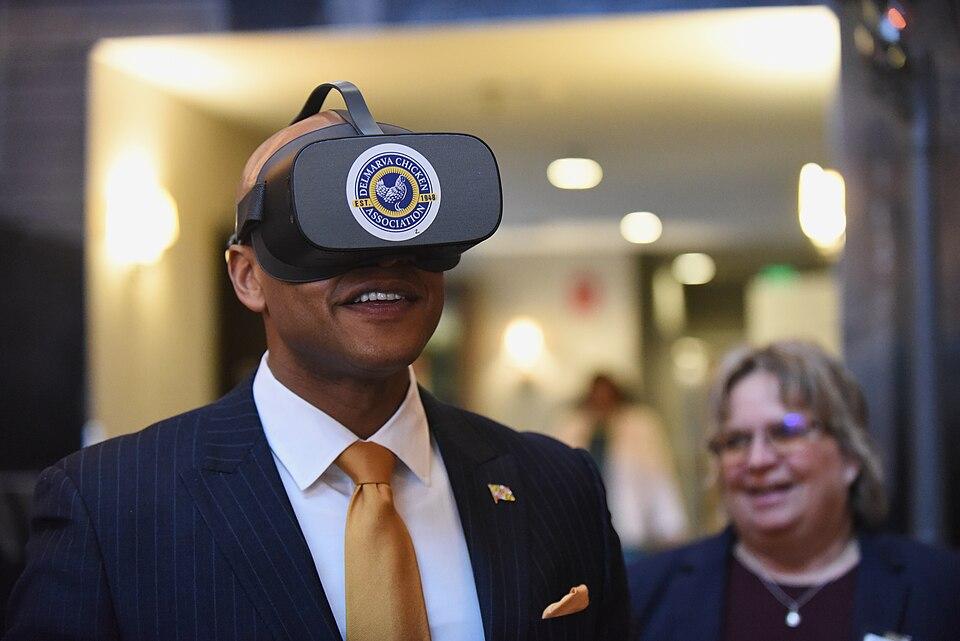
A virtual-reality demonstration at the Delmarva Chicken Association’s Chicken Day in Annapolis, 2023. Photo: Patrick Siebert/Maryland GovPics, CC by 2.0 via Wikimedia Commons.
Follow the residue of hype
Pronouncing the metaverse dead accurately describes its marketing trajectory but misrepresents its surrounding policy and techno-social landscape. Indeed, a name can collapse, while its budgets, labor arrangements, and concentrations of power continue. The funeral may even be useful, as it clears narrative debt and lets actors present inherited projects from the graveyard as fresh beginnings. But true hypes come with a nostalgic and recurrent force that does not disappear easily.
What remains is an accountability problem, particularly when viewed through the political economy of technological hype. In his account of the political economy of hype, cultural studies scholar Maxim Tvorun-Dunn argues that investors can profit from waves of technological enthusiasm even when the promised benefits never arrive. Rebranding adds another mechanism to this picture, as organizations can carry investments and influence into a new wave of hype while distancing themselves from the commitments that justified the previous one.
Surely, not every change in terminology is cynical or cosmetic. New language can reflect genuine technical developments. But the accountability problem begins when claims of novelty obscure inherited investments, unresolved risks, or promises that were never evaluated.
Funders should keep track of what earlier programs promised and delivered: What initiative did this one replace? Which original objectives were met? How much was spent? Which assets, contracts, and standards moved forward? Risk assessments should attach to capabilities such as gaze tracking, spatial mapping, persistent identity, and embodied interaction, regardless of the label used to sell them.
Hype is a way of organizing power in the present through stories about the future. The metaverse is dead only if we mistake a brand for a technological field and a headline for an institution. Many of its components are still here, increasingly presented through the language of spatial computing, wearables, and AI. Long live the metaverse! It has already learned to answer to another name.

Read other aticles in this series
Authors