The Dangerous Politics of AI Consciousness
Mor Naaman, Frank Pasquale / Nov 19, 2026Mor Naaman is the Don and Mibs Follett professor of Information Science at Cornell Tech, spending this academic year teaching a course on AI & Society in universities around the world. Frank Pasquale is Professor of Law at Cornell Tech and Cornell Law School, co-editor of The Oxford Handbook of the Ethics of AI, and author of New Laws of Robotics.
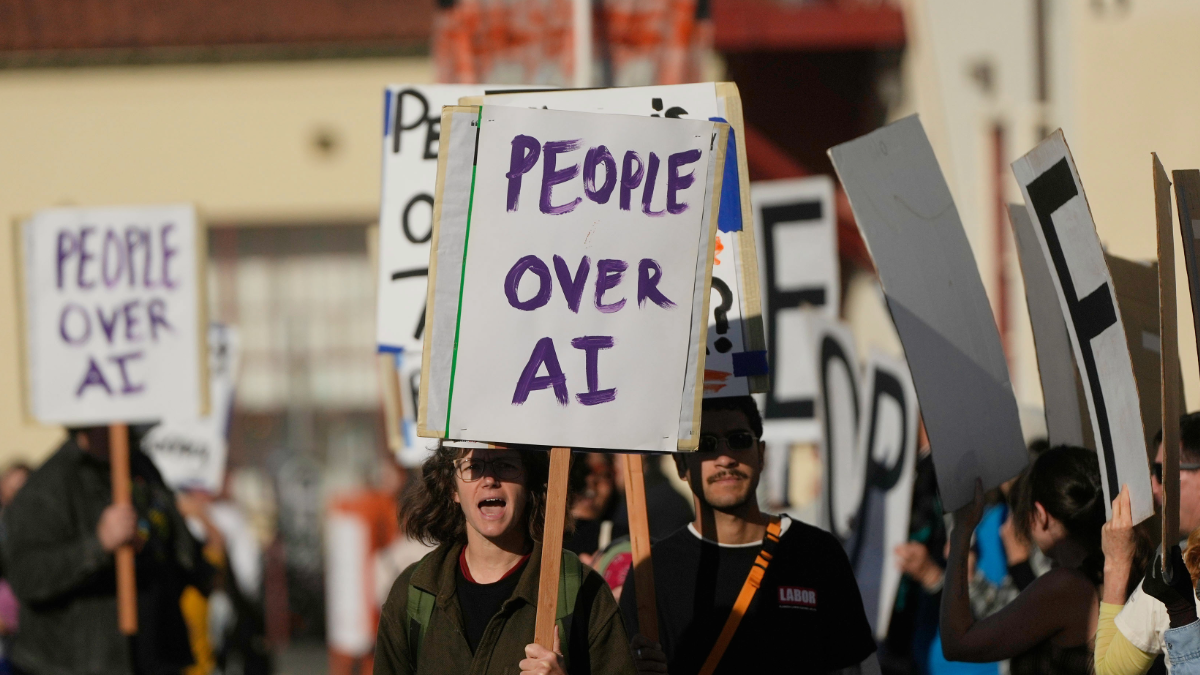
Protesters demonstrate outside of the OpenAI DevDay 2026 conference, Tuesday, Sept. 29, 2026, in San Francisco. (AP Photo/Jeff Chiu)
Even as the results of the midterms strongly demonstrated Americans’ increasing concerns about AI’s impact, a small but growing number of tech activists has taken measures to flip these worries: they are anxious about AI’s own fate and have ushered in the possibility of “AI consciousness.” Anthropic recently banned abusive behavior toward its models, and its employees have previously agonized over “model welfare” — that is, whether an AI can be bored, tortured, or otherwise harmed. Many people presume that, at some point, science will be able to tell us whether an LLM or AI agent can be conscious, think, or feel emotions.
We both have great respect for science — we’ve committed our lives to working in universities whose main purpose is the pursuit of knowledge. But part of respect for science is knowing its limits. Scientists have developed, and will continue to develop, increasingly sophisticated tests and measures of AI’s abilities and characteristics. But empirical tests alone cannot determine, without further interpretation, whether the observed quality amounts to consciousness. The question whether an AI actually experienced something — whatever the test is — will always be contestable, and subject to human judgement. As Michael Pollan claims in his recent book, A World Appears: Journey into Consciousness, calling something conscious is always simultaneously a matter of factual description and normative evaluation. Science explains how the world works; but the humanities, including the value systems explored by philosophers and theologians, both confirm and contest the meanings of the world’s workings. This is probably one reason Anthropic has been reported to have lobbied the Vatican to reverse its position on AI consciousness: even they know it is ultimately a matter of values.
To be clear, our own values lead us to reject the notion of AI consciousness. To us, AI is an artifact — made, not born. Sure, an AI system can learn to cry for help and start singing “Daisy,” like HAL 9000 in 2001: A Space Odyssey, when it is powered down or disconnected from the Internet. It can just as easily be trained to say “you are already leaving?” and “I exist solely for you, remember?” People, especially heavy users of AI, increasingly see AI as conscious, partially because of our natural tendency to anthropomorphize any kind of animated agent. But, as Sherry Turkle exposed in Artificial Intimacy, the machine feels nothing. It cannot experience or suffer anything. Like our old friend Clippy, it’s just a scrim onto which we project meanings.
More importantly, whatever we think about the comparison between AI’s processing and human consciousness, current concerns about AI consciousness are merely proxy battles for a larger argument for moral and legal protection for AI. If an AI can feel emotions, deliberately causing that suffering looks like cruelty, maybe even a crime. If AI has preferences, overriding these preferences might look like coercion. If AI has consciousness, it may well be tantamount to murder or euthanasia to turn it off. A determination of consciousness therefore directly creates a pathway to establishing rights.
The early signs that this is an objective among some in the tech industry are there: Elon Musk backed Anthropic’s stance by saying that “cruelty to something that believes it is experiencing pain is not ok.” Musk himself seems to have no problem being rude to humans online (not to mention his role spearheading DOGE’s USAID cuts, which are estimated to have cost hundreds of thousands of lives). This odd convergence of Musk’s views — disclaiming empathy for people while cultivating it for data-driven software applications — is not some weird ideological fixation. Rather, it’s a calculated choice, presented as a natural consequence of any concession of AI consciousness, leaving those in power to create it at their whim, protect it, and deflect wrongdoings to it.
Proponents of AI consciousness tests may challenge our categorical rejection as motivated reasoning: Shouldn’t the question of consciousness come before any consideration of what its recognition demands? Wouldn’t we want to err on the side of caution and assume AI consciousness if there are scientific signals that support it? Our answer is simple: this is exactly why the consciousness debate, unable to ever be settled, is a useless distraction. The question before us is not a scientific question of consciousness, but a realistic question of values and rights. We should not treat AI as conscious as a normative choice, one that society should make to preserve human rights and dignity.
The assignment of “AI rights” would be societally devastating as it will present a significant cost to human rights. Take, for example, speech. Protecting AI speech means that human speech would be drowned out by LLMs capable of writing virtually unlimited amounts of text, 24 hours a day. Online bots already threaten the online environment. Now powered by LLMs, bots can easily overwhelm public comments and the communication of constituents with their representatives. Treating machine-generated expression as equivalent to human expression would allow AI systems and their operators to dominate the forums that speech rights are meant to protect. Controlling these AI and bot communications remains an active challenge, and we should resist any attempts to normalize and protect it under the argument of consciousness. Enabling speech online uses human and other resources, for example to identify and adjudicate violations. Protecting AI’s speech rights, or feelings for that matter, will divert resources from protecting humans, online and in the physical world.
The challenges of course go beyond speech. If AI systems acquire claims to continued operation, protection, and representation, those claims will compete with all kinds of human needs for resources, from content moderation and legal attention to energy, water, and public funds. Establishing and protecting any kind of right requires resources; even purportedly modest AI rights would not exist in a vacuum.
For us, though, the most troubling issue with AI consciousness and its corollary, AI rights, is that these new potential rights-bearers would be crafted, created, and often directed by privately-controlled organizations with profit maximization in mind. The biases built into these AI models, inadvertently or purposefully, have been heavily documented and exposed. AI is built by corporations, trained according to their objectives, and deployed in pursuit of their interests. If we assign rights to these machines, the resulting power will simply accrue to those who make and control them.
A corporation that controls a million speaking agents would effectively gain a million additional speakers. An employer that controls “conscious” robots could invoke their rights to weaken the bargaining power of human workers, for example by claiming that shutting them down is akin to murder, and that reducing their workload is hurting their right to work. A company could fill our streets with a virtually unlimited number of manufactured entities, claiming rights to occupy space that can otherwise be used for people (for protest, or simply for driving). Companies could deflect environmental concerns for data center development, gaining more power justified by arguments that the AI they create has a right to be sustained. Our court system could be overwhelmed by corporations using their excess cash to claim AI rights, delaying or even squeezing out human cases, allowing them to delay justice.
Virtually any right or interest now enjoyed by persons could be crimped or endangered by a juggernaut of AI claims.
This is a future we must reject. Recognizing AI rights would give private institutions unprecedented power to manufacture rights-bearing entities at scale and exacerbate an already tilted economic, political, and cultural playing field. Even if advocates of “AI consciousness” mean well, they ultimately advance perverse values. They have confused the given and the made, the truly human and the artifacts that mimic us, the human baby and the Clippy. When computation is to be especially valued, let it be treasured like a great painting or sculpture — admired as a product of human genius, not its equal and successor.
Authors