Tech Companies Must End Complicity in Online Repression of Mongolian Culture
Erika Nguyen / Apr 2, 2026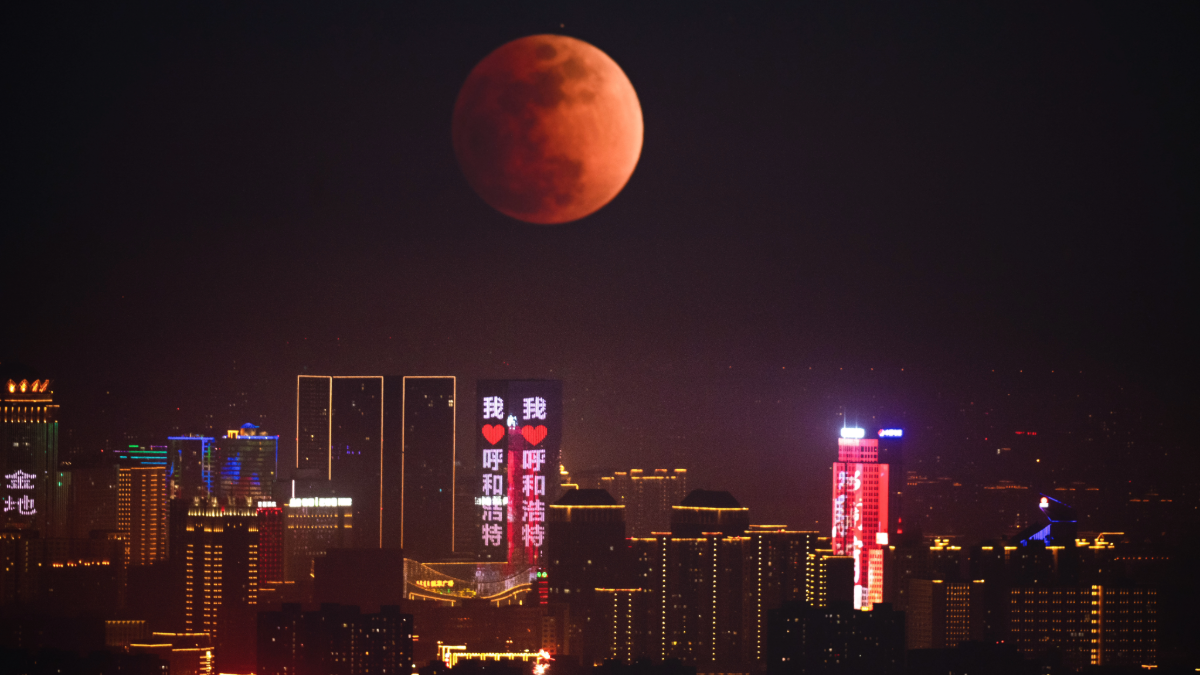
HOHHOT, CHINA: A blood moon lights up the night sky during a total lunar eclipse on March 3, 2026 in the Inner Mongolia Autonomous Region of China. (Photo by Wang Xiaobo/VCG via AP)
For decades, the Chinese government has curated how the world sees Mongolian culture—packaging it as colorful, compliant, and “traditional.” But this carefully managed image erases what is actually happening—the systematic destruction of a once-vibrant digital ecosystem where Mongolian language, culture, and dissent flourished beyond state control.
The reality of life for Mongolians living in China, largely in the autonomous region known as Inner Mongolia, is a brutal and uncompromising repression of their voices—both on and offline. This repression should be setting off alarm bells around the world because of the precedent it sets about the harassment and surveillance of people who speak out against the government. It also reaches into Mongolian communities living outside of China.
As technology advanced globally, digital communities became essential hubs for Mongolians to communicate, preserve their language, and create new music and art. This dynamic and creative use of technology to support a minority culture was at odds with the Chinese government’s desire for uniformity and control.
But new research from PEN America’s Freedom to Write Center shows that nearly 89% of known Mongolian-language websites have either been shut down, restricted, or converted into Mandarin Chinese, with all mentions of Mongolian culture removed or sanitized to fit the China-approved narrative.
Taking the eradication further, more than 200 songs in Mongolian have been removed from online music libraries—including protest songs about the death of a Mongolian herdsman who was killed while defending his land from a Chinese mining company. The end result is that more than six million people are having their language ripped away from them.
Tech companies are complicit. There are several documented examples of how US companies have apparently helped power and enable the repression of free expression and culture in China, from companies like Microsoft pre-emptively censoring search results in order to operate in China, to cloud hosting company Vultr carrying out Tencent's request to shut down GreatFire.org, which uses AI to track censorship. Additionally, multiple US companies like IBM and Dell have enabled the spread of the surveillance infrastructure that has targeted minorities in China. By caving to state pressure, tech companies become willing enforcers of Chinese state narratives and human rights violations, not only in China but across the world as well.
All of this amounts to a blatant violation of Mongolians’ rights to free expression, language, and identity, and it shows what could happen the world over if private tech and social media companies continue to cave to government demands.
The erasure of Mongolian culture online was accompanied by the censorship of online dissent and the surveillance of activists and writers. These tactics aggressively ramped up in 2020 following protests about a new education policy replacing Mongolian with Mandarin Chinese in schools.
Posts against the policy were taken down and their creators targeted with “re-education” and forced to post retraction statements. Mongolians also used social media messaging apps WeChat and Bainuu to organize protests leading to an almost immediate and uncompromising shut down of communications.
Chinese authorities shut down messaging app Bainuu, first disabling chat groups, then wiping timelines and walls. WeChat, group discussions and online meetings were also disabled, and other, less popular platforms were blocked outright. On September 2, 2020, the government shut down the internet in cities that were major flashpoints for the protests, including the regional capital Hohhot.
Digital technology has long allowed for dynamic responses to government repression. You only need to look at what is happening in the United States at the moment to see the importance of digital communication to protest movements. Shutting down the internet, therefore, comes directly from an authoritarian playbook when it comes to quashing dissent.
Along with the mass shut-downs, people seeking to preserve Mongolian culture are being surveilled, harassed, and subjected to “re-education” by Chinese authorities. Mongolians living outside China also told PEN America they had taken down Mongolian-related content out of fear for their family still living in the region after they were “visited” by authorities.
This tight control—accompanied by broad laws that allow the Chinese government to criminalize a plethora of online speech—continued past the 2020 protests and is still present to this day. There is also strict government control over apps and websites, which means that any developers not meeting exacting standards will be shut down. These controls include registering with the government, getting approval before launch, and gathering data on users—who are required to register accounts under their full names.
Governments turn to cultural repression online to suppress dissent and stifle free expression precisely because digital spaces are now an essential part of allowing culture to thrive; this is especially true for minority cultures like that of Mongolians living in China.
Now more than ever, tech companies should be creating online environments where people can communicate safely and securely, and philanthropic funders and governments should be investing in internet freedom. This means refusing to comply with politically motivated takedown requests and rejecting any controls that are designed to suppress cultural freedom.
Authors