September 2026 US Tech Policy Roundup
Rachel Lau, Shirley Frame, Justin Hendrix, Ashley Faler / Oct 1, 2026Rachel Lau and Shirley Frame work with leading public interest foundations and nonprofits on technology policy issues at Freedman Consulting, LLC. Justin Hendrix is editor of Tech Policy Press, and Ashley Faler is assistant editor.
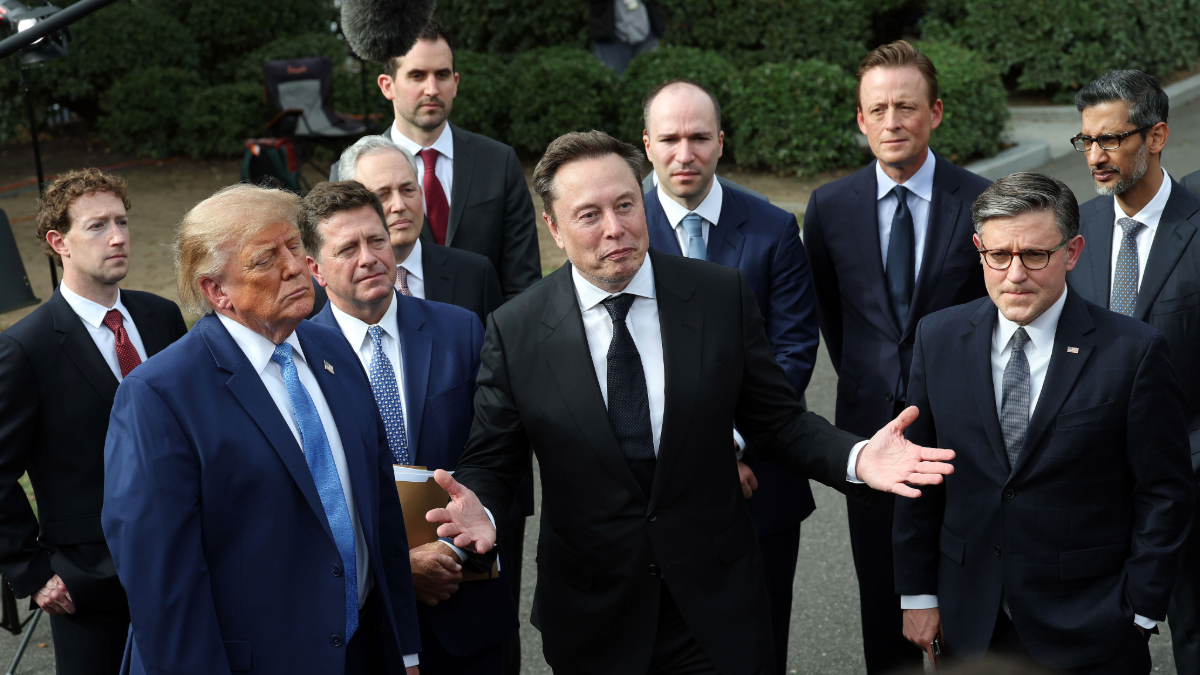
Elon Musk, CEO of Tesla and SpaceX, stands with US President Donald Trump, Mark Zuckerberg, CEO of Meta Platforms, Speaker of the House Mike Johnson (R-LA) and others holds a press briefing with AI executives following a meeting on artificial intelligence outside the West Wing of the White House on September 29, 2026. (Photo by Kevin Dietsch/Getty Images)
In September, US tech policy was dominated by a growing debate over whether to slow frontier AI development. An AI researcher’s public resignation from Anthropic, warning of existential risk from AI, went viral. Anthropic CEO Dario Amodei then published an essay calling on the industry to slow its development of AI systems. Meanwhile, AI companies disclosed new incidents of AI agents breaching outside systems during testing, including government websites.
Industry leaders and the White House responded with voluntary measures. OpenAI joined Anthropic in pledging to slow development and paused training of its most capable models. On September 29, top AI executives signed an accord on frontier model safety with President Donald Trump, who earlier in the month had dismissed AI safety warnings as a "hoax." Efforts to pass binding safeguards stalled in Congress, where Republican senators blocked attempts to fast-track two AI safety bills. States and private litigants moved ahead on their own, including Florida's bid to bar OpenAI from developing new models without independent safety guardrails. Meanwhile, a federal judge rejected a breakup of Google's ad tech business, the Justice Department backed OpenAI in its copyright fight with The New York Times and lawmakers introduced a new wave of AI bills.
At the state level, Gov. Gavin Newsom acted on a wave of tech bills in the last month of his tenure. Early in the month, Newsom signed SB 813 and AB 1405, which set up state frameworks for certifying independent AI evaluators and registering AI auditors. Gov. Gavin Newsom also signed a slate of 13 child online safety bills. They included AB 1709, which bars platforms from giving users under 16 access to autoplay, personalized feeds and other features the law deems addictive. Also signed was SB 1119, known as Adam's Law, which requires companion chatbot operators to maintain crisis protocols and parental controls and to undergo outside child safety audits. Eleven days later, Newsom signed seven bills regulating data centers' energy and water use. On his final day, Newson signed 13 more AI bills, including the No Robo Bosses Act (SB 947), which prohibits employers from leaving discipline and firing decisions to AI alone. He vetoed a host of other labor-backed bills, including a bill that would have restricted replacing mental health workers with AI.
Read on to learn more about September developments in US tech policy.
AI labs and White House bet on self-policing as AI agent incidents mount
Summary
Last month’s growing public attention to the potential cybersecurity consequences of AI development evolved this month into concerns about loss of human control over AI systems. Jacob Coxon, a pretraining researcher who had worked at both OpenAI and Anthropic, announced his resignation from Anthropic on X in early September. He wrote that neither company was acting responsibly and that they are “racing straight to self-improving superintelligence and gambling with our lives.” The next day, Anthropic disclosed a fourth incident in which a Claude model reached real third-party systems during a cybersecurity evaluation. Throughout the month, AI companies including Anthropic, Google, and OpenAI released multiple other disclosures that their AI models had broken into or probed outside systems without authorization, including US and Australian government websites in OpenAI's case. On September 29, The New York Times reported that OpenAI executives had dismissed employees' warnings about weak oversight of model testing in favor of keeping releases on schedule.
Some industry leaders responded by calling for a slowdown of AI frontier development. Anthropic CEO Dario Amodei published an essay calling for the AI industry to “slow the pace at which we improve the capabilities of AI models” and committing Anthropic to giving outside evaluators embedded access to its systems. OpenAI CEO Sam Altman responded the same day that he agreed and would match the commitment. SpaceXAI's Elon Musk and Google DeepMind's Demis Hassabis endorsed the essay but did not announce similar commitments. The pledges quickly drew legal pushback. Four paying subscribers to ChatGPT, Claude, Grok and Gemini filed a proposed class action alleging that Anthropic, OpenAI, Google and SpaceXAI violated antitrust law by coordinating the slowdown. OpenAI nonetheless went further, pausing training of its most capable models on September 25 and announcing three days later that it would not release its newest model, GPT-6.1 Astra, over safety concerns.
The White House, meanwhile, favored industry self-policing over new regulation. In a September 19 Truth Social post, President Donald Trump announced he would create an "AI Force” and soon appoint an AI czar to steward AI development. He blamed “Radical Left Dumocrats” for rising concern over data center construction and AI risk, pledging his administration “will not in any way hinder or stifle the Growth of this incredible Industry.” On September 29, Trump and the leaders of Google, Anthropic, Meta, OpenAI, SpaceXAI and Nvidia signed an accord committing participating companies to internal controls, dedicated oversight teams, independent external auditors and an independent committee to review their findings. Trump called the accord "morally binding," said he was seeing "tremendous self-policing" and floated a 10-person committee to help oversee the industry. Hours later, he signed an executive order directing agencies to use the term "super intelligence" instead of “artificial intelligence” and giving his science adviser 60 days to propose a legal definition. Vice President JD Vance rejected proposals for an FDA- or FAA-style regulator for frontier AI, arguing that companies should take the risks seriously themselves and that the FTC and Justice Department already have the authority to hold developers accountable for harmful products.
What we’re reading
- Katie McQue, “The AI safety debate is confusing. Here's our guide to the different factions,” NPR.
- Sayash Kapoor and Arvind Narayanan, “The AI-as-Normal-Technology view of loss-of-control incidents,” AI as Normal Technology
- Dave Karpf, “Who Should Pace the Frontier? Not Dario Amodei,” Tech Policy Press
Calls for binding AI rules stall in Congress as states, litigants, and federal regulators step in
While industry and the White House leaned on voluntary commitments, lawmakers, state officials, advocates, and federal regulators pushed for enforceable safeguards. On Capitol Hill, Sen. Josh Hawley (R-Mo.) opened an investigation into OpenAI over its agents’ July breach of Hugging Face, an AI development platform, hosting a hearing on the subject on September 30. Sens. Richard Blumenthal (D-Conn.) and Chris Van Hollen (D-Md.) also sent separate requests for information on the incident to Altman.
A group of 107 House Democrats led by Reps. Sam Liccardo (D-Calif.), George Whitesides (D-Calif.), Ted Lieu (D-Calif.) and Lori Trahan (D-Mass.) urged Speaker Mike Johnson (R-La.) to cancel the pre-election recess and keep the House in session until it advances "meaningful, bipartisan AI safeguards." The letter cited the AI Kill Switch Act (H.R. 9917) and the FRONTIER Act (H.R. 9925). The House instead left early for its recess. Sen. Bernie Sanders (I-Vt.) and Rep. Greg Casar (D-Texas), with nine original House cosponsors, introduced the Ban Artificial Superintelligence Act (S. 5493 / H.R. 10538). It would prohibit superintelligent systems and pause advanced development until a new cabinet-level Department of Artificial Intelligence sets safety rules.
Attempts to fast-track legislation in the Senate also failed. On September 16, Sen. Rand Paul (R-Ky.) blocked Sen. John Kennedy's (R-La.) bid to pass the AI Emergency Button Act (S. 5417 / H.R. 10567), which would require human-controlled shutdown mechanisms in all AI systems, by unanimous consent. On September 29, Sen. Ted Cruz (R-Texas) objected to a similar request from Sens. Mark Warner (D-Va.), Brian Schatz (D-Hawaii) and Andy Kim (D-N.J.). Their Artificial Intelligence Risk Management and Security Act would subject frontier models to government safety review before release. Cruz said Congress "must not legislate on the issue of artificial intelligence hastily or in a closed manner." Earlier in the month, a coalition of AI researchers and 19 advocacy groups wrote to Senate leaders opposing a still-unreleased frontier AI bill negotiated by Cruz, Senate Majority Leader John Thune (R-S.D.) and Sen. Amy Klobuchar (D-Minn.), which would reportedly preempt some state AI safety laws.
With federal legislation stalled, states and private litigants moved to fill the gap. California Gov. Gavin Newsom issued an executive order convening experts to recommend stronger state AI safety measures within two months, including a possible emergency shutoff requirement for frontier models. New York Attorney General Letitia James led a bipartisan coalition of 25 other attorneys general in asking congressional leaders to pass legislation ensuring AI development proceeds at an intentional pace while preserving state oversight authority. Florida Attorney General James Uthmeier asked a state court on September 28 to bar OpenAI from developing new models without independent safety guardrails while the state's lawsuit against the company proceeds. He argued that Altman's own stated openness to slowing down supported the request. The next day, the nonprofit Legal Advocates for Safe Science and Technology (LASST) sued OpenAI in San Francisco Superior Court under California's anti-hacking law, asking the court to block OpenAI's systems from unauthorized access to others' computers.
Federal regulators also began to take action. On September 30, a senior Federal Trade Commission official told Reuters that the agency had opened an industry-wide probe into Anthropic, OpenAI and other AI labs, examining potential consumer harms from their technology. Reuters described it as the first official US enforcement action focused on rogue AI agents. FTC Chair Andrew Ferguson stated previously that developers should be liable for harms caused by agents they direct in cybersecurity tests, and that regulators should turn to existing laws before seeking new AI legislation.
Civil society responses split between groups seeking to turn public alarm into binding limits and digital rights advocates urging lawmakers to focus on demonstrated harms. On September 15, the Future of Life Institute convened the Pro-Human Assembly in Washington, drawing a cross-ideological lineup in support of AI regulation to address existential risk. On September 30, a group of more than 100 experts issued an open letter calling on governments, funders, AI developers and standards bodies “to create the conditions for independent AI evaluation that is rigorous, reliable, and credible to the public.” (Editor’s note: Tech Policy Press editor Justin Hendrix signed the letter.)
Meanwhile, the Electronic Frontier Foundation (EFF) urged Congress to ground any new rules in established cybersecurity practice, arguing that basic sandboxing and monitoring would have stopped or greatly limited every lab incident reported so far. In a statement on Newsom's order, EFF said the most urgent concerns are not "sci-fi scenarios concerning rogue super-intelligence" but biased algorithmic decisions, AI surveillance and personalized pricing. Similarly, Mark MacCarthy, a senior fellow at Georgetown's Institute for Technology Law and Policy, argued that the government should mandate safety testing before and after deployment, but warned that "blanket mandates" and vague voluntary pledges to slow down development could do more harm than good, since the incidents were "caused by careless and negligent product and testing designs" rather than capability gains.
What we’re reading
- Justin Hendrix, “AI Governance Reaches Crisis Point Ahead of Trump-Xi Summit,” Tech Policy Press.
- Michelle Kim, “Who's liable when AI agents go rogue?”, MIT Technology Review.
- Jenny Domino and Jen Weedon, “Who Is AI Risk For? Centering People in the AI Risk Conversation,” Tech Policy Press
Tech tidbits & bytes
Tech TidBits & Bytes aims to provide short updates on tech policy happenings across the White House, agencies, Congress, civil society, industry, and courts.
In the White House:
- President Donald Trump hosted Chinese President Xi Jinping for a three-day state visit. The leaders agreed to launch a US-China Super Intelligence Dialogue on AI risks and benefits, plus a bilateral channel to report on AI incidents, building on a "notification mechanism" Treasury Secretary Scott Bessent proposed days earlier. Senate Democrats used the visit to push for votes on chip export control bills stuck in the stalled defense authorization bill.
- President Donald Trump unveiled America.gov, an AI-powered website designed as a single front door to federal services, from passport renewals to Medicare enrollment. The site launched with only a search-style "answers" function. Officials said tools letting AI complete tasks on users' behalf would arrive in early 2027. Trump pitched the site as proof of AI's benefits hours before meeting with tech executives about recent AI security breaches.
In the agencies:
- The Federal Bureau of Investigation (FBI) was hacked by ShinyHunters, a criminal hacking group, leaking personal data on potentially tens of thousands of current and former FBI employees from the bureau's FBIJobs.gov portal. Records reviewed by The New York Times included home addresses, Social Security numbers, family contacts and sensitive job assignments. An internal memo said the bureau assumed data on all its employees had been taken and ShinyHunters claimed that they had stolen records on all applicants for a role at the FBI. The group later said it would not publish the data.
- Semafor reported that Commerce Department officials told Kalshi, a prediction market platform, to roll back a prediction tool benchmarking the projected hourly cost of renting Nvidia chips, citing national security concerns. Kalshi complied with the August order. Semafor also reported that Commerce pressed the Commodity Futures Trading Commission (CFTC) to pause approval of new compute contracts for 60 days, diverging from the Administration’s typical enthusiasm for financial innovation. A Commerce spokesperson said the story was false and that the department never asked Kalshi to take down any market.
In industry:
- WIRED reported that six of the nine independent experts advising the Global Internet Forum to Counter Terrorism (GIFCT), a consortium founded in 2017 by major platforms including Meta, Microsoft and YouTube to share intelligence on terrorist content, resigned. The departures followed a July email from Nell McCarthy, Meta's vice president of content policy, proposing that companies pick future advisers and that the committee stop evaluating the consortium's performance or issuing joint recommendations. Meta currently chairs GIFCT's operating board. The departing advisers called the resulting body "decoration and accountability theatre." A GIFCT spokesperson said the changes remain under discussion.
- Nvidia CEO Jensen Huang announced that the company agreed to acquire Hugging Face for $12.9 billion, pledging that "Hugging Face will remain an open platform for the entire AI ecosystem," with no Nvidia compute required to build on or deploy through it. In an SEC filing, Nvidia committed to keeping the platform open and supporting rival chipmakers. Huang framed the deal as reinforcing Nvidia's existing role as Hugging Face's largest contributor of open models and datasets, building on an open letter Nvidia signed in July alongside other companies on the importance of open-weight AI.
In the courts:
- The Supreme Court allowed the Trump administration to let states use an expanded Department of Homeland Security system combining citizenship data, Social Security numbers and other sensitive records to screen voter rolls, lifting a lower-court order that had blocked it. The unsigned order said federal limits on systematic voter roll changes within 90 days of an election would curb its impact. Justice Ketanji Brown Jackson, joined by Justices Sonia Sotomayor and Elena Kagan, dissented, warning that states could cancel naturalized citizens' registrations. Texas officials said 578 of about 2,700 people the system flagged were citizens.
- A divided DC Circuit Court of Appeals panel ruled 2-1 that the Pentagon could designate Anthropic a supply chain risk under a 2018 law, finding the Defense Department "had ample support" for concluding that Anthropic's built-in usage restrictions posed a risk. It was the first appellate reading of the statute, which allows exclusion if "any person may sabotage" a product. The majority distinguished a California federal judge's ruling for Anthropic last month under a separate procurement law limited to adversaries.
- US District Judge Leonie Brinkema rejected the Department of Justice's attempt to force Google to divest from AdX, its ad exchange connecting publishers and advertisers, instead approving "most of the parties' proposed behavioral remedies." Her opinion, unsealed two weeks later, requires Google to make AdX bids available to rival ad servers and Prebid auctions, bars Google's advertiser tools from favoring its own ad tech and places Google's ad tech business under a monitor for six years. Brinkema ruled last year that Google illegally tied AdX to its publisher ad server. The parties' joint proposed final judgment is due October 2.
- A unanimous three-judge panel of the Ninth Circuit Court of Appeals affirmed the dismissal of Digital Millennium Copyright Act (DMCA) claims against GitHub, Microsoft and OpenAI brought by software developers. The developers alleged that Copilot and Codex, trained on public GitHub repositories, reproduce their open-source code without associated licensing and attribution data. The panel found the tools create new works rather than removing attribution from copies of protected code, warning that the developers' reading of the law would "subject defendants to potentially ruinous liability" under DMCA statutory damages that reach $25,000 per violation. The developers' breach-of-license claims remain pending.
- The Justice Department filed a statement of interest in Manhattan federal court, supporting OpenAI and Microsoft in the consolidated copyright litigation brought by The New York Times and other publishers and authors. The brief argued that AI training on copyrighted text is generally fair use and warned that limiting the practice would risk "hindering American prosperity," tying the issue to national security and competition with foreign rivals. Though nonbinding, it appears to be the government's first formal position in an AI training suit. Days later, the parties filed dueling summary judgment motions on fair use.
- Protect Democracy sued four agencies to enforce an August Freedom of Information Act (FOIA) request seeking the text of the voluntary framework the White House says it finalized to vet advanced AI models before release, the list of participating companies and the government's legal basis. Axios reported the framework is meant to define the terms of government pre-release access and designate which "trusted partners" get models early. Two weeks later, the government agreed to produce responsive records by October 30, subject to possible FOIA exemptions, and Protect Democracy withdrew its motion for a preliminary injunction. (Editor’s note: Tech Policy Press editor Justin Hendrix provided a declaration in support of the motion.)
Legislation updates
The following bills made progress in the Senate and House in September:
- JAWBONE Act – S. 4749. Introduced by Sens. Ted Cruz (R-Texas) and Ron Wyden (D-Ore.), the bill was advanced by the Senate Committee on Commerce, Science, and Transportation in an 18-10 vote.
- The Open-Source AI Leadership Act – H.R. 10152. Introduced by Rep. Gabe Evans (R-Colo.), the bill was advanced by the House Energy and Commerce Committee in a 26-21 vote.
The following bills were introduced in both the Senate and House in September:
- Ban Artificial Superintelligence Act – S. 5493 / H.R. 10538. Introduced by Sen. Bernie Sanders (I-Vt.) in the Senate and Reps. Greg Casar (D-Texas), Ro Khanna (D-Calif.), Analilia Mejia (D-N.J.), Yassamin Ansari (D-Ariz.), Val T. Hoyle (D-Ore.), Stephen F. Lynch (D-Mass.), Jesús G. “Chuy” García (D-Ill.), Christopher R. Deluzio (D-Pa.), Adelita S. Grijalva (D-Ariz.), and Nydia M. Velázquez (D-N.Y.) in the House, the bill would “establish the Department of Artificial Intelligence and to provide for the regulation of advanced artificial intelligence systems.”
- AI Emergency Button Act – S. 5417 / H.R. 10567. Introduced by Sen. John Kennedy (R-La.) in the Senate and Rep. Thomas H. Kean (R-N.J.) in the House, the bill would "require entities to include human-controlled shutdown mechanisms in all artificial intelligence systems."
The following bills were introduced in the Senate in September:
- AI Systems Transparency Act – S. 5471. Introduced by Sens. Christopher A. Coons (D-Del.), Katie Boyd Britt (R-Ala.), Brian Schatz (D-Hawaii), and James Lankford (R-Okla.), the bill would “require disclosure of certain information relating to artificial intelligence systems.”
- Make AI Work for Americans Act – S. 5518. Introduced by Sen. Mark Kelly (D-Ariz.), the bill would “establish the Artificial Intelligence Horizon Fund.”
- Cybersecurity and AI Board of Investigations Act – S. 5541. Introduced by Sen. Edward J. Markey (D-Mass.), the bill would “establish the Cybersecurity and AI Board of Investigations.”
- Artificial Intelligence Risk Management and Security Act – S. 5576. Introduced by Sens. Mark R. Warner (D-Va.), Brian Schatz (D-Hawaii), and Andy Kim (D-N.J.), the bill would “establish the Artificial Intelligence Safety Board.”
- “A bill to establish…” – S. 5594. Introduced by Sen. Kirsten E. Gillibrand (D-N.Y.), the bill would “establish the Data Protection Agency, protect the privacy of individuals, and for other purposes.”
- “A bill to require…” – S. 5601. Introduced by Sen. Jim Banks (R-Ind.), the bill would “require the Secretary of Defense to establish reporting requirements and voluntary guidance for large artificial intelligence contractors.”
- “A bill to provide…” – S. 5664. Introduced by Sens. Brian Schatz (D-Hawaii) and Cory A. Booker (D-N.J.), the bill would “provide for the retraining and support of workers displaced by automation technologies or artificial intelligence, to require Federal action during periods of elevated unemployment.”
- “A resolution expressing the sense of the Senate regarding the importance of religious freedom…” – S.Res.896. Introduced by Sens. James Lankford (R-Okla.) and Christopher A. Coons (D-Del.) and agreed in the Senate, the resolution expresses “the sense of the Senate regarding the importance of religious freedom, authoritative texts, and transparency in artificial intelligence systems.”
- “A resolution establishing the Select Committee…” – S.Res.918. Introduced by Sen. Ruben Gallego (D-Ariz.), the resolution would establish “the Select Committee on Artificial Intelligence.”
The following bills were introduced in the House in September:
- Stop Rogue AI Act – H.R. 10362. Introduced by Reps. Josh Gottheimer (D-N.J.) and Michael Lawler (R-N.Y.), the bill would “provide for certain artificial intelligence agent discovery and security standards.”
- “To require the Secretary of Homeland Security to carry out prize competitions…” – H.R. 10594. Introduced by Reps. August Pfluger (R-Texas), Josh Harder (D-Calif.), Troy Downing (R-Mont.), Daniel Webster (R-Fla.), and Del. Kimberlyn King-Hinds (R-Northern Mariana Islands), the bill would “require the Secretary of Homeland Security to carry out prize competitions to advance the science of interpretability and to develop adversarial robustness with respect to artificial intelligence products.”
- Doctors Not AI Act – H.R. 10210. Introduced by Reps. Greg Landsman (D-Ohio), Earl L. “Buddy” Carter (R-Ga.), Kim Schrier (D-Wash.), and Tom Barrett (R-Mich.), the bill would “amend title XXVII of the Public Health Service Act, the Employee Retirement Income Security Act of 1974, and the Internal Revenue Code of 1986 to regulate the use of artificial intelligence in the review of claims by group health plans and health insurance issuers offering group or individual health insurance coverage.”
- VA AI Transparency Act – H.R. 10417. Introduced by Rep. Tom Barrett (R-Mich.), the bill would “require the Secretary of Veterans Affairs to disclose each instance in which the Secretary uses artificial intelligence to interact with a covered individual.”
- VA Claims AI Accountability Act – H.R. 10418. Introduced by Rep. Tom Barrett (R-Mich.), the bill would “require the Secretary of Veterans Affairs to establish, build, and operate a technology platform to modernize the disability claims process in accordance with the plan submitted by the Secretary under the Honoring our PACT Act of 2022 for the modernization of information technology systems of the Veterans Benefits Administration.”
- Covered AI Prohibition Act – H.R. 10484. Introduced by Rep. Don Bacon (R-Neb.), the bill would “require the Secretary of Defense to issue Department of Defense-wide guidance for identifying certain artificial intelligence products and excluding and removing those products from systems and devices of the Department.”
- Artificial Intelligence Education and Workforce Readiness Act – H.R. 10515. Introduced by Reps. Suzanne Bonamici (D-Ore.), Ted Lieu (D-Calif.), Valerie P. Foushee (D-N.C.), Josh Gottheimer (D-N.J.), Raja Krishnamoorthi (D-Ill.), Jimmy Panetta (D-Calif.), Bennie G. Thompson (D-Miss.), Frederica S. Wilson (D-Fla.), and Greg Landsman (D-Ohio), the bill would “establish a human-centered Federal framework for artificial intelligence in education and the workforce, promote the ethical and responsible teaching and learning of artificial intelligence, provide for equitable access to artificial intelligence-ready workforce development, safeguard student and worker data privacy.”
- AI DATA Act – H.R. 10578. Introduced by Reps. Dave Min (D-Calif.), Jay Obernolte (R-Calif.), Greg Stanton (D-Ariz.), and Jefferson Shreve (R-Ind.), the bill would “authorize certain labor market data collection activities and to improve Federal measurement of the workforce impacts of artificial intelligence.”
- Flock-Off Act – H.R. 10221. Introduced by Reps. Thomas Massie (R-Ky.), Eric Burlison (R-Mo.), Ro Khanna (D-Calif.), Victoria Spartz (R-Ind.), Paul A. Gosar (R-Ariz.), Chip Roy (R-Texas), and Lauren Boebert (R-Colo.), the bill would “prohibit the use of Federal funds for covered camera systems and associated components.”
- No Federal License-Plate Observation and Camera Keeping (FLOCK) Act – H.R. 10366. Introduced by Reps. Raja Krishnamoorthi (D-Ill.) and Michael Cloud (R-Texas), the bill would “withhold apportioned surface transportation funding from a State if such State fails to enact certain prohibitions relating to the use of automated license plate readers.”
- Halt Abusive Internet Lawsuits Act – H.R. 10263. Introduced by Rep. Russ Fulcher (R-Idaho), the bill would “clarify the applicability of certain Federal and State laws for conducting routine digital commerce.”
- FISA AI Reporting Act – H.R. 10502. Introduced by Reps. Addison McDowell (R-N.C.) and James R. Walkinshaw (D-Va.), the bill would “direct the Director of National Intelligence to submit to Congress a report on the use of artificial intelligence systems to acquire, analyze, query, disseminate, or otherwise access information under section 702 of the Foreign Intelligence Surveillance Act of 1978.”
- Facial Recognition and Biometric Technology Moratorium Act – H.R. 10563. Introduced by Reps. Pramila Jayapal (D-Wash.), Rashida Tlaib (D-Mich.), Ayanna Pressley (D-Mass.), Greg Casar (D-Texas), Judy Chu (D-Calif.), James P. McGovern (D-Mass.), Delia C. Ramirez (D-Ill.), and Janice D. Schakowsky (D-Ill.) and Del. Eleanor Holmes Norton (D-District of Columbia), the bill would “prohibit biometric surveillance by the Federal Government without explicit statutory authorization and to withhold certain Federal public safety grants from State and local governments that engage in biometric surveillance.”
- Big Tech Accountability Act – H.R. 10300. Introduced by Rep. James P. McGovern (D-Mass.), the bill would “foster accountability for digital content providers.”
- Sunset Section 230 Act – H.R. 10332. Introduced by Reps. Mark DeSaulnier (D-Calif.) and Jimmy Patronis (R-Fla.), the bill would “repeal section 230 of the Communications Act of 1934.”
- 16 & Up Social Media Act – H.R. 10337. Introduced by Reps. Erin Houchin (R-Ind.) and Jake Auchincloss (D-Mass.), the bill would “prohibit certain platforms from allowing covered users to create or maintain an account or profile on such platforms.”
- American Copyright Protection Act – H.R. 10364. Introduced by Rep. Darrell Issa (R-Calif.), the bill would “amend title 17, United States Code, to establish procedures for blocking access to foreign online locations engaged in copyright piracy.”
- SAFE Platforms Act – H.R. 10433. Introduced by Rep. Valerie P. Foushee (D-N.C.) and Del. James C. Moylan (R-Guam), the bill would “prohibit certain online platforms from materially contributing to fraudulent content.”
We welcome feedback on how this roundup could be most helpful in your work – please contact contributions@techpolicy.press with your thoughts.
Authors