Private Investors are Steering Europe's AI Race
Zuzanna Warso / Apr 28, 2026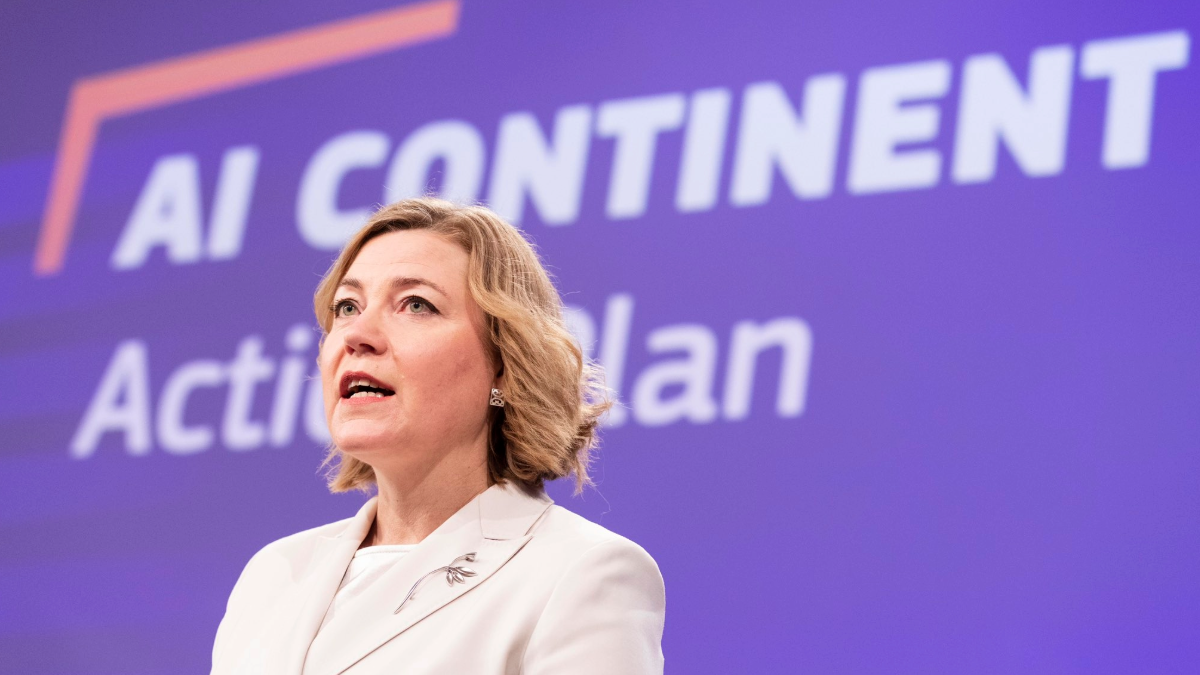
Henna Virkkunen, Executive Vice-President for Tech Sovereignty, Security and Democracy of the European Commission. Source
The European Union's AI investment policy has a characteristic move: announce a headline number, but assemble it by repackaging already-committed funds.
On April 9, the European Commission marked one year of the AI Continent Action Plan, boasting that "€1 billion in funding calls [is] already earmarked" to drive AI uptake through the Apply AI Strategy. This funding comes primarily from Horizon Europe, the EU’s main research and innovation program, and the Digital Europe Program, which supports the deployment of digital infrastructure and capabilities.
For anyone who has followed EU AI policy, the 1 billion figure might ring a bell.
In December 2018, the Commission's Coordinated Plan on Artificial Intelligence had already set out an ambition for the Union to invest at least €1 billion per year in AI under the then upcoming 2021–2027 budget cycle, “in particular the new Digital Europe Program and Horizon Europe.”
Eight years later, the same amount was announced as a fresh milestone.
For comparison, the OECD's 2025 report estimated total AI investment across the EU27 in 2023 at roughly €257 billion. Stripping out R&D, which funds the creation of AI rather than its uptake, and is not what the Apply AI Strategy is about, leaves around €224 billion flowing annually into the categories that constitute deployment. Of that €224 billion, approximately €64 billion is public spending. The headline €1 billion sits against that background.
The explanation for the Commission's modest contribution is relatively straightforward. The Commission operates within the constraints of the EU’s seven-year budget framework and it cannot unilaterally create new budgetary resources for AI. What it can do is re-prioritize and re-package funding within programs (such as Horizon Europe or Digital Europe) that were already approved.
When the Commission faces external pressure and a growing sense that Europe is "falling behind" in the AI “race,” repackaging is the instrument available.
This is not to say the reallocation of public funds within the EU funding programs is meaningless. In this case, it reflects a perception of AI as sufficiently mature and deployable: no longer treated mainly as something to study, experiment with, or support through research grants, but as something to commercialize, scale, and roll out across the economy.
The €200 billion announced by the European Commission President Von der Leyen at the Paris AI Action Summit in February 2025 applied the same logic at an industrial scale and added something new: an alignment with international private investors that would shape the terms of EU AI policy itself.
Unpacked, that €200 billion is:
- €50 billion from the Commission, assembled from program legislated long before Paris (and most likely Member States contributions — although this was not clear from President Von der Leyen’s speech in Paris and the subsequent press release) into an “Invest AI initiative.”
- €150 billion pledged over five years by private, international investors (including Blackstone, KKR, EQT, General Catalyst, Warburg Pincus) through the EU AI Champions Initiative.
One can’t help but wonder whether the capital allocators behind the €150bn figure are genuinely a top-up, or whether they are, in large part, the funds already moving into European AI. That would reflect a maturing market, high valuations of US AI companies relative to their revenues, and the fact that much of the talent is here in Europe. VC funding to European AI companies rose from just over $10 billion in 2024 to around $17.5 billion in 2025 — the first year AI was the leading sector for venture investment in Europe. Was the capital coming anyway?
If so, the story is less about the amounts and more about the conditions attached to them and the trade-offs they imply.
The private parties' pledge was explicitly conditional on Europe creating "a transparent and targeted, competition-driven AI framework", “streamlining and simplifying” the laws, which in Brussels jargon stands for deregulation.
That matters because it changes how the Paris pledge should be understood.
The significance of the pledge lies less in mobilizing new capital than in the Commission helping project a narrative of public-private partnership and entrepreneurial dynamism, while also using investors’ support to reinforce the case for deregulation.
Those conditions do not end with regulation alone.
As Leevi Saari argues in his recent paper, what is emerging in the EU’s current approach to AI industrial policy is an "inversion of conditionality": "instead of the state attaching conditions to its capital, strategically aligned private financiers may attach conditions for their cooperation" with the result that "the EU's pursuit of external sovereignty is subsidized by a reduction in autonomy of [the] domestic political sphere."
As a result, in the name of catching up, in the global AI race, public resources – laws and capital – are being redirected to meet the demands of international investors.
The problem is compounded by the fact that the spaces where these political decisions, as well as the choices about what kind of AI gets built with the use of public money, are even less transparent than the legislative processes in Europe. Those legislative venues were never fully open or insulated from corporate influence, as sustained (and successful) lobbying by major technology firms has repeatedly shown. But they still created more visible sites of contestation, documentation, and public debate than the forums where the EU’s AI industrial policy is shaped. A case in point: how did the Commission arrive at AI gigafactories as the industrial-policy answer, and at the roughly €20bn envelope now being assembled around them? The answer is even less accessible than the already imperfect channels of scrutiny that accompanied Europe’s regulatory agenda.
The lesson from watching this shift is that paying attention to legislation is no longer enough on its own. An increasing share of power is exercised through investment decisions, industrial partnerships, and executive choices over infrastructure. Announcements meant to portray significant public investment in fact signal an alignment of public strategy with private interest. As the center of gravity of AI governance in Europe shifts from legislation to industrial policy, making those spaces visible is the first step to making them accountable.
Authors