OSTP Vision for Science is a ‘Golden Age’ for Corporations
Cole Donovan / Jul 24, 2026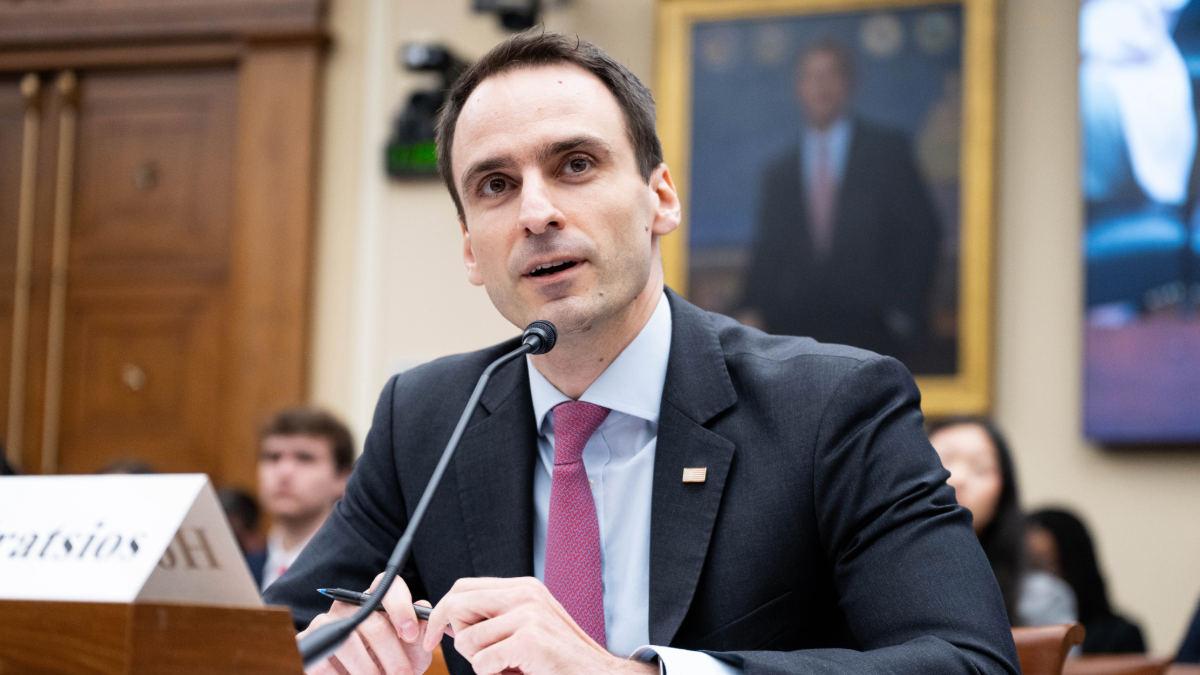
Michael Kratsios, Director, White House Office of Science and Technology Policy, speaking at a hearing of the House Committee on Science, Space, and Technology at the US Capitol in Washington, DC. (Photo by Michael Brochstein/Sipa via AP Images)
When new policy documents come out, one of the most important things a policy expert should do is take a moment, look the document over, and then decide how much time they actually want to devote to reading and analyzing it. “Science: A New Golden Age,” a report published this week by Michael Kratsios, Director of the White House Office of Science and Technology Policy (OSTP), is no exception. Billed by the Trump administration as “the first comprehensive rethinking of the United States science and technology enterprise in over 80 years since Vannevar Bush’s ‘Science: The Endless Frontier,’” the document certainly thinks very highly of itself, going as far as trying to replicate the font used by Bush in his report to President Harry Truman in July 1945.
Like Bush in “The Endless Frontier,” “A New Golden Age” is written under Kratsios’ exclusive byline, though it is almost certainly written in collaboration with others. Bush at least gave us the benefit of appendices where we can see the contributions made by various advisory committees, and we can trace language in the final text back to committee submissions.
But the two documents, as well as the circumstances under which they were written, could not be more different.
Bush—a widely-published scientist who was instrumental in the development of the Manhattan Project, oversaw the World War II-era Office of Scientific Research and Development, and even conceived of early predecessors to the World Wide Web—made specific recommendations, from the establishment of a National Science Foundation (NSF) to the declassification and publication of military-supported research. “The Endless Frontier” is clearly the work of an experienced federal manager with deep networks outside the government’s research establishment. Its appendices outline the contributing committees and their recommendations (you can even read what language is lifted directly from committee reports) while delving into the nitty-gritty details of everything from committee member compensation; ownership of patent rights for medical research; and the structural function of what would become both the NSF and National Institutes of Health.
Contrast that with Kratsios, who, in his testimony this week to the House Science, Space, and Technology Committee, absolved himself of knowledge or responsibility for actions of the US government and its agencies related to science policy in recent months, including when confronted with evidence of White House meddling in the operations of the NSF or recent rulemaking actions by the Office of Management and Budget (OMB) that promise to further politicize research funding. Kratsios’ background in science is much more limited—his ties are closest to infamous Silicon Valley tech bros who are deeply dependent on government contracts. Notably, he co-led DOGE’s staffing efforts during the Trump transition.
More on that shortly.
A faulty foundation
The recommendations in Kratsios’ “A New Golden Age” are vague, rely heavily on straw-man arguments, and regurgitate decades-old projects and policy pronouncements. It treats Advanced Projects Research Agencies, or ARPAs—first established in 1958—like they’re a new and innovative idea. It champions X-Labs, whose primary differentiating factor from national laboratories and university-affiliated research centers (UARCS) is that the latter are fairly old. Many of the recommendations are oft-cited maxims about the need for funding diversification, grand challenges, and to unleash the power of innovators through permissionless innovation. On that last point, Kratsios blissfully ignores the fact that the Trump Administration is explicitly constructing a system where experts require permission from political appointees before receiving federal grants. It talks about empowering individual scientists, neglecting the departure of senior scientists and Nobel Prize winners to foreign countries as a result of the worsening climate for scientists in the US.
The documents in the report also talk as though scientists and skilled tradespeople seldom interact. Nothing could be further from the truth. The reality of modern science and engineering means that individuals with specialized skills, who need to have deep and substantive understanding of the work being performed, are needed in order to build the tools necessary to tackle some of the world’s most challenging problems. Government procurement for science programs, from the Apollo Program to the Deep Underground Neutrino Experiment are only possible thanks to the work of skilled craftsmen and construction crews.
In advanced fields like high energy lasers, US providers are still able to provide unique capabilities that are not found in other countries. The gaps in skills in specific fields are more reflective of a collapse in federal support for particular programs—in fusion energy, the US only has a single working tokamak commissioned in 1986, making fusion teams dependent on resources built and constructed abroad. If we want more scientists like Rainer Weiss, who is named in the report as someone who had the chance to work as a lab technician in a way that advanced his understanding and enabled him to build LIGO, then we need to actually build and sustain investments in scientific infrastructure to create the demand signal and opportunities for people to do so—simply wishing trades programs into existence isn’t going to do it. What is necessary is committed and consistent funding that’s not subject to the whims of the OMB director.
This all gets worse when we factor the Trump administration’s Genesis Mission into the equation. Rather than using new money to build the program, the Department of Energy is redirecting funding from its existing science projects and programs in support of AI-driven discovery. To do this, the administration has to take money that was previously allocated for projects and programs that would have supported the development of next generation infrastructure and discovery, putting the funding toward AI projects instead. Scientists I’ve spoken with describe how every project and every program needs to be justified under the Genesis rubric in order to be funded.
As my friend, Ars Technica science editor John Timmer, pointed out in his excellent analysis, one of the clearest expressions of a goal in the document is the statement “A decade from now, American researchers should look back at our work and say: ‘The vital questions I could not pursue then, I am free to pursue now.”
We don’t need to wait 10 years to determine whether we are on a trajectory towards that goal. The scientists who are being pushed to change their research plans to fit the political needs of the administration should be evidence enough. We can go much further. The Office of Management’s new rules for research grants are explicitly designed to place greater political controls on the questions asked by researchers seeking government support. According to the Association of American Universities, despite a three percent increase in the number of domestic students applying to PhD programs from 2025 to 2026, admissions to those programs have fallen by 13 percent for domestic students and 17 percent for foreign students. Each PhD student turned away from an academic program represents an individual who is no longer free to pursue a program of original research, cutting off a generation of future scientific talent and mentors for future generations.
The administration’s realignment of research funding to match political priorities means that ideas that might sound outlandish—like studying how cells reproduce led to the use of bacteria to mass-produce human insulin and kick-starting the biotech industry–are less likely to be funded. While administration officials argue that business and philanthropy can step in to fill in the gaps, reporting from the Science Philanthropy Alliance last year demonstrates that substituting one for the other is extremely unlikely, and that’s even before one considers the types of research that business and philanthropy typically support.
The method to the madness
It’s a mistake to assume that all of this is dumb policy, or that there isn’t a coherent thought process behind this. All rhetoric is goal-oriented, and Kratsios knows that he has an audience in the science policy community. More importantly, Kratsios appears focused on the “just knowledgeable and interested enough” political community. What he’s done is taken the framework provided by Bush, put in all of the trappings of a big report, and used it to make a particular set of arguments that favor a particular policy result. It makes a lot more sense if you remove yourself from Bush’s framework and think about it from the perspective of a management consultant or private equity firm justification for carving up a company and jettisoning all the pieces they don’t like in the name of “efficiency.”
In this case, the target is very explicitly the university establishment.
This is a document that tries to reframe the conversation away from the destruction of American science, facilitated by the policy actions of this administration, in order to justify the mass reallocation of resources toward politically favored projects and administration supporters—particularly the large artificial intelligence firms and hyperscalers. If you believe that there are too many academics, you construct arguments about why the people who can no longer take part in PhD programs need to pursue other careers instead. You build fever dreams of information flows that don’t exist to help justify your decisions to dump massive amounts of resources into fields where you and your friends are heavily invested.
OSTP apparently set out to create a document that’s just credible enough to people who have an interest in science policy and to use their acceptance to acquire enough political capital and trust to move forward with the administration’s policy actions. Policy influencers fell for the rhetoric once before.
The good news is that doesn’t seem to be the case this time. Headlines are starting to reflect the gravity of the situation. The OMB rulemaking represents a clear wake-up call for the scientific community, and significant voices are now willing to call out exactly what’s going on.
So I come back to my original question: how much time should policy experts devote to this document? Like the nearly-forgotten AI Action Plan, I would argue “not much.” This is just a policy document. Its only power is to direct and try to shape the conversation. Focus instead on the things that matter—the rulemakings, the grant cancellations and delays, the targeting of critical institutions. The hits will keep coming. The US is a year and a half into a four year presidency. Even if control of Congress flips in 2027, expect the destruction to continue. Scientists and advocates, alike, need to brace themselves for more to come, and to make ready for when the time comes to build something new.
Authors