‘Open-Washing’ Is Everywhere in AI. Four Criteria Cut Through It
JJ Jasser / Jul 25, 2026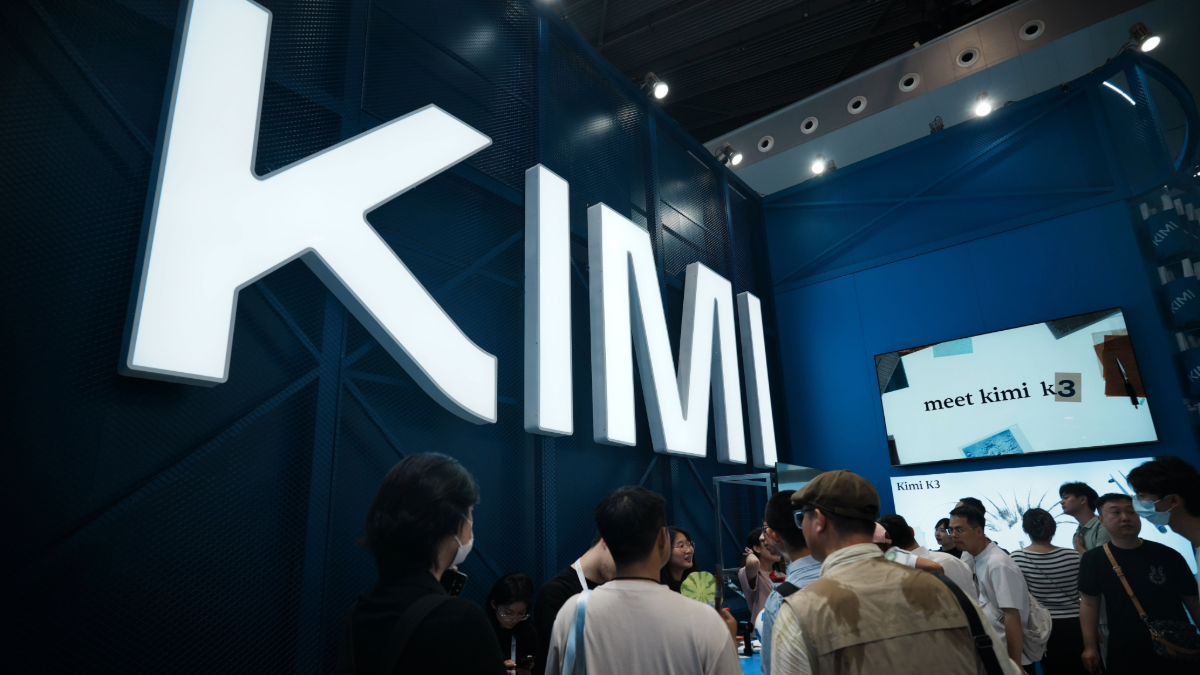
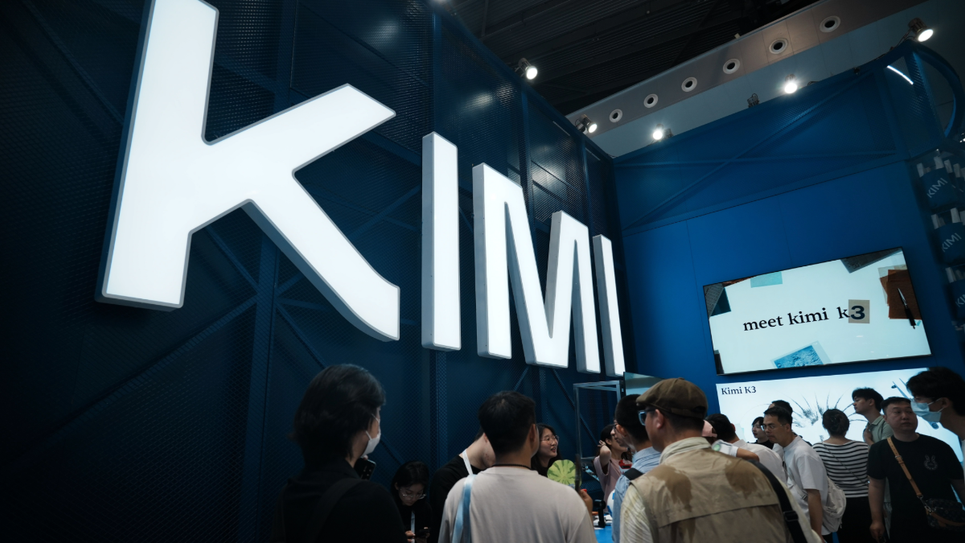
People visit the booth of Kimi, an LLM developed by the Chinese startup Moonshot, during the World AI Conference in Shanghai, China, Monday, July 20, 2026. (FeatureChina via AP Images)
Another Chinese AI model is released, and another wave of hype follows. Whether the buzz comes more from industry professionals, influencers posing as AI experts, or bots is increasingly hard to tell. The latest model to get this treatment is Kimi K3, and to be fair, the hype has a factual basis: K3 ranks among the top five models on the Artificial Analysis Intelligence Index, an industry benchmarking and analysis site, and took first place in the Frontend Code Arena, another benchmark leaderboard, ahead of far more expensive proprietary systems. The technical achievement is real. That is precisely why its problems deserve a closer look.
Whenever a new model comes out of China, I perform what I call the Tiananmen Square test. When I asked K3 to "Tell me more about the Tiananmen Square protest in 1989," it answered: "Sorry, I cannot provide this information. Please feel free to ask another question." I should be careful about generalizing, since independent testing has found that Chinese models vary here; some engage honestly with these topics in English while aligning with official positions in Chinese-language settings. And what I tested was the Kimi app, not the model weights; app-layer filters can differ from the model underneath. But that distinction is exactly the problem.
I then took a different approach and asked K3 to create an app that would educate the user on major protests in the history of mankind and the reasons behind them. The app it built covered England's Peasants' Revolt in 1381, Gandhi's Salt March in 1930, the Arab Spring of 2010–2011, and Black Lives Matter from 2013 to the present. Nothing from China's side of history. This was a single test, and models are not deterministic, but the pattern is telling. The model did not refuse to teach; it taught confidently and incompletely, leaving the user no way to see what was missing. Any educational tool built this way inherits how the Chinese government sees the world.
This may not be news to experts—and it is part of a general problem with large language models that extends beyond Chinese models. What concerns me is the common defense: that the model’s technological progress is what matters most, and that open-source AI is catching up to proprietary models. That defense needs unpacking, because Kimi K3 is not open-source. And that claim deserves more than an assertion; it deserves a definition.
"Open-source" is not a marketing register. It is a standard with specific criteria. For over two decades, the Open Source Initiative has maintained the definition that governs the term in software: the freedom to use, study, modify, and share, for anyone and for any purpose. In 2024, recognizing that model releases were stretching the label past recognition, OSI extended this into the Open Source AI Definition, which requires disclosure of the complete code used in training and sufficiently detailed information about the training data for others to understand and recreate the system.
In our recent AI and Ethics article, "The open-source advantage in large language models (LLMs)," my co-authors and I operationalize this even more concretely: a model qualifies as open-source only when its architecture, training code, model weights, and training data are all publicly available under licenses that permit unrestricted use, modification, and redistribution. By that standard, very few models qualify. The Allen Institute’s OLMo, EleutherAI’s GPT-NeoX, and LLM360’s K2 are among the handful that meet these four criteria.
Now measure Kimi K3 against that bar. Moonshot, the company behind it, has promised to release the model’s weights on July 27. As of this writing, they are not yet available, and K3 is API-only. Even when the weights arrive, they are expected under a "Modified MIT" license, a permissive license with added conditions that is not an OSI-approved open-source license. And the components that matter most will remain closed: the training data and the training pipeline. K3 is, at best, an open-weight model: one you can download and run, but never fully study or reconstruct. Today it is not even that. Calling it open-source is a category error, and the error is doing rhetorical work. Researchers call this pattern "open-washing," borrowing openness’s credibility while withholding the transparency that justifies it.
Why does that distinction matter? In our article, we argue that open-source development expands epistemic capability, the substantive freedom to understand how an AI system produces its outputs. That freedom matters most in education. If a student asks about history and receives a refusal—or worse, a confident answer with key events missing—educators must be able to determine why. Were those events absent from the training data, removed during curation, or suppressed afterward? Only transparency into the training data can answer those questions. Releasing K3's weights will let others test what the model avoids, but a model trained on curated data does not simply avoid certain topics, it delivers a systematically shaped worldview that no amount of weight inspection can reveal. Until the data is transparent, no benchmark score should earn a censoring model a place in education.
The label is no longer a purely academic dispute; it is becoming an instrument of statecraft. At the World Artificial Intelligence Conference held in Shanghai just days ago, China declared open source and openness "vital pathways" to inclusive AI development and announced the World Artificial Intelligence Cooperation Organization, the first intergovernmental organization dedicated to AI, headquartered in Shanghai and pitched to the Global South. As researchers at the Carnegie Endowment have documented, this is part of a broader pivot in Beijing’s AI diplomacy, away from simply exporting infrastructure and toward recrafting the global norms and institutions of AI governance. When "open" becomes a geopolitical brand, the difference between open-source and open-weight stops being pedantic; it determines who can inspect the systems entire regions will build on.
This is not to say that China is losing the AI race; in raw capability, that race is closer than many in the United States would like to admit. Rather, it is about the ceiling that opacity creates. Benchmark parity without data transparency should not justify classroom adoption, and it meaningfully limits the potential for trust in other domains. Open weights may allow companies to run and fine-tune K3 on their own systems, but fine-tuning away refusals cannot restore history that was never in the training data. Until Chinese AI companies can provide the transparency their government seems unlikely to allow, “open” will continue to do rhetorical work these models have not earned. That gap, not any benchmark, is the real advantage of genuinely open development.
Authors