No Cure Without Evidence? AI Overviews Cut Clicks 40% and Give Users Nothing
Courtney C. Radsch / Nov 20, 2026Courtney C. Radsch, PhD, is a journalist, scholar and human rights advocate who currently directs the Center for Media & Digital Governance at Open Markets Institute and is a non-resident fellow at the Brookings Institution. She serves on the board of Tech Policy Press.

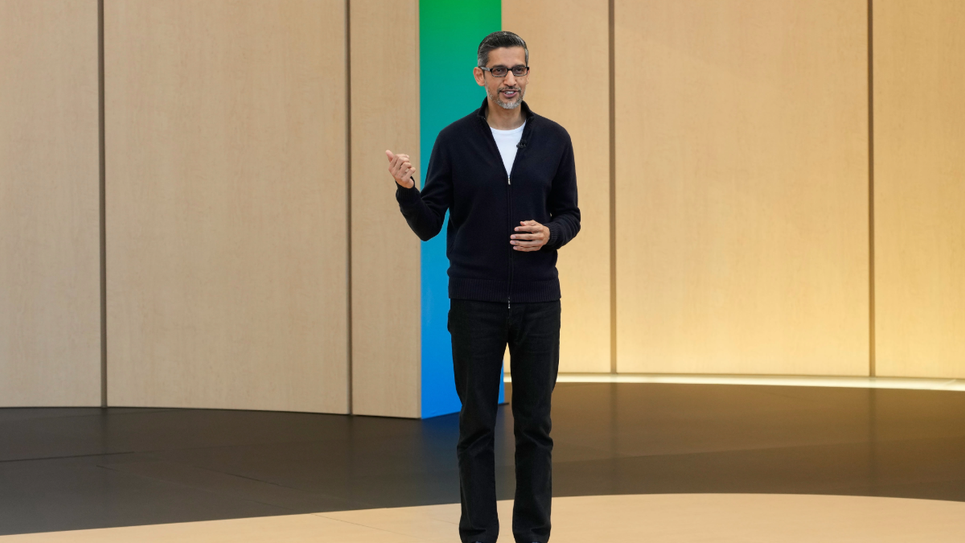
Alphabet CEO Sundar Pichai speaks at a Google I/O event in Mountain View, Calif., Tuesday, May 19, 2026. (AP Photo/Jeff Chiu)
In September 2025, the federal judge who found Google illegally monopolized search declined to give publishers a way to keep their content out of Google's AI products because of a lack of evidence. "The court heard evidence about Google's opt-out offerings, but no testimony from a single publisher," US District Judge Amit Mehta wrote. "The court does not doubt that publishers face new challenges because of GenAI technologies, but there can be no cure without evidence to support it."
The evidence has now arrived. And although it is unfortunately too late for that case, it is not too late for the European Commission, the UK's Competition and Markets Authority (CMA) investigation, Brazil's CADE or India’s competition authority, all of which are examining Google's AI search in light of its impact on publishers.
A new paper by Saharsh Agarwal of the Indian School of Business and Ananya Sen of Carnegie Mellon confirms what publishers have been saying since AI Overviews were rolled out and dismantles the main defense Google has offered in response: the generated summaries cannibalize traffic while offering “no measurable improvements in perceived search quality or ease of finding information.” This is the first randomized behavioral observation test of the impacts of AI Overviews on the downstream websites whose content gets summarized, examining how people engage with content given different AIO configurations.
I served as discussant for a presentation of the paper that was organized by the Center for Economic Policy Research as part of its Media Plurality Webinar series, and one of my big takeaways is that the results underscore why a “remedy” that lets publishers opt-out one at a time will do little to reverse the damage or anticompetitive implications of AI Overviews.
What the experiment found
The methodology and design of the study were rigorous and the results unambiguous. The researchers recruited 1,065 US adults who use Google on desktop Chrome — none of whom knew the purpose of the experiment — and paid them to install a browser extension developed by the authors for two weeks in early 2026. The extension unobtrusively removed AI Overviews for a randomly chosen group (shifting results up so the page looked normal), redirected a second group to Google’s Gemini-powered AI Mode for every search, and left Google untouched for the control group. Participants did not know what was being tested, and in our discussion Sen said that only a single person thought the purpose of the study was related to AI Overviews, which in my opinion strengthens the findings even further. And the two-week time frame meant that there were no major changes to Google’s algorithm (they checked) and people had time to use the version they were provided regularly — but not so long that they developed new habits.
The results were stark:
- AI Overviews appeared organically (i.e., via Google’s algorithm) on about 41% of searches.
- On those searches, they reduced outbound clicks to websites by about 40%, from 0.62 to 0.37 clicks per search. Searches ending with no click to any website (zero click) rose from 54% to 73%.
- The losses were concentrated where the overview sits at the top of the page and on the top three organic results, which is the real estate publishers compete hardest for on the world’s search monopolist. (And given that this was a desktop-based study one could extrapolate that this would be even worse on mobile, where most people do their searching).
- Citations inside the overview generated only about 7% of the outbound clicks on those searches (indicating citations won’t save publishers).
- Clicks on ads and on Google's own pages did not change, and neither did the number of searches people ran (which has interesting implications for advertisers and for Google’s claims about user utility).
- Visitors who did reach a website stayed just as long and bounced just as often with or without AI Overviews, which indicates that they do not have a better experience or gain greater utility with AI Overviews.
- Users reported no better search experience with AI Overviews than without them. The group with full AI Mode clicked even less, and many people assigned to that group dropped out or installed workarounds to get ordinary results back.
The design of this study matters as much as the evidence it provides — no corporate funding, independent academics, robust methodology. When Pew found in 2025 that people clicked a traditional link on 8% of visits with an AI summary and 15% without one, Google disputed the methodology in an effort to delegitimize it. But this pre-registered study validates those findings. Randomizing what real people see in their own browsers, checking that searches without overviews show no effect, and then switching the groups and watching the effect reverse makes the result very hard to dismiss, though no doubt Google will try to do just that.
Google's response to falling publisher traffic has been to claim that AI is sending fewer but better clicks. Last year the head of Search said click volume was stable and click quality had risen, though the search giant provided no evidence or independent audit. This study tested this claim and found nothing to support Google’s unsubstantiated assertion (but underscores yet again why data access and transparency must be required to help even the informational disparities between the platform and publishers).
Same gatekeeper, more of the value
In light of the 2024 US court ruling that Google holds an illegal monopoly in general search, the pattern is a transfer of value because Google keeps the attention it monetizes through ads while publishers lose the visits they would have monetized through ads and subscriptions. Users, by their own account, gain nothing measurable in exchange. This is the double bind my Center for Media and Digital Governance (CMDG) colleague Karina Montoya and I documented in Same Gatekeepers, New Tollbooths, our report on the AI content licensing market: the companies eroding publishers' traffic also set the terms on which their content is used, and Google, alone among AI companies, can do this to publishers who cannot afford to leave its index. Splitting out its AI training and search crawler bots does nothing to address this double bind.
The 7% figure also exposes a deeper problem as policymakers and platforms keep treating attribution as the answer, as if a link in the AI summary restores the old bargain. It does not. The content does its work on Google's page whether or not anyone clicks. And clicks were always an imperfect measure of what journalism is worth to a search engine, as another behavioral study a few years ago by Fehr Advice in Switzerland that was replicated in several other jurisdictions confirmed when it found that users experienced a decline in the value of search without news results. That study was commissioned by a Swiss publishers’ association; its core finding, that news content made search measurably more valuable to users, is the same thing Agarwal and Sen now show from the other direction. Both studies identified different types of searches — informational, transactional, navigational — and sought to home in on the specific utility provided by news results in informational searches.
But just trying to measure these impacts is a costly feat in and of itself. The authors of the AI Overviews study put the cost of running the two week experiment at around $30,000, not including their months of work building the browser extension, to measure something Google observes for every search it serves. The Fehr study was similarly costly to conduct. Google almost certainly runs experiments like this internally and does not share the results with publishers, who cannot even isolate AI Overview traffic in the tools Google gives them, much less run A/B testing.
Independent researchers should not have to raise money to reconstruct a dominant firm's own data, which is why regulators must compel it. The UK’s CMA requires Google, which it designated with “Strategic Market Status” in a move CMDG advocated for and welcomed, to provide publishers with detailed user engagement metrics including how often AI Overviews actually send users to publisher sites beginning on Dec. 3. But this individual publisher data is not available as far as I know to external independent researchers or industry bodies, making it of limited utility for research or public policy making. And while the EU opened up a formal antitrust inquiry into AI Overviews as an abuse of dominance, the case is ongoing; the DMA requires that Google share anonymized data only with rival search engines and AI chatbots starting in the new year, but not downstream sites.
The opt-out trap
One of the study's most important implications for policy is one the authors did not originally set out to test. In the experiment, when users did not get AI Overviews downstream, sites saw a 40% recovery in clicks.
An opt-out works very differently, however. Under the UK Competition Authority's new rules, and the controls Google said it will roll out more widely, a publisher can keep its content out of AI Overviews while staying in ordinary search results. But the overview does not disappear nor does a publisher have the option of vying for placement at the top of the page.
This is the opt-out trap. Each publisher acting alone arguably does better staying in, while publishers acting together could recover far more by withholding at a scale that degrades the overview. That is what we call a collective-action problem, and it explains why opt-outs handed out publisher by publisher leave Google's position intact and do nothing to balance out the market. The exception is content with no substitute, original local reporting above all, which is where local news holds leverage it has rarely been able to use, particularly since those are the publishers least likely to have the technical expertise and wherewithal to block via robots.txt (especially for fear of retaliation in traditional search). I’d love to see a follow-up experiment on coordinated withholding and its impact on the quality of AI Overviews as well as user satisfaction.
US courts are closing the door but regulators need not
In the US, the judicial route is not going well. Judge Mehta dismissed a local news class action brought by Helena World Chronicle and Emmerich Newspapers in March 2026, and in September dismissed Penske Media's and Chegg's antitrust suits over AI Overviews, finding no formal agreement guaranteeing publishers traffic and treating search and AI Overviews as a single product. Each ruling acknowledged the harm and rejected the legal theory even as the judge that ruled over the Google Search monopoly case expressed sympathy for the bind publishers are in. That is an argument for Congress to act, and the judge said as much in his rulings, calling on the legislative branch to address the issues that he felt these antitrust cases could not.
Bu the US is only one jurisdiction, and the study has arrived just in time for many other jurisdictions that are investigating Google’s AI Overviews. The European Commission opened an investigation in December 2025 into whether Google imposes unfair terms on publishers by using their content for AI Overviews without fair payment or a real way for publishers to refuse. The UK's CMA will eventually have to judge whether its opt-out actually works once its mandate goes into effect, and has signaled further measures to secure a fairer exchange of value. Brazil's competition authority, CADE (Administrative Council for Economic Defense), opened a formal proceeding in April into Google's use of news content, including in AI Overviews, following comments from CMDG and many others. Each of these bodies needs evidence of harm, of the value Google takes relative to what it returns, and of whether opt-outs offer a meaningful choice. This study supplies all of this, though US desktop data will carry less weight in Brussels or Brasília than local replications of this study.
What should happen now: recommendations for regulators and competition authorities
- Make AI use opt-in. Separate consent to indexing from consent to AI use, so that the default no longer feeds the overview and the burden shifts to Google.
- Let publishers act together. Collective bargaining with an antitrust safe harbor, or a statutory licence with collective distribution, gives the long tail of local, ethnic and non-English outlets the leverage no single publisher has.
- Pay for use. Licensing rates should rest on how much content AI products consume, with clicks as a floor.
- Mandate disclosure. Domain-level data on AI Overview impressions, citations and clicks, reported to publishers and regulators.
- Fund independent evidence beyond the US and across devices. Replications in Brazil, Canada, the EU, India and the UK would provide the evidence sought by competition authorities. But budget is an obstacle. And while publicly available version of the extension would help (and the authors said they would explore this option) that does not address the need to pay participants to join a study.
The evidence that Google’s AI Overviews negatively impact traffic to downstream websites while doing nothing to improve user experience is in. Google’s Search dominance has already been litigated. The question now is whether lawmakers and regulators will come up with a cure before the challenges publishers face become insurmountable and the market even more imbalanced.
Authors