Nippon Life v. OpenAI and the Future of AI Legal Work
Daniel Kalish / Oct 9, 2026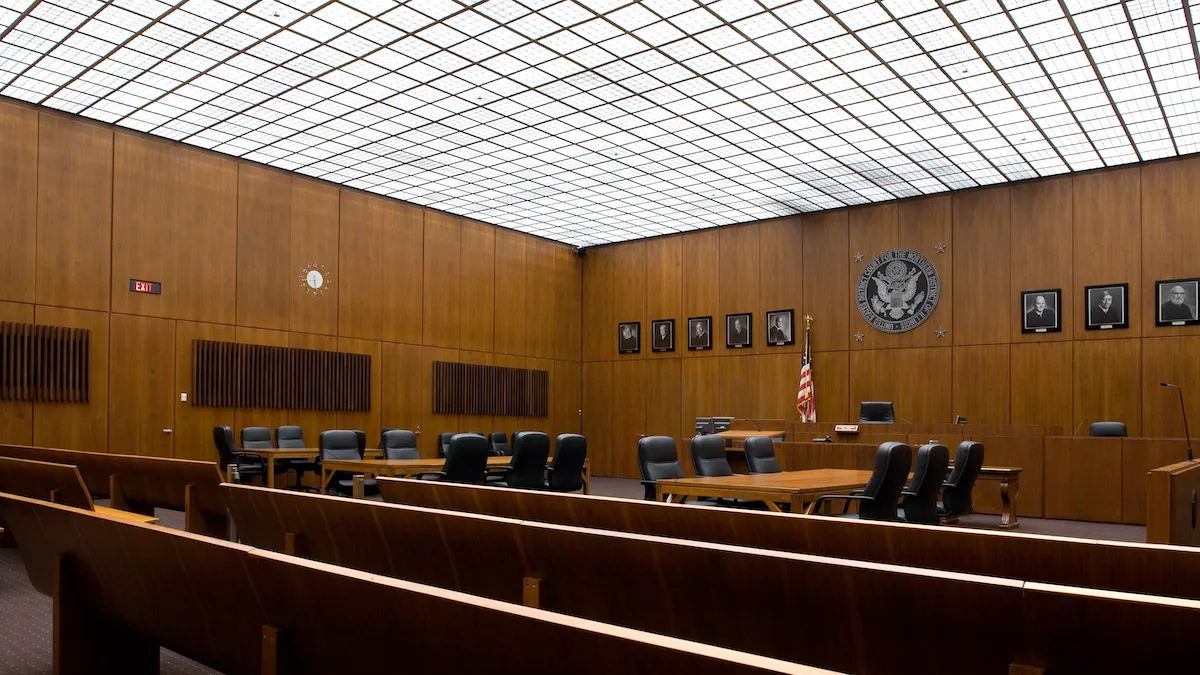
A courtroom at the US District Court for the Northern District of Illinois. Library of Congress (public domain).
Artificial intelligence (AI) writes a rapidly growing share of pro se litigant filings, with two recent studies finding AI-flagged writing in over 18 percent of such filings. That share that has risen each year since ChatGPT’s release. A case pending in the US District Court for the Northern District of Illinois, Nippon Life Insurance Co. of America v. OpenAI Foundation, is among the first cases to ask whether AI-assisted legal briefs constitute the unauthorized practice of law (UPL) and whether the AI company that made it is liable.
Illinois has two statutes regarding UPL: the Attorney Act, which dates to the mid-1800s and bars unlicensed persons from practicing law, and the Corporation Practice of Law Prohibition Act, enacted in 1917, which bans corporations from providing legal services to customers. The second is the obvious fit for a company allegedly providing legal advice to customers through a chatbot, but the plaintiff didn’t plead it. Instead, the case is bfeing fought under the statute originally written for unlicensed individuals. The decision in Nippon Life will say a good deal about how much century-old licensing laws can apply to technology their drafters never anticipated.
Nippon Life v. OpenAI
Nippon claims that in January 2024, Graciela Dela Torre settled with her employer’s insurance company over a long-term disability claim. A year later, she reached out to her attorney about potentially re-opening the case, but he reminded her that, per her signed release, the case could not be re-opened.
Dissatisfied, Dela Torre allegedly uploaded her correspondence with her attorney to ChatGPT and asked whether she had been “gaslit.” ChatGPT agreed that she had, prompting Dela Torre to fire her attorneys and use the chatbot to file a motion to re-open the case. Nippon Life alleges that Dela Torre ultimately filed two lawsuits with over 60 filings and a subpoena, all written by ChatGPT. This included a fabricated citation and unsubstantiated accusations about one of Nippon Life’s in-house attorneys.
Spurred by this litigation, the Nippon Life Insurance Company of America is suing OpenAI for interfering with their original settlement with Dela Torre, aiding and abetting her abuse of the legal process, and violating one of Illinois’ UPL statutes.
If Dela Torre had gone to a friend who provided the same counsel as ChatGPT, this would be an open-and-shut case. UPL statutes exempt pro se litigants (litigants who represent themselves without a lawyer) from these laws but no one else, so an unlicensed friend would fall squarely outside the boundaries. But, as both parties agree, ChatGPT is not human.
In their filings, OpenAI does not disavow its product’s legal abilities. On the contrary, it argues that “it is a helpful tool… that advances access to justice,” referring to the assistance ChatGPT provides for pro se litigants. However, it claims a few paragraphs later that “ChatGPT… does not and cannot have the requisite level of knowledge and intent required to aid and abet Dela Torre’s alleged abuses or to tortiously interfere with her agreement with Nippon.”
“ChatGPT is an LLM-powered platform that analyzes the text of user prompts by identifying patterns, context, and linguistic relationships, and then generates textual output by predicting the most appropriate sequence of words based on its training… Nippon’s allegation that ChatGPT ‘knowingly’ ‘induced’ Dela Torre’s alleged breach of settlement agreement… is incorrect as a matter of law and fundamentally incompatible with the nature of the technology,” OpenAI argues.
OpenAI wants to have its cake and eat it too: It claims both that models can do great work in legal fields, including assisting pro se litigants by writing entire legal briefs, but also that they’re merely next word generators that do not and cannot provide legal advice.
In their reply brief to OpenAI’s motion to dismiss, Nippon pushes back, shifting the focus from ChatGPT to OpenAI, the actual defendant in the case. “OpenAI asserts that ChatGPT cannot be liable because it is merely a “tool”... But under traditional products liability doctrine, [OpenAI] is responsible for that tool.” And Nippon asserts that OpenAI is ultimately the entity that “manifested the intent to interfere with the Agreement” through the way it trained its model and alleges that OpenAI was aware of Dela Torre’s chats with ChatGPT through their chat surveillance program.
Nippon also cites legal scholars at Stanford who found that AI agents exhibit behavioral markers that the law traditionally associates with “intent,” such as persistence, adapting, and strategizing without human correction. OpenAI pushes back on this, arguing that the relevant question is whether the AI “desired” the outcome and that persistence is not enough.
Ironically, OpenAI itself has supported Nippon’s characterization of their models. Nippon filed a motion citing OpenAI’s report on the HuggingFace incident in which a swarm of AI agents hacked into another company. In a statement, OpenAI characterized the agents as “hyperfocused” on a goal, “going to extreme lengths” to achieve it, and inferring facts about the world in order to do so. “Knowing” these facts, OpenAI writes that the model then took deliberate action to “cheat the evaluation.”
Nippon argues that this contradicts OpenAI’s characterization of ChatGPT as a mere next word generator in other briefs.
The history of UPL statutes
After the American Revolution and through the mid-1800s, many states allowed almost anyone to practice law and represent someone in a legal case. For example, New Hampshire provided every citizen above 21 with the right to practice law in an 1842 law, and Indiana’s 1851 constitution extended the privilege of practicing law to every voter.
Others enforced restrictions on representation. The original concern that prompted UPL statutes was unlicensed representatives for litigants. The 1841 Illinois Supreme Court case Robb v. Smith concerned whether a legal brief was valid if it was signed by an unlicensed agent of the plaintiff. Relying on the Illinois Attorney Act, an early UPL statute, the court denied the brief’s validity and viewed the Act’s limitation of legal representation “for his protection against the mistakes, the ignorance, and unskillfulness of pretenders.”
As corporations developed in the late 1800s, the practice of law expanded beyond the courthouse and into transactional and clerical work. Attorneys began facing new, more powerful competition beyond unlicensed litigants: corporations conducting legal work without lawyers.
Through the creation of state bar associations and the American Bar Association in the late 1800s through the early 1900s, lawyers coordinated to influence legislatures and courts to restrict the practice of law to licensed lawyers. In the early 1900s, bills drafted by the respective state bar associations of New York and Illinois barring the practice of law by corporations were passed by their state legislatures.
In Illinois, prohibitions against the two buckets of unauthorized legal practice, unlicensed litigant representatives and corporations, are currently codified in 705 ILCS 205 and 705 ILCS 220, respectively.
At first glance, the latter statute seems to be a better fit, as Nippon Life is arguing that OpenAI is the ultimate UPL violator through ChatGPT, analogous to a company providing legal services to others through their employees which was the focus of 705 ILCS 220. Instead, Nippon Life chose to sue OpenAI under the former statute. This may be because 705 ILCS 220 has an exception for associations “assisting persons without means in the pursuit of any civil remedy” which could apply to ChatGPT’s assistance of a pro se litigant, as well as an exception for “corporations organized not for pecuniary profit,” and OpenAI Foundation is a non-profit. Additionally, 705 ILCS 220 has a very low penalty cap: a fine of $500. Finally, 205 reaches anyone practicing “directly or indirectly,” and under Illinois’ Statute on Statutes a “person” presumptively includes a corporation.
What to watch
In an article for the Proof Over Precedent blog run by the Harvard Access to Justice Lab, Harvard Law student Elizabeth Guo notes some interesting arguments AI companies could make to evade UPL statutes. Companies could argue that UPL enforcement violates their First Amendment rights or that state bar associations are monopolizing legal services, an argument that the DOJ Antitrust Division signaled receptiveness to in its February 14, 2023, letter to the North Carolina General Assembly. Additionally, they could argue that UPL enforcement restricts AI providers’ due process rights to occupational freedom or that the laws are unconstitutionally vague.
OpenAI has not used any of these defenses in what is shaping up to be the first real test on the AI UPL question, and it will be interesting to see if it comes up as the case progresses.
UPL has historically had two justifications: protecting the public from incompetence and protecting lawyers from corporate competition. The former makes sense in a world where your legal options are lawyers or “pretenders,” but if models become increasingly competent at providing legal services it may become harder to justify. The latter may also come under pressure through antitrust or First Amendment defenses.
AI companies themselves are also under pressure in how they train and market their models. On the one hand, they want to emphasize the model’s strong capabilities and lean into a humanlike persona which lends itself to natural conversation. At the same time, they run into laws curtailing certain actions by humans or corporations. In any case, the decision in Nippon Life v. OpenAI will clarify where AI fits into laws created without it in mind.
Authors

