At NCSL, Geoffrey Hinton Warns State Lawmakers Not to Buy Big Tech's Anti-Regulation Pitch
Justin Hendrix / Aug 2, 2026
The 2026 National Conference of State Legislatures in Chicago. Photo by Justin Hendrix.
Good morning!
This week I saw some members of the Tech Policy Press community in Chicago last week at the National Conference of State Legislatures, the annual gathering of state lawmakers, policy experts and the lobbyists who hope to influence them.
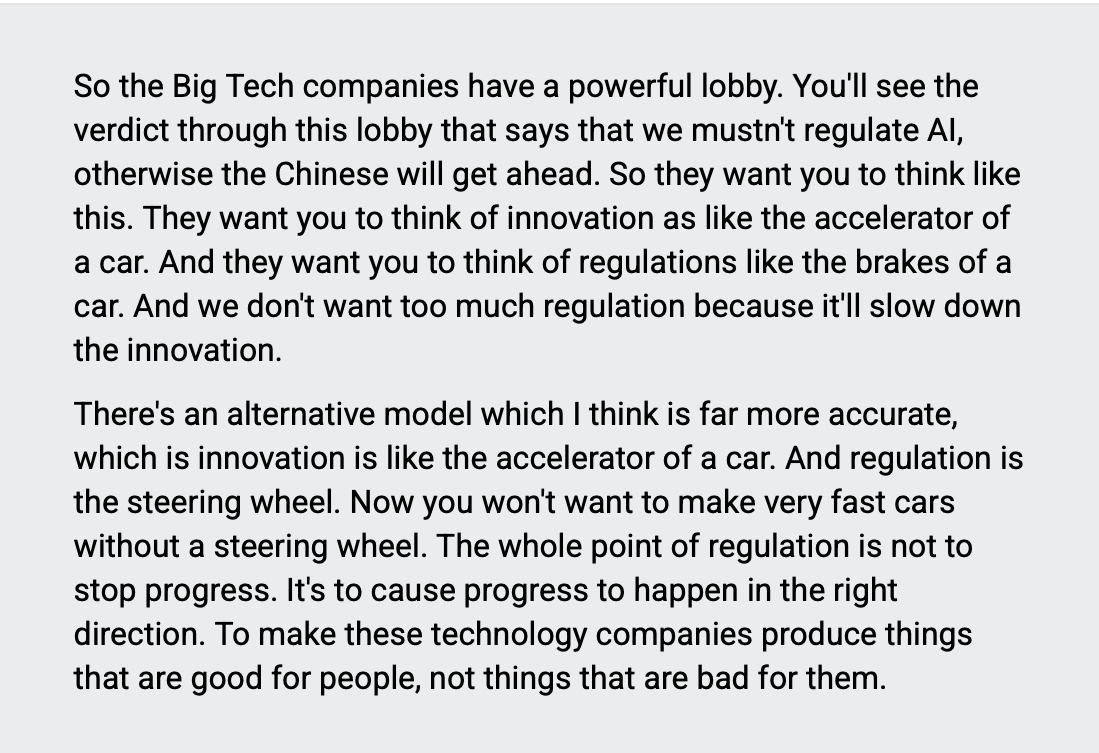
This year, the program featured a distinct track on artificial intelligence, and the prime Tuesday morning keynote discussion featured Nobel Prize-winning computer scientist Geoffrey Hinton. In conversation with Rep. Paul Cutler, a Republican state legislator from Utah, Hinton told a packed ballroom that “nobody knows what the future’s going to be like,” citing concerns around mass unemployment, information integrity, and the concentration of power. He defended the necessity of AI regulation to some applause, even as he shared a grim forecast for the years ahead.
There were other sessions where potential harms of AI were discussed, including one on child safety moderated by Pluribus News state affairs national reporter Austin Jenkins featuring lawmakers from Oregon and Tennessee and an expert from the American Psychological Association. But the main impression I left with was of lawmakers, staffers and legislative researchers looking for ways to more rapidly adopt AI into government. Multiple sessions looked at trends on AI adoption, touting case studies and best practices. NCSL introduced its own chatbot, embodied by a dog named Nora, that lets users of its website interact with material there. Stuffed Noras were distributed during Hinton's keynote session.
Another theme this year, as in the past, was how to do the business of politics amid the nation’s highly polarized politics. There were sessions such as “Your Brain is Addicted to Revenge,” “How Laughter Builds Resilience,” and “Personal Security Training for Legislators.” And the exhibition area was once again a glamorous circus of corporate messages and swag, including fancy displays from Big Tech firms such as Google, Amazon, Meta and TikTok. Some civil society and tech accountability organizations competed for attention with more humble booths, including the Kids Code Coalition, Data & Society, Future of Privacy Forum and the Center for Democracy & Technology.
Speaking of technology in government, in a piece this week, Merici Vinton from the Center for American Progress and Lynn Overmann from Georgetown's Beeck Center extracted five principles from New York City's new Public Interest Technology Crew that they argue should be standard practice for digital capacity initiatives everywhere.
That’s just one of many on the site—read on for more.
On the OpenAI-Hugging Face incident
- Dynamite blasting and nuclear waste are treated as "ultrahazardous"—strict liability applies no matter the precautions. Reflecting on the OpenAI-Hugging Face incident, Keith Porcaro of Duke Law argues advanced AI belongs in the same category.
- Public Citizen's J.B. Branch makes the case that the OpenAI–Hugging Face incident was "a foreseeable governance failure rooted in private decision-making"—and that voluntary corporate risk management is not enough. Congress must investigate, he says.
Safeguards and enforcement in the EU
- The European Commission gains full enforcement powers over AI companies today, including the ability to investigate providers, order corrective measures and impose fines. Journalist Joana Soaresreports on what the first months of enforcement may look like.
- AI-powered nudification tools are making image-based abuse faster, cheaper and harder to stop. Ana Ornelas, advocacy officer at the Digital Intimacy Coalition and policy officer for digital rights at the European Sex Workers’ Rights Alliance, investigates how sexualized deepfakes are affecting survivors, why sex workers face unique harms, and how Europe's safeguards are struggling to keep up.
- The European Commission has not shown why Europe needs to triple data center capacity, nor how existing infrastructure is being used. Michelle Thorne (Green Web Foundation), Aurora Gomez Delgado (Tu Nube Seca Mi Río), Fieke Jansen (Critical Infrastructure Lab at the University of Amsterdam) and Rosi Leonard (Friends of the Earth Ireland) make the case for a moratorium.
Data access and the DSA
- The European Commission accepted X's corrective action plan under the DSA this month. Luka Bekavac and Alice Palmieri, PhD students at the University of St. Gallen, analyze whether the measures will give researchers the data needed to audit systemic risks.
- The European Commission accepted X's revised DSA remedies on data access on July 15. Vineet John Samuel, a doctoral candidate at the Hertie School, on why the commitments are a partial victory and what researchers need to do to verify they hold. “Ensuring lasting, durable data access will require a researcher-underwritten, shared set of expectations around data access and a common set of remedies,” he writes.
Dependency by design?
- Europe hopes the Chips Act 2.0 will reduce dependencies on foreign semiconductors. But the bloc's massive AI infrastructure buildout is poised to increase demand for advanced processors it still cannot produce, reports freelance journalist Joana Soares.
- Cristina Caffarra, honorary professor at University College London, co-founder of the Competition Research Policy Network and co-founder and chair of the EuroStack Initiative Foundation, argues Europe's "digital sovereignty" push should stick to a narrow plan—buy, fund, build across the full stack—rather than roll in all directions pursuing various goals grafted on to the concept.
- Europe's highest court dismissed Google's Android antitrust appeal this month. Lucas Lasota, Jithendra Palepu and Dario Presutti of the Free Software Foundation Europe argue the next battle is already underway over who governs trust in the Android ecosystem. “It is becoming increasingly clear that the next struggle over digital markets may concern something even more fundamental: not who controls platforms, but who controls the governance of trust itself,” they write.
Global AI governance & who gets left behind
- Liz Orembo, research fellow at Research ICT Africa, argues AI risk is relational—it "does not reside in code alone." A model can pass every frontier safety test and still cause harm when deployed into different languages, institutions and social realities. That matters, in particular, for Africa.
- Jane Munga of the Carnegie Endowment for International Peace examines the ITU's new AI for Good Global Commission and identifies five issues it must address to deliver real benefits for Africa.
- AI's benefits are concentrated in a few companies and countries, but its footprint is distributed, argue Jamila Venturini and Marina Meira from Derechos Digitales. They call for a global infrastructure to hold the AI supply chain accountable.
Tech policy moves at Downing Street
- By scrapping DSIT and redistributing responsibilities across Whitehall, new UK Prime Minister Andy Burnham has significantly reshaped the UK government’s technology policy in his first week in office—in ways that have divided initial expert reaction, writes Tech Policy Press fellow James Ball. And in a follow-up podcast discussion, I asked James Ball, State of the Future’s Gavin Freeguard, and Careful Industries’ Rachel Coldicutt to help me make sense of the "muddle" that is UK tech policy.
Information integrity
- A network of Telegram "local news" channels has no newsroom behind it. Democracy Reporting International’s Ognjen Karadzic and Daniela Alvarado Rincón trace how it grew across 19 languages undetected—and argue the EU should reconsider its light-touch approach to Telegram.
- Google didn't just add AI to Google Earth—it briefly turned one of the world's most trusted sources of evidence into a generator of plausible fakes. shirin anlen & Sam Gregory from WITNESS on a foreseeable fiasco, and why tech firms must consult civil society experts before launch, not after.
- Drawing on a new report, Princeton CITP’s Hilke Schellmann and Mihir Kshirsagar see two futures: one where we lose confidence in facts and settle into rumor, another where trusted producers hold the line. Which wins depends on whether newsmakers and technologists actually talk to each other, they say.
- Informed by his research on Venezuela, political scientist Philipp Lutscher writes that DDoS attacks on news organizations censor primarily through friction: they raise the cost of accessing and distributing information for both readers and journalists.
Threats to technology researchers
- The Trump administration tried to use visa denials and deportation to silence researchers who study social media. A federal court just said no. Sunday Tagliasacchi and Elisabeth Snyder, former legal externs at the Knight First Amendment Institute at Columbia University, break down the CITR v. Rubio ruling. “The government is free to dispute their findings and oppose their recommendations. It may not threaten exclusion or deportation to determine which questions may be asked, which conclusions may be published, or which views may enter public debate,” they write.
Chatbots, consent, and children’s online safety
- When it comes to AI chatbots, "Congress should not expect parents to shoulder the burden of unsafe product design," writes Americans for Responsible Innovation's Brandie Nonnecke. Her recommended fix: an enforceable duty of care.
- Age restrictions and design obligations are complementary measures. Lorena Giuberti Coutinho, commissioner at Brazil's National Data Protection Agency (ANPD) and a Professor at IDP in Brasília, on Brazil's ECA Digital law and the case for regulating how platforms are built, not just who can use them.
- Laws against image-based abuse protect people only when images are sexual. Eva Blum-Dumontet, head of movement building and policy at Chayn, argues that's the wrong threshold: any photo shared without consent can be a weapon, and legislation should reflect that.
- “The hardest part of age restrictions is not defining who should be excluded. It is building a system that can tell who is a child in the first place.” Zainab Samantash, head of legal affairs at JazzCash, on what Pakistan got wrong and the experience it already has to draw from to get it right.
- Audio reporter Laura Karpas talks to the Center for Democracy & Technology's Michal Luria and Harvard Business School's Julian De Freitas about dark patterns in AI companions—and what happens when users try to say "goodbye."
Agentic AI systems and human rights
- Raquel Vazquez Llorente, Rafiya Javed and Vinodkumar Prabhakaranof Google, Google DeepMind and Google Research examined whether human rights law can serve as an alignment target for agentic AI systems, embedded during training rather than bolted on after deployment. They discuss the results of their experiment.
Open source AI
- “Open models now do about a third of the world's AI work, but they collect only about four percent of the money.” Mozilla CTO Raffi Krikorian says the real question for builders isn't which AI model they are using—it's whether they could leave for a different one. The door's still open to choose a different path—for now.
What we’re watching
We’re watching to see if new details emerge about the voluntary framework for AI safety evaluation that the Trump administration has reportedly circulated to leading AI firms. And, next week in the Senate Commerce Committee, senators will host a markup session on numerous child online safety and privacy measures.
I wish you the best for the week ahead!
-Justin

Authors