How AI is Powering Transnational Repression
Ana Sofia Harrison, Marlena Wisniak / May 20, 2026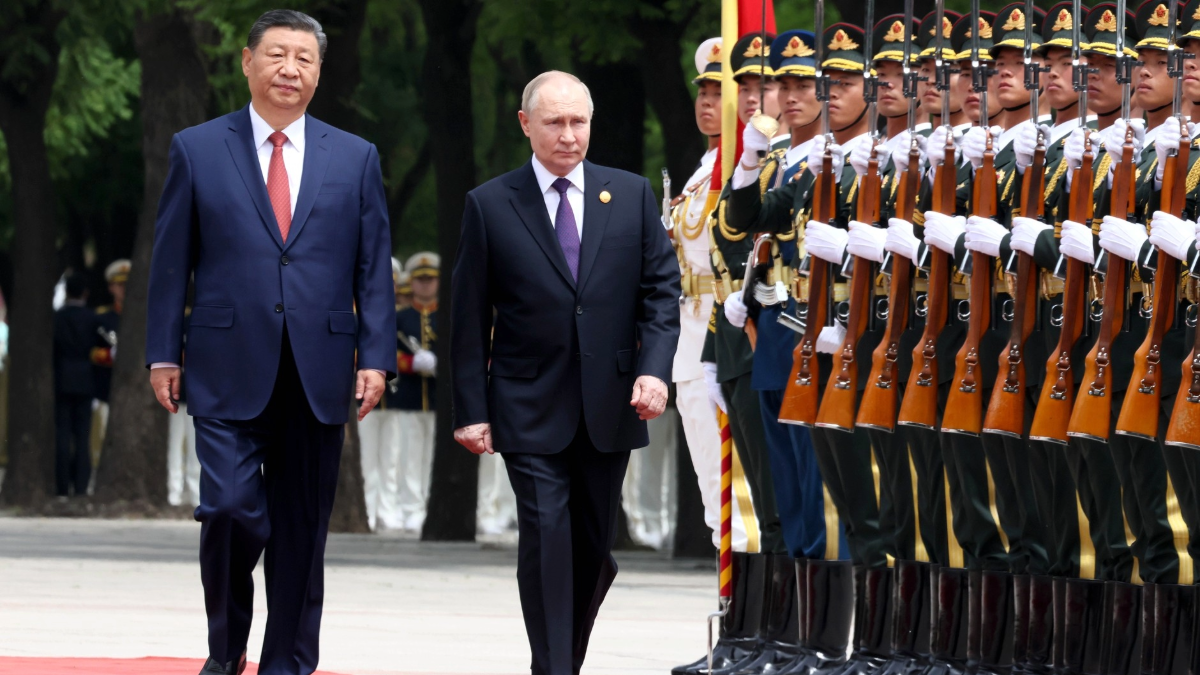
At the invitation of President of the People’s Republic of China Xi Jinping, Vladimir Putin arrived in China for a state two-day visit in May 2024. Source
Repression no longer stops at national borders, and AI is becoming one of its most powerful and invisible tools. In today’s hyperconnected world, states are extending their reach far beyond their territories to silence critics, intimidate dissidents, and suppress human rights advocacy abroad. This phenomenon is known as transnational repression (TNR), and it is increasingly being automated. At the center of this shift is what researchers describe as digital transnational repression (DTR), which has fundamentally transformed both the reach and impact of TNR. Through digital means, states or their proxies monitor, intimidate, and silence individuals and groups across borders, including diaspora communities, exiled journalists, human rights defenders, and political dissidents. AI systems have become a core engine of this machinery, accelerating and exacerbating longstanding forms of repression.
The consequences of AI-powered DTR are twofold: the global expansion of authoritarian control and censorship, alongside the normalization of self-censorship among those who fear they are being watched. Just as significantly, DTR undermines the sense of safety that exile once provided, especially as governments in both the US and Europe grow increasingly anti-democratic themselves.
These developments extend well beyond technological concerns. DTR raises urgent questions about sovereignty, international law, and democratic accountability. Yet, because it operates largely out of sight, it remains extremely difficult to document abuses and hold governments accountable for human rights violations. The harms are also not evenly distributed. As intersectional feminist researchers, sociocultural identity structures are central to our analytical lens. AI-powered DTR disproportionately impacts womxn, especially those with overlapping identities, including race and ethnicity, nationality, religion, class, age, disability, gender expression, and sexuality.
To be clear, AI did not create transnational repression. However, it enables TNR to be faster-moving, farther-reaching, and more scalable than ever before. It enables unprecedented levels of monitoring, profiling, and targeting across borders, often at lower cost and with greater precision.
The tools of digital transnational repression
The cross-jurisdictional and concealed nature of both AI and TNR makes these practices inherently difficult to document. Targeted communities often face serious risks when reporting incidents, while the opacity surrounding how AI systems are designed, deployed, and governed further limits public understanding. As a result, much of the current knowledge base remains incomplete. Even so, growing evidence points to a range of AI-enabled tools that have been, or could be, deployed as instruments of transnational repression, as we’ve documented in our recent report.
AI surveillance
Governments increasingly deploy biometric and facial recognition systems in transit hubs, streets, and other public spaces, creating a chilling effect that deters people from attending protests, community gatherings, or cultural events. In practice, these systems discourage public dissent. Modern AI-enabled CCTV networks can automatically track individuals across entire cities, and when systems are interconnected, across international borders.
This surveillance capacity is often paired with broader cyber operations. For example, Russia has used AI technologies not only within its own territory but also across borders to conduct cyberattacks against foreign governments and institutions, while simultaneously spreading AI-generated disinformation through social media.
Predictive AI systems extend these harms even further. By analyzing patterns in behavior, social networks, speech, online activity, and even consumer habits, such systems can generate “social scores” or threat rankings based not on what individuals have done, but on what authorities believe they might do. AI-generated blacklists and automated risk assessments may then be shared with foreign law enforcement agencies or used to flag individuals at borders or embassies. Civil society organizations operating in exile or relocation also face growing difficulties accessing financial services when automated risk systems classify them as suspicious.
AI platforms
Beyond surveillance infrastructure, AI is also reshaping the information environment. AI-generated disinformation and harassment campaigns increasingly rely on deepfakes and manipulated media designed to shame, discredit, impersonate, or silence activists both in their home countries and in exile. Women are disproportionately targeted through technology-facilitated gender-based violence (TFGBV), including rape threats, stalking, and doxxing. In 2025, the Chinese government reportedly deployed an AI-generated smear campaign targeting Rushan Abbas, Founder and Director of the Campaign for Uyghurs, a US-based civil society organization. In an apparent attempt to discredit her advocacy exposing China’s persecution of Uyghurs, state-linked actors circulated a deepfake video and other fabricated allegations through digital platforms.
At the same time, social media monitoring and automated content moderation can also fuel DTR. These systems often rely on large-scale data collection from social media platforms, messaging applications, and in some cases private communications. Using natural language processing techniques, such as sentiment analysis, text classification, and keyword detection, states can monitor and suppress dissenting voices across multiple platforms. Egypt, for example, reportedly deployed an AI system scanning Facebook, Twitter, YouTube, WhatsApp, Viber and Instagram across 26 topic categories, ranging from defamation of religion to calls for protests, with likely implications for Egyptian activists living abroad.
Perhaps most alarming is the emergence of AI agents capable of monitoring online behavior in real time, twenty-four hours a day, across multiple platforms simultaneously. These agents can flag keywords, relationships, or location patterns, and be deployed to systematically surveil diaspora communities abroad.These systems can de-anonymize activists and whistleblowers living in exile, map diaspora networks, identify key leaders, and disrupt networks, undermining collective action. They also create new forms of plausible deniability. Governments can easily deny responsibility, by claiming AI agents acted autonomously or were manipulated through prompt injection, further complicating efforts to establish accountability.
A policy landscape failing to keep pace
The stakes have now reached the highest levels of global governance. At the June 2025 G7 Kananaskis Summit, transnational repression was formally recognized as both a cybersecurity risk and a threat to national sovereignty. Yet despite this growing recognition, policy responses remain fragmented and inadequate.
In some cases, existing legal frameworks may even enable transnational repression under the banner of counter terrorism. International security instruments such as the UN Security Council 2396, (2017) and 2671 (2021), the Budapest Convention on Cybercrime (2001), the recently adopted UN Convention against Cybercrime (2025), and international policing mechanisms such as INTERPOL all facilitate cross-border intelligence sharing and law enforcement cooperation. These mechanisms can give repressive governments access to sensitive information that may be exploited to identify targets, map vulnerabilities, and persecute dissidents abroad.
Meanwhile, major democratic jurisdictions are struggling to regulate AI at the speed the threat demands. In Europe, the delayed implementation of the EU AI Act has left one of the world’s most comprehensive AI regulatory frameworks in limbo at precisely the moment it is most needed. On May 7, the EU adopted the Digital Omnibus package, announced on November 19, 2025, postponing key compliance deadlines under the EU AI Act until December 2027.
The United States faces a different but equally consequential challenge, where federal policy is actively working to dismantle state-level accountability mechanisms without establishing comparable national safeguards. The Trump administration’s December 11, 2025 Executive Order on a National AI Policy Framework directed the Department of Justice to establish an AI Litigation Task Force tasked with challenging state AI laws deemed inconsistent with federal policy. The March 20, 2026 National AI Legislative Framework reinforced that direction.
Taken together, these trends reveal a widening gap between the speed of technological change and the pace of democratic governance. Unless governments act decisively, the current policy landscape risks normalizing and enabling AI-driven TNR rather than constraining it. Responding effectively will require sustained coalition building and rigorous collaboration across civil society, academia, governments, and international organizations. It demands rights-based, community-centered approaches that prioritize those most at risk, strengthened by international, participatory oversight mechanisms capable of monitoring violations and ensuring accountability. It also requires mandatory impact assessments, meaningful transparency from both governments and technology companies, and accessible remedies for those harmed.
Transnational repression is not only a human rights challenge, but also a core national security threat–addressing it is as much a matter of AI regulation as it is preserving civic space, public trust and defending core democratic values.
Authors