Google’s ‘New Era for AI Search’ May Threaten Democracy
Elise Silva / Jun 8, 2026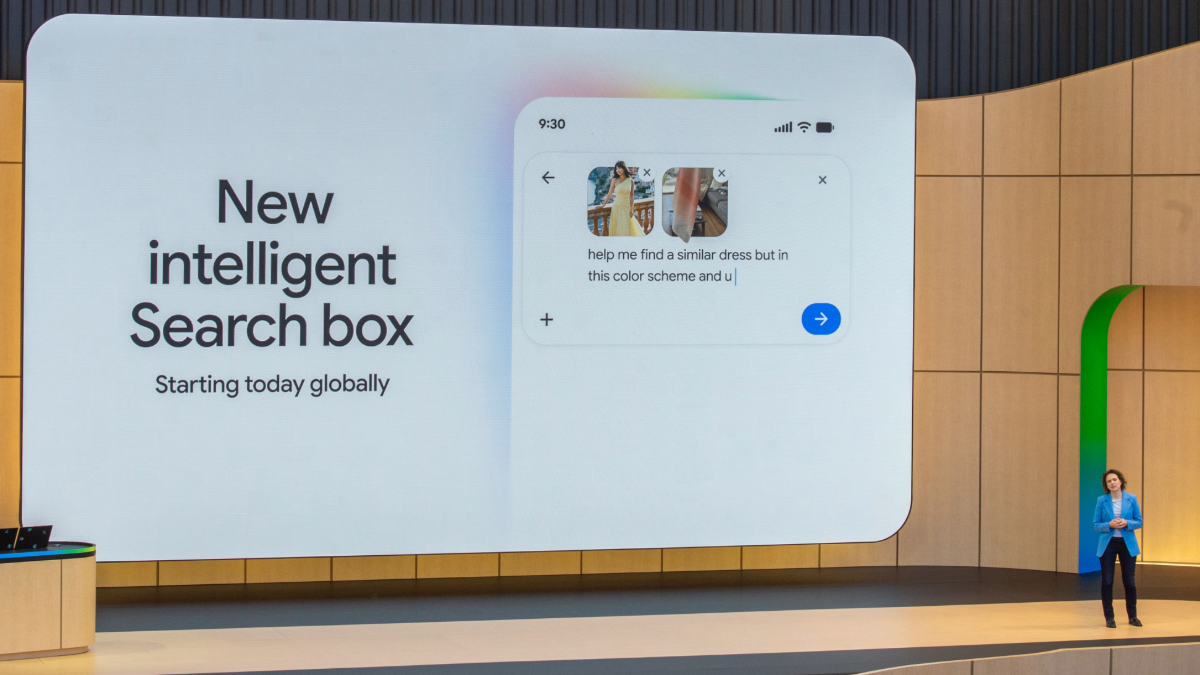
Mountain View, California: The Google manager responsible for the search engine, Liz Reid, presents a search field improved with artificial intelligence at the Google I/O developer conference on May 19, 2026. Photo by: Andrej Sokolow/picture-alliance/dpa/AP Images
At its I/O conference in May, Google announced what it called the biggest overhaul of Search in more than 25 years. Since 2024, Google Search has moved through several phases: from legacy search, which used some personal data to rank results; to AI Overviews, AI-synthesized summaries displayed above traditional results; and now to AI Mode, a fully conversational interface that can now draw on Gmail, Google Photos, and Calendar to personalize responses. While framed as improving convenience, these changes have deeply changed the over 5 trillion searches happening globally on Google’s search interface annually.
If you've opened Google in the past few weeks, you may have noticed something new embedded in the search box itself: an AI Mode button, sitting right next to the voice and image search options. You can type your question into the search bar and hit enter for a more traditional search experience, or click AI Mode for a conversational, AI-synthesized one. Google reports that AI Mode now has over one billion monthly users worldwide—though it's worth noting that users are often defaulted into this new experience rather than actively selecting it.
Google maintains roughly 90% of the global search market. Design choices made by Google, therefore, shape how the majority of the world finds information. Much of the legal and policy attention on Google has focused on whether that dominance harms competing firms. But monopoly power doesn't only harm competitors. It also shapes the experience of billions of individual users, and the collective information environment those individuals share. It’s worth understanding how that experience is changing and analyzing the implications of such for individuals and wider communities.
How search behaviors and options are changing
Google has given us some insights about how user searches are evolving in AI mode, which are delineated below:
- Mode of query: People are using voice and image search with increasing frequency. More than one in six AI Mode queries in the United States are now multimodal, with image searches growing over 40% month-over-month. While Google doesn’t give reasons, this might partially be because individuals are using their phones to run searches more, making search easier on the go. Multimodal queries forgo breaking something down in written language—cutting out this step while simultaneously providing more context for the search makes searching for some kinds of things more efficient. It’s worth noting here that voice and image inputs also carry different kinds of personal data than text and disclose different things about a user’s life—a new kind of data source for companies ever-interested in different layers of data on users.
- Length of query: The average AI Mode search is triple the length of a traditional search query. Users may be beginning to intuit that the AI interface can break down complex questions, run parallel searches, synthesize results, and tailor a response so they no longer have to do these steps. This leads to more personal queries and less synthesizing on the part of the user (which I have previously commented on). Longer queries may often disclose more personal information on the part of the user to Google.
- Type of query: People are using AI Mode to plan and brainstorm significantly more, Google reports. Planning queries and searches starting with "ideas for" and "where should I" are increasingly common. Considering that the platform has significant advertising revenue, the company’s influence in such advice-based searches warrants scrutiny.
Also new is the introduction of information agents—background tools that monitor the web continuously and push synthesized updates without requiring a new query.
While convenient, this significantly changes the search experience and offloads a great deal of user control and decision-making. These agents are being granted increasing power to make decisions through Google's new Agent Payments Protocol including completing purchases on your behalf.
Implications
Much of the commentary on these changes has focused on implications for Google's dominance in search and on institutional harms—including, very recently, what these changes mean for publishers and the news organizations whose content powers AI search results. Less attention, however, has been paid to what these changes mean for the individuals using the product and the communities they belong to, which is the focus here.
Protecting individual users
- Privacy: The new search experience is an extraordinarily personalized one—and personalization at this scale requires data at scale. Personal Intelligence, now expanded to nearly 200 countries, draws on users' Gmail, Google Photos, and Calendar to tailor responses. Google frames this as opt-in, but as Help Net Security noted, "once this model starts to feel normal, the bigger question is how much real choice users will have." Policy should address the gap between opt-in and informed choice—especially as features that launch as experiments tend to become defaults over time.
- Advertising and agency: Google's AI Mode queries are increasingly personal and advice-based—people are asking where to go, what to buy, and what to do. This is valuable territory for a company whose core business is advertising, and how sponsored content is disclosed within a conversational interface is not yet well regulated. The conversational format may make advertising even less visible than it currently is. The stakes rise further as information agents gain the ability to act on users' behalf: consumer advocates have raised concerns that data from AI prompts could enable price discrimination, and lawmakers in at least nine states have introduced proposals targeting surveillance pricing practices. An agent that knows your location, your purchase history, and how urgent your need is also knows just how much you might be able (or willing) to pay for a good or service.
Protecting wider knowledge communities
Individual harms matter, but so do collective ones, and both tiers are worth considering.
- Shared knowledge and citability: When two people search the same question and receive substantially different AI-synthesized answers drawn from different sources, weighted differently by their personal histories, what does it mean to “share information?” The ability to cite where you got information—and for others to verify or challenge it—has historically been foundational to how knowledge communities function. This is true from journalistic conventions to scientific practice to civic discourse. What might happen to our already-fractured understanding of public truth when information objects are ephemeral and fleeting, difficult to recreate, and even harder to cite?
- A community of one: Personalization in search is not new, and Google has long used browsing history to shape results, but this new iteration does seem to supercharge the depth and breadth of personalization, thus amplifying its effect. Search results have historically had a degree of shared reality: the same query returned broadly similar results for most users, providing at least a common informational ground. Now, with Personal Intelligence drawing on email, photos, and calendar data, and information agents monitoring different topics for different people, each user inhabits an increasingly distinct information environment. Research on algorithmic personalization has long warned about this, noting that habitual adaptation to personalized content can fragment the shared informational basis on which public deliberation depends. Democracy is inherently pluralistic. It depends on people who disagree sharing enough common ground to at least argue about the same things. The most individualized search experience in the platform's history arrives at a moment when that common ground is already thin.
Google has opened up a "New Era for AI Search," indeed. And by so doing, opened up even more questions about how individuals find, evaluate, and use information in an increasingly AI-inflected information ecosystem. The questions around how these design choices get made, and who gets a say in them, are ones we should be asking as individual users, policy makers, and members of wider democratic communities. The regulatory conversation has long asked whether Google harms competitors. It should also be asking how Google's design affects people and publics.
Authors