Google Employees Push Back on Government Surveillance Contracts
Justin Hendrix / Mar 15, 2026Audio of this conversation is available via your favorite podcast service.
Over the past decade, workers at Google have repeatedly joined together to protest various company practices they deemed unethical.
In March 2018, leaked details of a Pentagon contract called Project Maven revealed that Google was using its AI to help the military analyze drone surveillance footage. Within weeks, more than four thousand employees signed an open letter to CEO Sundar Pichai asserting that "Google should not be in the business of war.” About a dozen engineers resigned, and the employees drew support from across the tech industry and amongst experts. By June of 2018, Google announced it would let the contract expire.
That summer, a second wave hit over Project Dragonfly, Google’s plan to build a censored search engine for China. Over fourteen hundred employees signed a protest letter arguing it violated Google's own AI principles.
In the fall of 2018 employees organized a global walkout over the company’s handling of sexual harassment claims. More than 20,000 workers in fifty cities walked off the job at the same moment to demand pay equity, management accountability and transparency, and an end to forced arbitration over sexual harassment claims. Google partially complied. But several demands went unmet, and some organizers later said employees faced retaliation.
In 2019, more than a thousand employees petitioned the company to drop contracts with Customs and Border Protection over immigration enforcement. In 2020, over a thousand signed a letter demanding Google cut ties with police departments with records of racial discrimination just weeks after the killing of George Floyd by Minneapolis police. And when AI ethics researcher Timnit Gebru was forced out in December 2020, more than twenty-six hundred colleagues signed a public letter of protest. By January 2021, these years of rolling activism crystallized into the Alphabet Workers Union, a labor organization open to employees of the company as well as contractors, temporary workers, and vendors.
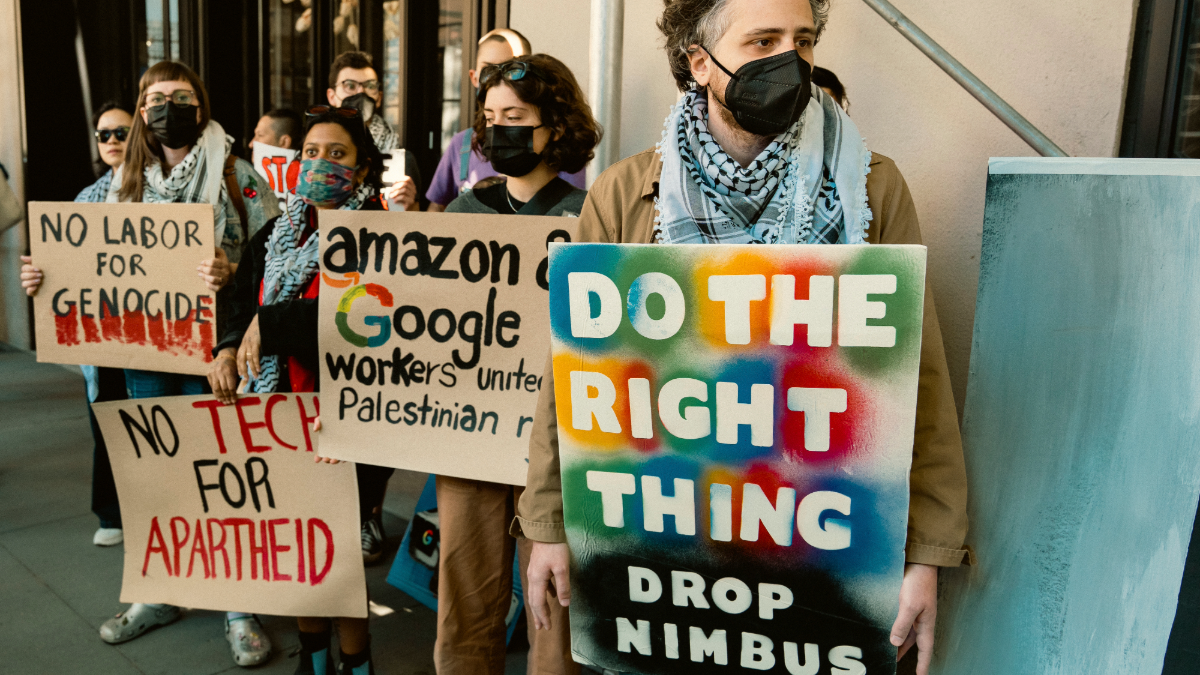
Tech workers from Google, Meta and Amazon protest against Big Tech supplying Israel with intelligence tools outside Google offices in Chelsea, Manhattan, NY, on Tuesday, April 16, 2024. Google faced criticism for terminating employees dissenting its relationship between the Israel Defense Forces. (Photo by Cristina Matuozzi/Sipa USA)(Sipa via AP Images)
Then, in April 2024, under the banner of No Tech for Apartheid, workers staged sit-ins and protests at Google offices including New York, Sunnyvale, and Seattle to contest a $1.2 billion contract with the Israeli government and military to provide cloud services called Project Nimbus. Nine employees were arrested. Google fired twenty-eight workers, and then roughly twenty more, in what the fired workers claim was retaliation.
Early this year, following the deaths of Keith Porter, Renee Good, and Alex Pretti at the hands of federal agents and the violent immigration raids on communities across the country, 1,500 Google workers signed a new petition, this time demanding the company cut contracts with ICE and CBP.
For this week’s podcast, I spoke to two of the employees who signed that petition about why they signed it, the environment inside the company, and how they think about the risk they face for speaking out. To protect their identities, we're identifying them only by their first names.
What follows is a lightly edited transcript of the discussion.
Angela:
My name is Angela. I am head of business at Google, and I've been at Google for 11 years. And before we begin today, I just wanted to say that any views expressed today by Alex or myself are personal opinions and not representative of the company at large.
Alex:
My name is Alex. I've been working for Google for seven years. I'm a senior software engineer. It goes without saying, I do not represent Google here.
Justin Hendrix:
How did you come together? Did you know one another before this campaign?
Angela:
I did not know Alex before this. I think I was sent the petition just randomly by somebody at work and I looked at it and it felt really aligned with my values. And I signed the petition and I took a minute and I thought to myself, I would like to get more involved. So I signed up to be a part of our group here on campus called No Tech for Apartheid and got connected with Alex to learn more. We had a chat about the values, the mission statement of the group and how I could get involved, and now we're here.
Alex:
I joined Notice for Apartheid very recently. I think it was November last year. I have seen people distributing flyers in the San Francisco office. Those flyers were about Google's relationships with Israel, Project Nimbus that provides Israel with cloud capacities that are used in genocide in Palestine. That's how I joined No Tech for Apartheid. And soon after I joined the news of Google's contracts with the Department of War came out, and the ICE campaign wrapped up and I got very involved with the Googlers Against ICE campaign from the very beginning.
Justin Hendrix:
Well, let's talk a little bit about that campaign specifically. And I'd love to hear from the two of you what you're demanding, what it is that your group is seeking. What is this petition about? And folks can read it on the internet and they can see the specifics, but I'd love to hear it in your own words.
Alex:
Our demands are extremely reasonable. We have four demands. The demand number one is to acknowledge the danger and the violence that workers face each day. Demand number two is to host a Q&A session for workers to learn about our DHS, CBP, and military contracts, and other kinds of involvement with this agencies that happen without any contractual obligations. Demand number three is to protect all Googlers from cafeteria workers to data center employees. And the last one is to disclose ties and declare red lines around use of our products for state violence and repression.
Let me emphasize how easy it would be for the leadership to acquiesce to our demands. For the first one, we're just asking for a statement from the leadership. Google leadership has been surprisingly silent about everything that happened since ICE operations started ramping up. And Jeff Dean, senior researcher in Google, tweeted something about how everybody is supposed to be outraged by what happened. However, nobody from our leadership has made a single public statement about that. Next, our third demand protection all Googlers to contextualize that. OpenAI CEO, Sam Altman, recently announced that every OpenAI employee has a $15,000 budget for legal fees that might come up in context of interactions with ICE. So if somebody is detained or arrested or faces legal issues, OpenAI is ready to provide its employees with up to $15,000 to cover legal fees.
Google made no such effort. Even though Google workers are the ones at risk. There has been news of ICE agents trying to enter our data center in Cambridge. There have been multiple ICE and CBP agents, I think, around Google campuses. People feel afraid and our leadership doesn't do anything to address that. The last two demands are about transparency. We as Googlers are tired from learning what our company does from the news. None of the things we have learned about Google's interactions with ICE were disclosed internally, everything we know from news reporting, and we're sick and tired of that.
Angela:
Thanks, Alex. I think those are great points. I think the key thing to remember here is that what we're asking for is truly basic support and protection, as well as transparency and accountability. To us, there are very reasonable demands and there should be no issue from our executives in meeting those and being transparent about what Google is doing and also speaking openly.
Justin Hendrix:
There must be some response you've had from management, either in terms of some awareness of what's happening in the office. Any response, any internal communication, in the least, in the response to the petition or in response to your organizing activities. I assume that if flyers are being handed around, there's at least some visibility inside the organization that this is happening. There's obviously been news reporting about your efforts, your petition is public. Has there been any discussion in a formal context?
Alex:
Despite our best efforts, all we have is non-response from our leadership. You're right that there's been an extensive reporting on that. And on internal forums, people often ask questions about our involvement with ICE and CBP, with Department of War and with Israeli IG. And best questions never get answers. The last answer I've heard from somebody in the leadership was that Google collaborates with various government agencies, which includes our collaboration with NASA centered on the exploration of outer space. So clearly that's not what people ask about when they raise questions related to our government contracts, but the leadership tries to dodge these questions.
Justin Hendrix:
And I understand the company has made warnings around policies around personal political opinions. Is that something that you've each experienced, any warning directly from the company or your manager or someone in the chain of command that you work for? Or how do those warnings, how are they propagated?
Angela:
I can speak from my experience that I honestly have not received anything. I think for me, I've started with our efforts at No Tech for Apartheid about two months ago. I do a fair amount of tabling, which means we sit in a Google cafe and we have signs up that they ask me about Google's involvement with ICE or some iteration thereof. And there are other employees who approach us, but we do not solicit. And to be honest, we have not gotten, or I have not gotten any notifications from my management. I firmly believe that I'm exercising my First Amendment rights for free speech and we are raising concerns in the workplace. So yeah, that's on my piece, Alex. I don't know if you've received anything differently.
Alex:
Yeah. We all have received a communication from higher apps about political activities and how we shouldn't represent Google when doing political activities. However, I'd like to highlight that a Googlers Against ICE campaign is not political activism by any means. It's a labor issue and an ethics concern of current workers. It doesn't have anything to do with politics. We do not advocate for a political party or for a political movement and any attempts to paint it as a political movement are done to try and squash our activities under the guise of being a political.
Justin Hendrix:
Obviously, things have changed just the last couple of months. Some of the issues that you started out concerned about with regard to the relationship between Google and the Department of Defense or with the Israeli government. We're now in a very active war in Iran. There's a lot of scrutiny on the extent to which tech tools are being deployed in that context. And of course, there's been this moment where Anthropic has been labeled a supply chain risk for drawing its red lines, effectively been turfed out of its contracts with the federal government. Google and OpenAI employees have filed an amicus brief on behalf of Anthropic supporting its argument in the Northern District of California. Is that initiative tied to this one? Are those employees among the same employees that are part of the No Apartheid movement?
Alex:
It is a separate movement. They are not a part of our organization. Perhaps some of them are members of No Tech for Apartheid, but amicus brief is not associated with No Tech for Apartheid. It's a distinct movement within Google.
Justin Hendrix:
I want to ask a couple of questions about what you cited as an ethical concern, the way that you think about that. The petition calls out Palantir's immigration OS being powered by Google Cloud. I assume there are other types of connections. When you think about the relationship between different pieces of Google's stack, different pieces of Google's business, how do you tease out those ethical questions? How do you think about that when you're inside the company? One thing that you're working on could be daisy-chained to many, many other things, and you may not ever know necessarily precisely what advertisers connected to that product or what potential government activity or law enforcement activity might happen. As employees, how do you think about that every day?
Angela:
For me personally, there's a big reckoning around the true connection between what we do. I can speak a little bit more about my role. I work directly in Google Ads with a ton of small businesses. And while Google Ads is not mentioned in the petition rate or any of our materials or so far in our conversation today, it's truly still connected. I am still a part of the labor workforce at Google. The revenue we make from ads funds data warehouses. It also funds the activity that we make around supporting Palantir's efforts as well. I do not believe that our departments are separate. I think under Google, we are all working together and I think that is one of the reasons why it did compel me to join No Tech for Apartheid and come on this podcast today.
Alex:
I also don't subscribe to this extremely individualistic view, but I am only responsible for the work I myself do for Google. We are all a part of Google workforce and we're all collectively responsible for the output of our company. We are responsible for the products we develop and for how these products are used. For example, I work in infrastructure. I am not directly involved with any products, but my work indirectly powers all of the products, including the ones used by ICE and by Palantir and by Department of War. So I believe that we, as Googlers, are all equally responsible. And you are right in that it's very hard to tease out these relationships at the moment. And that's our primary demand for this Googlers Against ICE campaign. We demand disclosure and transparency because we want to make our own assessments of ethical implications of our contracts. We do not want our leadership to make unilateral decisions in that regard.
Justin Hendrix:
I want to ask you maybe a difficult question, which is there's probably someone listening to this right now thinking, "This is wonderful. Pleased these folks have done a petition, pleased they take the stance inside the firm, but when is enough enough? What would be the red line that they wouldn't cross?" And there's been a lot of discussion here about red lines in relationship to the Anthropic contract. So I think that phrase is on people's mind. How do you think about that? How do you think about the ethics of ongoing employment if in fact you feel a red line has been crossed?
Alex:
That's a great question. I've been thinking about that a lot. I think the best thing I can do for Google as a company and for people impacted by that is to continue working in Google and continue leveraging my position to advocate for changes. If me and everybody else who feels strongly about the skeptical concerns just leaves Google, there would be only apathetical uninvolved people left in the workforce and there would be no way for things to get better. I am confident that there's nothing our leadership wants more than for all people who are unhappy with Google's course of action to leave the company.
Angela:
I want to add on to what Alex said as well. I think you raise a very bad question, Justin, and I have as well had a true, I think, push and pull inside me. And I personally, I think, hit a real reflection point in January and felt a calling to not only read and talk about what's going on, but also do something about it and finding this group, No Tech for Apartheid and being part of this cause has been really helpful for me. I have also come to see that there is power in being a Google employee and that there is power in speaking out and educating others, spreading awareness. Regardless of whether or not somebody agrees with me, it is still really powerful to be a Google employee and be able to do that. So I have felt that a part of this cause is really what drives me every day and continues to make a big impact on me.
Justin Hendrix:
I want to ask you also just about the broader context in which you're doing this. I mean, there have been many protests inside Google in past Project Maven kind of going back now some eight years ago and more recently a No Tech for ICE earlier campaign that also didn't result in any contract cancellation, I suppose things have carried on. What is the sense inside of the group you're in now, looking back on that history?do folks look back now and say, we've got, I assume, folks in the company who maybe have been involved in each of those efforts, is there still a sense that despite not seeing maybe progress in some of those prior moments, that there is a possibility that the leadership would take you seriously and hear your voices in this particular instance?
Alex:
Actually, I want to expand on the history of Project Maven and the context surrounding the protests against Project Maven. 2017, Google signed a contract with Department of Defense to provide AI for targeting military strikes. And as soon as that happened, a campaign against Project Maven has started within Google and I believe more than 5,000 people signed a petition against Google's involvement in Project Maven and there were a staged walkout and external support. And as a result of that, in 2019, Google decided not to renew the contract with Department of Defense. So even though the contract wasn't canceled, it wasn't renewed either. And as a result of the campaign against Project Maven, Google's AI principles were updated to say that Google's AI will never be used for military or surveillance purposes. And this clause was removed from AI principles in, I believe, March of 2025. We actually see campaign against Project Maven as the success story that we want to replicate here.
I believe that Google's back sliding into more proprietary and into powering surveillance has accelerated fairly recently, and I believe that if we as Google workers stand together in the opposition to that, we can bring back the AI principles of 2019, the red lines that stand against AI usage for military and surveillance purposes. And I want to draw this distinction between Anthropic’s red lines and Google's red lines prior to the updates in early 2025. Our principles stated that our AI cannot be used for military purposes, period, not just autonomous AI, even AI with humans approval wasn't allowed to be used for military purposes.
Angela:
I'm going to add on to Alex a little bit too. And I just want to remind anyone listening that progress is not linear. And I'm sure we've all heard that trope before, but it's really important when we're thinking about joining a cause like this and signing a petition and joining any efforts that it's not going to take one day for anyone to respond or any action to be taken. It's a series of steps and it does take time. So I think it's really important to think about the success of what we have done so far. Our petition's gotten about 1500 people that have signed on to support us already, and we are going to look to make an active larger change in the future as well.
Justin Hendrix:
I'm sure you've all been observing the situation with Anthropic and you've been watching as this has unfolded, it's been a huge news event. I remember having a conversation a couple of weeks ago as the news was really hotting up around this topic. One of the points in the conversation that someone made was that to some extent this does really justify the perspective that the Google employees had at the time of the Project Maven protests, that seeing the current administration effectively threaten to use the Defense Production Act to acquire the technology that it might need outside of the contract, and then ultimately to retaliate against the company for not allowing it a no restrictions opportunity to use its AI products. That in many ways justified the hard line that employees there took, that there effectively could be no good military application. You might put yourself in this situation effectively with a sovereign state that may decide to redraw the line. Have folks look at it that way inside of Google? Did you feel that way about it as you watched the anthropic situation unfold?
Angela:
I can only speak for myself, and I definitely did. And a point of reflection for me too, to get a little bit more personal is at the time when a lot of my colleagues spoke out about Project Maven, I was not involved in any of the efforts. And looking back, I wish I was more involved and I totally draw parallel lines with what you're talking about.
Alex:
Yeah, to add to that, Google activists are proven again and again to be right, but too early. And Google workers as a collective, spoke against Project Maven, it was seen as an unjustified concern. And now many years later we see that we see what this involvement with military industry can lead to. Googlers actually started a campaign against Google's involvement with CBP many years ago. I believe it was in 2019 or 2020 was a no GCP for CBP campaign. And GCP is a Google Cloud platform. And Google workers demanded that we don't provide any technologies to CPP. And back then, cloud vice president said that this technology is used for some demos, for some testing, for basically nothing bad would come out of it. And again, several years later, we learned that Google Cloud is used to deploy surveillance technologies in Arizona.
Justin Hendrix:
I'm going to ask you one last question about the risk to your employment. And obviously you've brought up the visa problem effectively. That folks are contending with potentially imminent threat from administration that is taking a hard line, cracking down. In some cases, making statements about wanting to take hard look at people who are working in fields like trust and safety and content moderation and other kinds of tech related activities. It's also not a good job market. As I understand it's really hard to get a software development job these days. These jobs at firms like Google are prized and it's not exactly a seller's market when it comes to labor. I just want to ask you about that context, not so much about yourselves perhaps, but how you see it maybe affecting others around you. Does it keep people on the fence very much? Do people shy away from speaking their mind purely for the reasons that the economic and political context is potentially dangerous to them?
Angela:
I would say that we're at a time when the labor market is really tough, especially in Silicon Valley and in tech, gosh, we just heard there were two other companies that did big layoffs recently, right? One was Block, and then I think yesterday was Atlassian, something like that. So I do agree. People are afraid they want to keep their jobs. Even people in jobs who have not been laid off are afraid that they will lose them. The question of job security is very real, and I do think it keeps people not necessarily looking to read about things like this, speak about things like this, or even have conversations with one another, but I also want to say that being silent and being complicit is dangerous. And it's really important for those of us that really feel strongly. And for me personally, I know you didn't ask about on a personal level, but integrity is something that I will never get back. And if I am silent and if I don't try to say something or spread awareness at the end of the day, then I do not feel that I'm living true to my values.
Alex:
We conduct our Googlers Against ICE campaign in a very safe manner, we aim to protect all our members and all people involved from retaliation. We believe that there is safety in numbers and we see that our numbers are growing. People are tired of staying silent. And yeah, let you also add to this that there are lots of engineers that leave Google every year because of ethical concerns. And now all of these people who would've left the company because of these concerns, they have an alternative of staying and organizing and participating in this. They're really empowering and uniting activity. So for every person who is afraid to speak out because of the drug market, there are several people who are tired, who have been looking for an opportunity to organize against this unethical and immoral contracts that Google signs with ICE and CBP and Department of War. And we see an outpouring of support for every action we take. Whenever we distribute flyers on campus, there are so many people that stop by and thank us for taking this risk to speak out. People want to take further action. Lots of folks are energized to continue organizing, to continue fighting for divestment from ICE and CBP.
Angela:
If anyone is listening and you are a part of Google, I would really encourage you to go to googlers-against-ice.com and join us in the petition. And if you are not a Googler and you're working in big tech, there are lots of opportunities in those areas as well. And it's really important in this time that we act based on our integrity and our values. And I know that you can always get another job. I know that there's hesitancy, but let's try to put our values forward over our own financial comfort levels and further the world into a better place for our next generation.
Alex:
Yeah. I believe that's the most important point. Google is powered by its workers. Our collective voice is strong and Google leadership. We have a say in how our products are going to be used.
Justin Hendrix:
I thank the two of you for taking the time to speak to me.
Angela:
Thank you.
Alex:
Thank you, Justin.
Authors