From Manhattan to Manila, Protesters Push Back on Big Tech’s Grip
Justin Hendrix / Nov 22, 2026The Tech Policy Press newsletter is published every Sunday. Subscribe here to receive it in your email inbox.
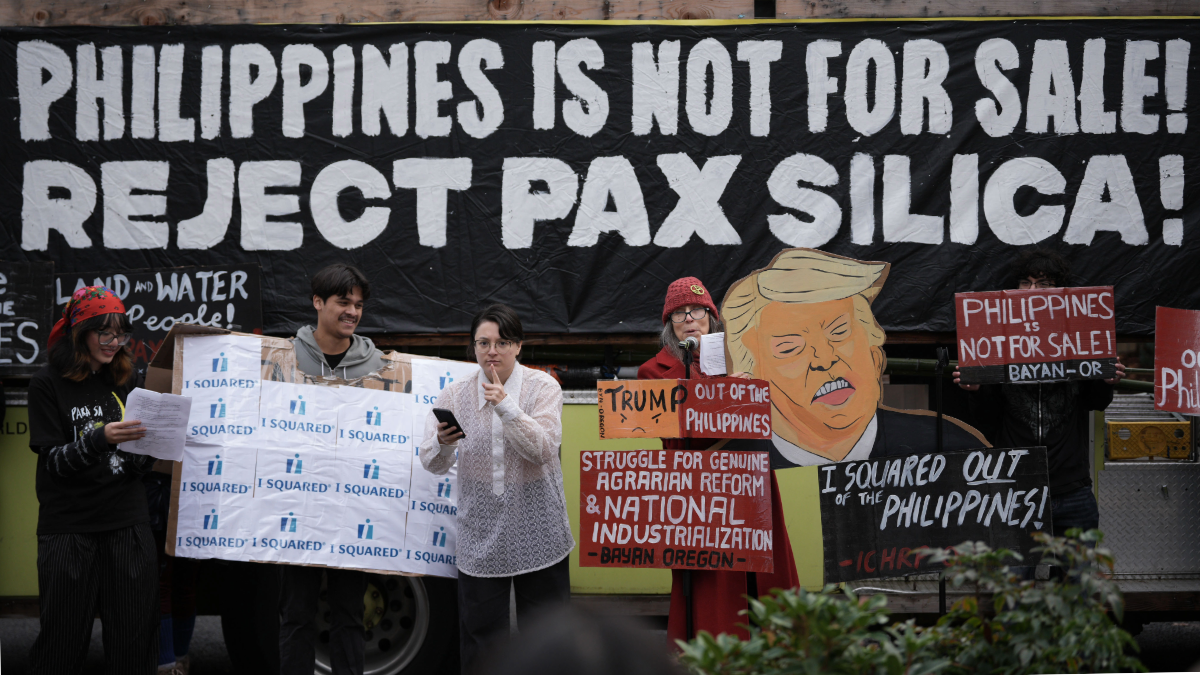
Bayan, Malaya and International Coalition for Human Rights in the Philippines (ICHRP) protesters hold a rally outside the office of Senator Ron Wyden (D-Ore.) in Portland, Ore., on Nov. 16, calling for US President Trump to stay out of the Philippines and to reject Pax Silica as he attends the ASEAN Summit. (Photo by Alex Milan Tracy/Sipa USA)(Sipa via AP Images)
Good morning!
On Thursday morning, I took the subway to Times Square to the Nasdaq. It was a bright, sunny fall day. As Anthropic executives including CEO Dario Amodei applauded their Nasdaq debut inside the glass building, demonstrators outside held signs reading "Stop Tech Oligarchs" and "Freeze AI." The demonstrators made it clear what they want: regulation of AI systems to ensure their safety, mitigation of the environmental and labor impacts of the technology, and assurance that if the bubble bursts, there will be no bailout for Big Tech.
We had multiple pieces covering the IPO and the markets this week. One came from journalist Chris Stokel-Walker, who used the debut as an opportunity to consider where we've got to on governance. AI companies have spent three years building governance structures meant to keep powerful AI in check, he wrote, but the question is whether those structures work in practice. “Three years after OpenAI's board demonstrated that it could fire a CEO — but couldn’t keep him fired — its rivals have developed elaborate governance mechanisms intended to make independent oversight more effective,” he reports. Anthropic’s corporate governance structure is unusually complicated.
A second piece focused on one of the ideas we hear about all the time these days: recursive self-improvement (RSI). The sales pitch for the Anthropic IPO included the promise of self-improving AI, and Eryk Salvaggio, a Gates Scholar researching AI and the humanities at the University of Cambridge, asked what, precisely, is the "self" in RSI — and whether the evidence supports the idea that we are on the verge of an "intelligence explosion."
Despite the excitement around the Anthropic IPO, on Friday, the S&P 500 stock market index entered into correction territory on concern about the sustainability of the AI boom. Questions loom as to whether the bubble is about to burst.
On that subject, Mark MacCarthy, an adjunct professor at Georgetown University, and David Klaus, former deputy under secretary at the US Department of Energy, argue that this month's market crash reflects investor recognition of AI overinvestment rather than fear of regulation. “The US does not have industrial policy tools capable of dealing with overinvestment — contraction cycles,” they wrote. “But the political backlash against data centers might provide an accidental substitute, forcing a necessary slowing in data center growth just as the oversupply was becoming increasingly evident to everyone. Let’s hope that AI developers take advantage of reduced compute supply to cut back on an increasingly dead end AI race and focus on providing real value to AI users.”
Platform extractivism and the gig economy
We published two podcasts this week, which are complementary.
- Tech Policy Press fellow Lam Le recently attended a gathering of platform workers from across Asia hosted in Bangkok. In a new podcast, she shares what she learned from riders, outsourcing workers, artists, unionists and researchers who are fighting for their rights, including interviews and recordings of their remarks.
- I had a chance to speak with Yale's Julián Posada about Platform Extractivism: Data Work and the People Powering Artificial Intelligence, his new book on the Venezuelan data workers who labeled training data for AI during the pandemic. You can listen to our conversation here.
Political participation & democracy's digital fault lines
- NYU's Center for Social Media, AI and Politics and the Knight-Georgetown Institute convened researchers and policy experts on AI and elections. KGI’s Leticia Bode and NYU CSMAP’s Katie Groome report three takeaways. Among them: AI "can provide accurate election information, but often doesn't."
- Social media bans for young people, write Tess Vartanian and Aliya Bhatia of the Center for Democracy & Technology, function as "a tool for censorship and a barrier to entry for political participation." Cutting off the communications networks young people use to find one another can stop a movement before it starts.
Regulators close in on platforms
- The EU's case against TikTok over harmful rabbit holes signals that regulators are demanding fundamental changes to platform design. Lisa Dittmer of Amnesty International writes that it is time to set out clear, binding rules.
- Brazil is racing to pass its first law targeting Big Tech's economic power before a new Congress is sworn in. Journalists Giovana Fleck and Laís Martins on the vote, the lobbying against it, and what CADE would gain. “If approved, Brazil’s digital markets bill will be the first of its kind among Global Majority countries, and could set a precedent for other BRICS countries,” they write.
Personal AI agents, corporate control
- OpenAI, Anthropic, Meta, Google, Microsoft and xAI have all released personal AI agents since mid-2026, writes George Colville of Open Markets Institute Europe. He warns that a few firms could become the gatekeepers of how people shop, read the news and communicate.
- "Surveillance is the business model of the internet," write Brett Frischmann, the Charles Widger Endowed University Professor in Law, Business and Economics at Villanova, and Bruce Schneier, a professor at the University of Toronto Munk School — and AI agents are about to inherit it. They say governments still have time to impose data minimization rules, but need to act now.
The US tech grip has global costs
- US President Trump arrived in Manila for the ASEAN Summit amid protests against Pax Silica, a US-led tech supply chain coalition. Tech Policy Press fellow Lam Le reports on why thousands of students, activists and Indigenous communities oppose its first industrial hub in the Philippines. “Beyond the environmental and social concerns, the project has also prompted debate over whether Pax Silica makes sense as an industrial policy strategy for the Philippines,” she reports. (There were solidarity protests elsewhere in the world, such as the one pictured above.)
- A global Microsoft outage locked UK public sector workers out of email and Teams across hospitals, police forces, courts and government departments. Days after, UK ministers said the NHS's Palantir contract would be extended to 2029. Tech Policy Press fellow Evie Breese reports on what it exposed about the UK’s control of critical digital infrastructure.
Google AI overviews pose problems for publishers
- A field experiment finds Google's AI Overviews cut outbound clicks to publishers by about 40%, with no measurable gain in user satisfaction. Courtney C. Radsch, director of the Center for Media & Digital Governance at the Open Markets Institute, on what it means for regulators.
A proposal for the UK’s AI Assurance Agenda
- The UK's AI Security Institute could anchor Britain's AI assurance industry, lead research on AI verification, and build a middle power coalition on AI safety, write Luke Cavanaugh, head of strategic initiatives at Cosine, and Harry Camilleri, an advisor to the Government of Ukraine.
Congressional staffing shortfalls limit tech oversight
- The number of congressional committee staff is “just over half of its peak in the early 1990s,” writes Anna Lenhart, a former technology policy advisor at the White House and US House of Representatives. She argues the shortfall leaves Congress overwhelmed, with consequences for both oversight and legislation.
AI hype & the AI ‘race’
- "Hype is a way of organizing power in the present through stories about the future," writes Martin Wählisch, associate professor of international relations at the University of Birmingham. The metaverse, he argues in a new installment in the Hype Studies series, offers a case study in how people and institutions organize themselves around hype.
- "AI is an artifact — made, not born," write Mor Naaman and Frank Pasquale of Cornell Tech. "If we assign rights to these machines, the resulting power will simply accrue to those who make and control them."
- Shuxian Liu and David Gray Widder of the University of Texas at Austin compared how the US government, Chinese state media and online publics in both countries talked about DeepSeek. Their conclusion: "Who is winning the AI race?" is the wrong question.
Surveillance, ‘synthetic suspicion,’ and state overreach
- An EU plan would let border agency Frontex flag posts under the DSA and ask national authorities to order removals. Civil society groups warn it could weaken the law's safeguards against government overreach, reports Tech Policy Press deputy editor Ramsha Jahangir. “Civil society groups argue that the practical effect could be that platforms give greater weight to notices from an EU agency that also has power to ask national authorities to initiate enforcement action,” she reports.
- What happens when the suspicion behind a police action is synthetic? Tech Policy Press fellow Jake Laperruque asks what happens when the basis for that restraint is an AI score instead, and why it's so hard to know how much weight such recommendations deserve.
Large platforms are hiding behind privacy claims
- Eric Null and George Slover of the Center for Democracy & Technology argue that competition laws mandating interoperability and data sharing should be written to protect user privacy and security, while preventing large platforms from using those concerns as a pretext to hindering legitimate privacy and security protections.
Department of nomenclature
- Bugmageddon. Patchpocalypse. Vulnerapocalypse. Bugocalypse. Breachpocalypse. Patchageddon. Ashley Faler and I cataloged the variety of names for the AI bug/patch flood.
What we’re watching
- Tech Policy Press is hiring a US Editor! The role is remote, but is US-based. The role will shape our US coverage: commissioning, editing contributors and fellows and writing reported analysis on AI governance, platform regulation, privacy, competition and digital rights. Rolling review until Dec. 15. Apply now.
- Help us build our annual reading list! Which tech policy or tech politics book published this year deserves a spot on everyone’s shelf? Submit your nomination by Dec. 7.
- Interested in learning more about AI agents and how they will reshape the web? In the coming weeks, the Knight-Georgetown Institute will soon launch a new online hub featuring a curated syllabus of key research and readings, a technical primer exploring how the web is responding to the rise of AI crawlers and agents accessing online content, and additional resources. The hub will continue to grow, with forthcoming analysis and a report from the recent Workshop on the Agentic Information Future hosted by KGI and Tech Policy Press. In the meantime, check out this tutorial recording.
I wish you the best for the week ahead!
-Justin
Authors