Europe's W Social Bet Tests its Vision of Digital Sovereignty
Megan Kirkwood / Jul 7, 2026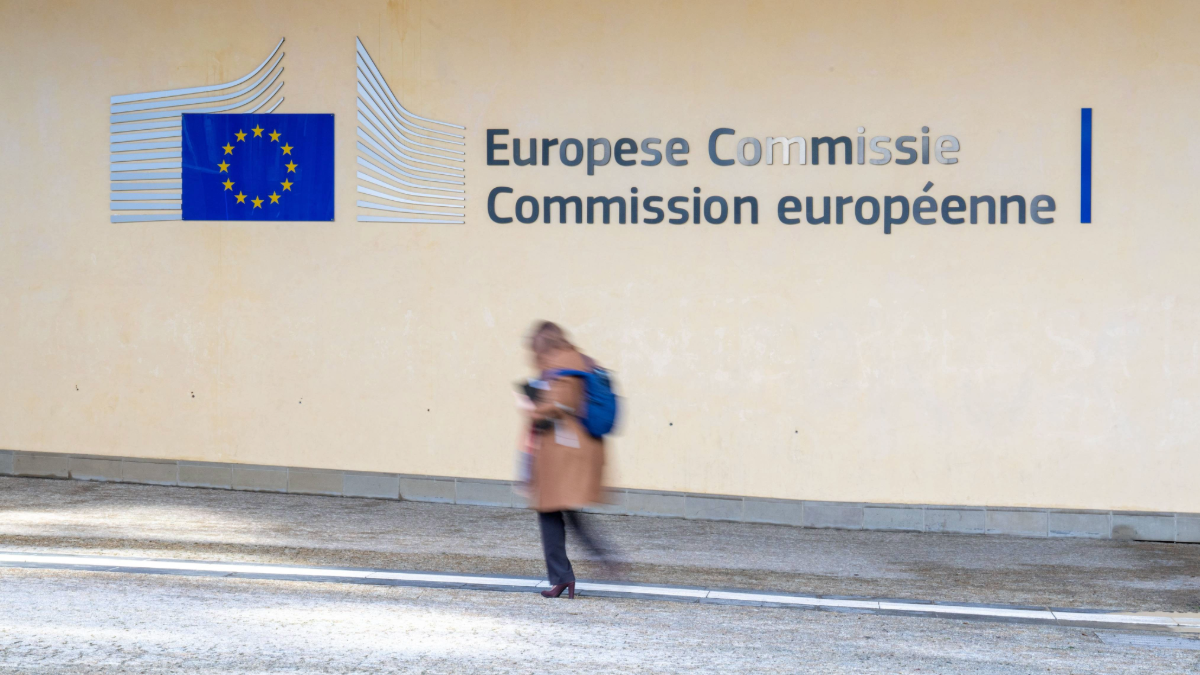
A woman is passing by the logo of the European Commission at the Berlaymont building in Brussels, Belgium, on Friday, 17 April 2026. (Photo by Marius Burgelman/Belga/Sipa USA)(Sipa via AP Images)
When the European Commission announced that it was joining W Social, a new European social media platform built on the AT Protocol, the move attracted attention as an apparent effort to align its communications strategy with its broader digital sovereignty agenda.
The announcement followed the Commission’s release of its Tech Sovereignty Package, a set of legislative proposals to boost the bloc’s autonomy over its digital infrastructure, which includes support for decentralized open networks. Yet the move to W Social has also prompted criticism. Although W Social does not appear to meet the EU’s own Open Source Strategy, senior EU leaders — including European Commission President Ursula von der Leyen and President of the European Council António Costa — have publicly endorsed the platform, and the Commission has migrated its Bluesky account to W Social.
The episode raises broader questions about what "digital sovereignty" means in practice. In a policy brief on tech sovereignty, the European Commission outlines that digital sovereignty is understood as the EU's capacity to exercise its independence in the digital domain, ensuring the EU retains its “ability to decide, invest, and innovate according to European values of democracy, openness, and the rule of law.” Acknowledging that Europe is highly dependent on US technology, the need for greater control over its digital infrastructure has been highlighted as a top priority for the EU.
The Commission’s Open Source Strategy outlines the ambition not only for Europe to wean itself off US Big Tech but also to pursue a different approach to European tech adoption, recognizing the benefits of a more open and distributed approach to tech adoption that avoids the pitfalls of vendor lock-in. However, its actions signal a pursuit of tech sovereignty which focuses only on where infrastructure is located, ignoring the need to also pursue sovereignty through openness, interoperability and user choice.
A European alternative to X
Launched at the 2026 World Economic Forum in Davos, W Social describes itself as a for-profit European social platform governed by European law, hosted on European infrastructure, and "designed for conversations among humans around the world." The platform positions itself as a European alternative to X. Its principal distinguishing features are identity verification intended to reduce bots and its use of the AT Protocol, the decentralized networking protocol developed by Bluesky.
The company’s CEO and co-founder is Professor Anna Zeiter, previously a professor in Data Protection Law at the University of Bern with experience working at companies like Flo and eBay. Ingmar Rentzhog is the co-founder and sits on the board of W Social and is a co-founder and CEO of the media firm We Don’t Have Time, a backer of W Social.
On the surface, its uptake by the European Commission is a positive sign that decision makers in Europe are signaling interest in moving away from platforms based in the US. Although the Commission already maintains a presence on Mastodon — including operating its own server — it continues to rely heavily on commercial platforms such as X and LinkedIn for public communication. However, artist and open-network advocate Elena Rossini noted that W Social had removed its public GitHub repository, prompting criticism from developers and open-source advocates, who viewed the move as inconsistent with the collaborative ethos of the AT Protocol ecosystem.
What the protocol was built to do
Understanding the criticism requires understanding the goals of the AT Protocol itself. Although often associated with the Bluesky social network, the protocol was designed by the Bluesky team as a shared infrastructure that allows multiple applications to interoperate rather than tying users to a single platform. This simplifies app creation for developers, who can build on top of an open protocol and plug straight into a network. Rather than competing against apps to concentrate all users on their individual platform, users can mix and match apps and components of apps without having to rebuild their accounts and networks of followers and friends.
The purpose of the protocol is to facilitate the creation of an ecosystem of apps that users can easily move between or use in combination, which is diametrically opposed to the dominant model of centralized platforms like Facebook and Twitter, which are designed to lock in users. Going beyond enabling competing apps within the ecosystem, the protocol aims “to enable decentralization by having multiple interoperable providers for every part of the system.” This means users control their feeds and how they are presented, and can pick their own content moderation services within the apps on the protocol. Though technical commentary has questioned the potential limits to how decentralized from Bluesky the AT Protocol ecosystem can become, the AT Protocol was designed with “credible exit” in mind to avoid the pitfalls of remaining trapped within “enshittifying” centralized platforms.
With openness at the heart of the project, major apps like the Bluesky social network and Blacksky, a social networking organization that began as a custom feed on Bluesky centering black voices, have both open sourced their code, which is viewable on GitHub. Though it is not mandatory to open source its code, it is in keeping with the philosophy behind the protocol to do so. Indeed, openness has meant that developers are able to learn from each other.
For instance, Blacksky, which has grown from a custom feed to now offering a fully open source and decentralized stack of technologies for communities to build their own social networks, inspired the team at Eurosky to develop a similar European social networking infrastructure based on the AT Protocol. Sherif Elsayed-Ali, a co-lead for Eurosky, wrote that the team can build new apps quickly “because we’re building on open source foundations and years of work by others. We contribute back by open sourcing our work so others can use it. Open source is an incredible force multiplier.” This illustrates why it is significant that W Social has chosen to close its codebase; it directly contradicts the project of the AT Protocol. Because the company has chosen to close its GitHub repository, other developers cannot build on their work or build interoperable services with W Social.
Part of W Social’s pitch is to build a space where only verified humans can participate. For users who sign up for W Social or migrate their existing Bluesky accounts to W Social, their account is still viewable to those using other AT Protocol apps, but W Social requires identity verification for posting, commenting, messaging, and interacting with users on the W Social platform and the feed is only viewable from the W Social app. To verify, users must use a separate app, W Identity, to scan either a passport or a national identity card, prompting security concerns for some.
However, this approach undermines the interoperability that the decentralization movement aims to achieve. The goal is to let users access networks through the apps or communities of their choice, mix and match feeds and algorithmic ranking, and customize content moderation to meet their needs. By building on the open protocol, W Social acknowledges the benefit of directly plugging into the entire existing network comprising over 40 million users. However, critics say it is also attempting to draw users into a closed ecosystem. Elsayed-Ali stated that while there are cases for closed community spaces to be built, public apps that position themselves as a public square “should not be gated.”
W Social has publicly explained that while repositories were previously publicly accessible, they were made private while “we reviewed security, privacy, licensing, intellectual property, documentation and commercial considerations.” They have said that they may again publish “selected components, improvements, integrations, bug fixes and technical documentation” in the future upon review. They reiterated a commitment to supporting open standards, interoperability and user choice, as well as contributing “responsibly” to the AT Protocol ecosystem, while balancing a need to build their own “secure, sustainable and distinctive service.”
However, by closing its codebase and attempting to shy away from the interoperability that the AT Protocol ecosystem was built to facilitate, it moves closer toward the model of the centralized platform, locking in users, denying user choice and control, the very issues that adopting open source and decentralized networks are supposed to fix. The mere fact that its servers are based in Europe is not sovereignty if users are denied control.
What the Commission's own strategy says
Online commentary on the Commission’s move to W Social has questioned why the agency has backed a closed source platform mere weeks after publishing its Open Source Strategy. The strategy outlines a set of recommendations by the Commission to support the adoption and development of open source technology, arguing that it can be a successful strategy for Europe to maintain control over its digital infrastructure. At the heart of the strategy is the pursuit of a digital ecosystem that is “interoperable, portable and based on the widespread adoption of open standards – to ensure that public and private users can choose, switch and scale technological solutions without prohibitive costs.” The open strategy includes tech throughout the entire stack, from cloud computing to social networking.
The strategy makes clear the benefits of open source, pointing out that it promotes secure and auditable digital infrastructure, enabling independent inspection and peer review, while also boosting competitiveness. Similar to the motivations behind the AT Protocol, the strategy points out that open source lowers the barriers to market entry, and reduces costs by fostering “collaborative innovation by enabling communities and companies to jointly develop, adapt and secure technologies.”
The strategy lays out objectives not only to “strengthen and promote a vibrant open source ecosystem” but also to promote and adopt “open and interoperable digital ecosystems for public administrations, including EU institutions.” Recognizing the Commission “as a major public administration and policymaker,” the strategy states that the administration will use and develop open source broadly, “contributing to a European open and sovereign digital ecosystem.”
Mastodon’s Executive Director, Felix Hlatky, told Tech Policy Press that “we believe the European Commission is making thoughtful decisions,” citing the Commission’s Mastodon server and the Tech Sovereignty Strategy as demonstrating “that they understand sovereignty isn’t just built at the server level but throughout the entire technology stack.”
However, Sebastian Vogelsang, a co-lead at Eurosky, reacted to the Commission’s adoption of a closed-source app with "surprise," given the aims outlined in the strategy to support open source. He also stated that in a recent workshop on the future of social media, researchers from the Commission’s Joint Research Center had “presented recent work highlighting the importance of open social media infrastructure and specifically referenced initiatives such as Eurosky”, further adding confusion to the decision to migrate to W Social.
Nicholas Gates, Senior Policy Advisor at OpenForum Europe, told Tech Policy Press that “this decision doesn’t reflect well on the Open Source Strategy.” “There is a need to have the right principles beyond just seeing that this is built on an open protocol. It also shows some of the contradictions inherent in implementing a strategy like this and reveals some of the underlying friction in implementing an Open Source Strategy in such a large bureaucracy.” Gates, however, does not think that this decision dooms the strategy as a whole, but it shows that implementation is going to be uneven at times.
Jean Cattan, the Future of Technology Institute’s Of Counsel, warned that the European Commission’s policy choice could risk favoring closed solutions and signals “a narrow pursuit of digital power.” He warned that the Commission should protect its aspirations of an open, distributed, and shared digital economy, arguing that “we should redirect momentum toward genuine market openness rather than a race for power that would run counter to the founding principles at stake.” Aline Blankertz, co-founder of the digital-policy collective Structural Integrity, similarly added that the Commission’s pick of W Social “illustrates the Commission's interpretation of sovereignty: European companies should imitate the principles of US companies instead of building on principles that structurally limit dependencies.”
This may be the first stress test for the AT Protocol, one that tests how well centralization resistance is built into the protocol’s structure. Bluesky’s stated motto, “the organization is a future adversary" articulates the project of the AT Protocol to ensure that users “can easily pack their bags (take all of their data and relationships with them) and move to a different server.” Infrastructurally, users cannot be locked in. W Social may become the protocol's first significant test of that premise.
The question is not simply whether users can leave the platform, but whether Europe's digital sovereignty agenda will ultimately favor infrastructure that keeps exit possible or platforms that seek to recreate familiar forms of enclosure under European ownership. Will the Commission proceed to pursue an open source strategy that recognizes the benefits of a distributed approach to tech adoption and avoids the pitfalls of vendor lock-in, or one that settles for sovereignty based on server location?
W Social did not respond to a request for comment by Tech Policy Press.
Authors