Dispatch from the Coalition for Independent Technology Research v. Rubio District Court Hearing
Courtney C. Radsch / May 15, 2026Courtney C. Radsch, PhD, is a journalist, scholar and human rights advocate who currently directs the Center for Journalism & Liberty at Open Markets Institute and is a non-resident fellow at the Brookings Institution. She serves on the board of Tech Policy Press, which is a member of the Coalition for Independent Technology Research.
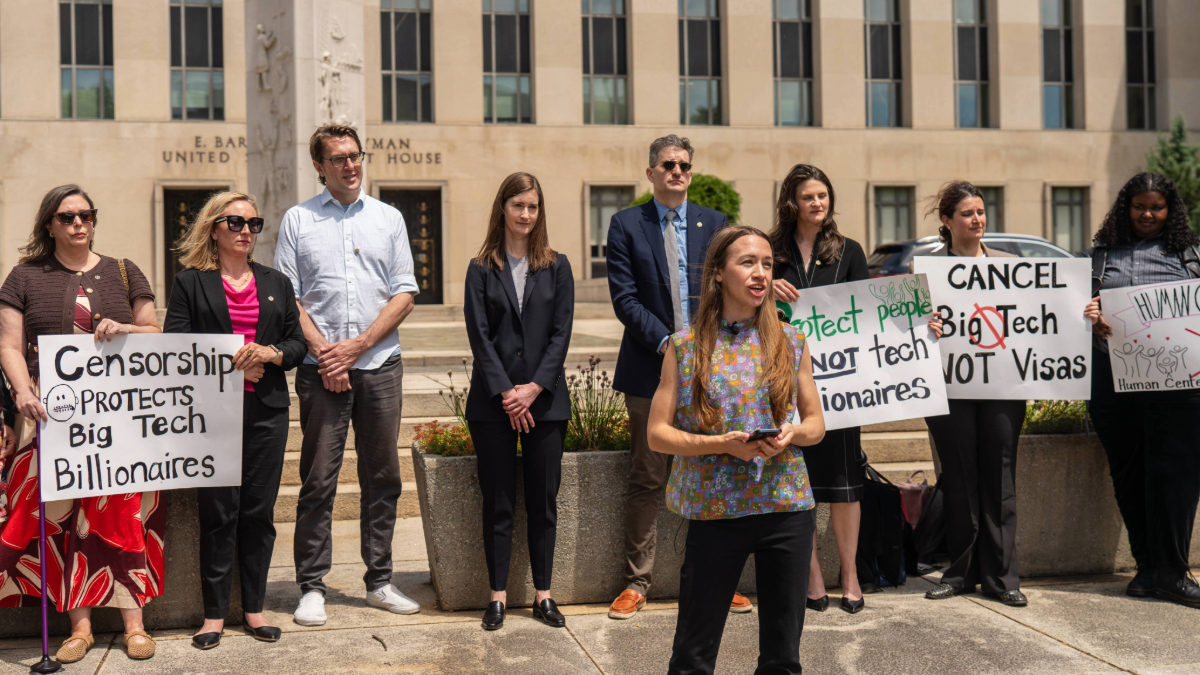
Coalition for Independent Technology Research executive director Brandi Geurkink makes remarks outside the E. Barrett Prettyman Courthouse in Washington, D.C., which houses the United States District Court for the District of Columbia, as members of the coalition (including the author) look on. (Photo credit: Joe Newman)
I spent Wednesday morning at a federal courthouse in Washington, D.C., as a judge heard arguments in Coalition for Independent Technology Research v. Rubio, the lawsuit challenging the Trump administration visa restriction policy on researchers who study social media and online harms. As a member of CITR who has worked with some of the affected researchers over the years, I’ve seen and felt firsthand the chilling effect of the administration’s crackdown on independent research, science, and expression. It felt important to be there.
The policy—first announced in May 2025 and followed by various public statements—targets noncitizen researchers, fact-checkers, and trust and safety workers for visa denials, revocations, detention, and deportation based on their expression and professional associations. It gives the Secretary of State enormous, largely unreviewable discretion to bar any foreign national whose entry or proposed activities in the United States would have "potentially serious adverse foreign policy consequences." As the judge seemed to grasp, the provision was clearly designed with foreign government officials and genuine state actors in mind, not academics and experts, although subsequent statements by Trump administration officials later in the year undermined this formulation.
The hour-long hearing kicked off with US District Judge James E. Boasberg describing the four primary issues he saw as relevant, including: whether there is a single policy or more than one at issue, standing (does CITR or its members even have the right to even bring this case), the constitutional merits of the case with respect to the First Amendment in particular, and remedies. CITR, represented by the Knight First Amendment Institute at Columbia University and Protect Democracy, filed the original complaint in March then moved for a preliminary injunction and a Section 705 stay (asking the court to halt enforcement of the policy while the litigation proceeds), which the government predictably opposed.
The government has framed its policy as a response to "censorship" of American speech online by foreign governments, even though the people actually being targeted by the policy study a range of phenomena, including platform advertising practices, content moderation, and children's exposure to harmful content. The plaintiff attorney, Carrie DeCell of the Knight First Amendment Institute, did a masterful job of laying out how the policy punishes people for their viewpoints and professional associations, chilling not just the speech of noncitizen researchers but the First Amendment rights of their US citizen colleagues who have a constitutional interest in hearing from them. I find that it directly chills citizen expression because people have told me they don’t want to study or speak out on these issues for fear of retaliation and the unknown, such as being pulled aside at the border or investigated for who knows what.
The judge tried to pin down the federal government’s attorney, Zack Lindsey, on the link between the stated written policy focusing on foreign governments and the affected parties, who are nongovernmental organizations and scholars. Lindsey argued that because the targeted people worked for or with foreign governments that the policy did not infringe on their First Amendment rights because it was their behavior or actions, not their speech, that was at issue. Judge Boasberg seemed rightly skeptical of the government’s inability to define the administration’s position on what constitutes working on behalf of a foreign government, and the implications of asserting that anyone who writes, meets, or advocates with a foreign government could be targeted. As the government danced around the question, I found myself wondering if anyone who writes a report, briefs a policymaker, or testifies before a foreign authority on these issues could be accused of aiding a foreign government.
The plaintiffs' argument is constitutional and practical, and frankly, I found myself feeling sorry for the government lawyers tying themselves in knots trying to defend this crackdown on First Amendment grounds while arguing that researcher visa bans and the threat of deportations were somehow not directly related to the policy’s implementation. He seemed to assert that the Secretary of State’s discretion over immigration matters gives him carte blanche and that each affected individual should bring a case on the merits as opposed to reviewing the constitutionality of the policy itself. Watching him try to figure out how to respond to the judge’s repeated questions about a hypothetical policy that banned or deported all redheads and whether a plaintiff could seek relief by contesting the law or just on an individual level by seeking injunctive relief gave me hope that rule of law is still in effect.
The government’s lawyer basically said an individual’s only recourse would be to contest an individual decision, not the policy itself, which the judge seemed rightly skeptical of because he kept asking some version of the same question while observing that this would essentially make it impossible to contest a bad policy. It’s too bad we couldn’t record in the courtroom; it was really interesting and instructive to hear the judge break down each legal issue in what he noted repeatedly is a “complex” case.
The hearing yesterday echoed what I wrote when the complaint was first filed:
Piece by piece I feel like I’m watching as a new system is constructed in which the US government decides who is allowed to study global American platforms, which foreign democracies are permitted to regulate them, and which speech acts constitute censorship worthy of sanction. This is a protection racket dressed in First Amendment language, paraded out in executive orders and weaponized lawfare, and backed by the wealthiest corporations and people in the world.
At least we have the facts and talent on our side, and a judge who seemed skeptical (of both sides) and aware of the importance of this decision not just for CITR and our members, but for researchers around the world, and that this issue is likely to become even more contentious amid the co-called AI race.
The researchers who have already been barred, or who have curtailed their work out of fear, are not just names on a list. Some of them I’ve worked with for years, in the wake of events such as the livestreamed Christchurch massacre in New Zealand, the ISIS beheadings of hostages in Syria, and the insurrection at the US Capitol as we sought to understand how content moderation, terms of service, and platform power shape our information ecosystem and their very real impacts on real people. These are colleagues whose research provides critically important empirical evidence for policymaking. Some of them study the very harms—to children, to democratic discourse, to marginalized communities—that platforms have spent years insisting are too complex to address and which policymakers in the US have failed to stem even as their European counterparts have tried. The administration's position is that studying those harms makes you a censor, that informing and advocating for something better makes you an enemy of free speech.
Sitting in that rather majestic courtroom on a hard wooden bench alongside a dozen CITR colleagues, what struck me was the stakes hiding inside the procedural mechanics of a preliminary injunction hearing, where questions about whether CITR has “standing” and whether there are remedies available were the case to succeed are asked. The core question at stake is about freedom of expression and association, and whether the government can use immigration enforcement as a tool to shape what research gets done, what questions get asked about powerful corporations, and who is permitted to study the platforms that now mediate most of public life. Will the First Amendment protect the research ecosystem that makes accountability and governance possible?
For more on the case, visit knightcolumbia.org/cases/citr-v-rubio, and for more details on the Trump administration’s censorship efforts, visit here.
Authors