Data Centers Were on the Ballot Across the US, and They Lost. What Comes Next?
Jenna Ruddock / Nov 5, 2026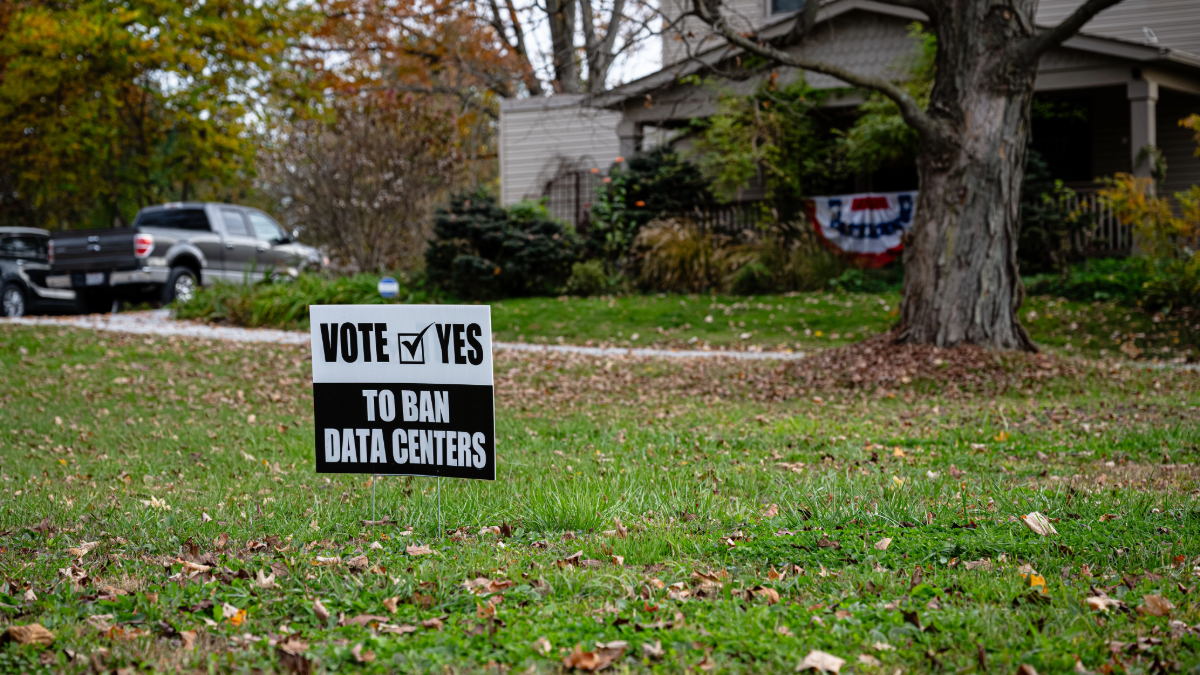
A sign supporting the banning of data centers is seen outside of a home near the Meta Prometheus Campus, an AI data center and supercluster project, is seen on November 1, 2026 in New Albany, Ohio. (Photo by Jon Cherry/Getty Images)
Texas. Ohio. Georgia. Michigan.
As opposition to Silicon Valley’s infrastructure frenzy bloomed across the country over the past year, it became increasingly clear that AI and data centers would have some role to play in the midterm election cycle. We just had to wait and see exactly what the role would be.
On Tuesday night, the answers rolled in.
In Texas, a state that saw some of the most stunning outcomes of the night, data centers featured prominently in Democratic candidates’ platforms all the way down the ballot.
Senator-elect James Talarico has called to end the state’s sales tax exemption for data centers — research from Good Jobs First calculates that the price tag on that tax break is approaching a projected $3.3 billion. Governor-elect Gina Hinojosa called on her opponent, outgoing Governor Greg Abbott, to implement a moratorium until the legislature can convene to pass restrictions.
The state’s incoming agriculture commissioner, the first Democrat to hold that seat in 40 years, is vocal about wanting to support Texas communities fighting data center projects.
“People really understood—especially the rural counties understood—that the same people who are closing our schools, who are telling us we don’t have money, are also giving billions to data centers,” observed Matthew Rodriguez, co-founder of the Amanecer People’s Project in El Paso, Texas. “Data centers felt like kicking rural Texas while they were down.”
In Georgia, another epicenter of new data center construction, the power-hungry facilities’ impacts on utility bills became a flashpoint in special elections last year that saw Democrats flip two seats on the state’s five-person Public Service Commission, which has been Republican-controlled for the past thirty years.
On Tuesday, Democrats held onto those gains and flipped a third seat, gaining control of the Commission for the first time since 1996.
Georgia Governor-elect Keisha Lance Bottoms has called to pause data center construction across the state. So has Maine’s incoming governor, Hannah Pingree. With results still pending in Kansas and Alaska, both states also look poised to welcome governors who have called for moratoriums until statewide regulations on data centers are passed.
Like many Congressional candidates who made data centers a central issue in their campaign, Michigan’s new Senator-elect Abdul El-Sayed linked voters’ concerns about these projects to the broader affordability crisis that was top of mind for many voters as they went to the polls.
One of El-Sayed’s final campaign stops was in Ypsilanti Township, where residents have been fighting a controversial data center project being pushed by the University of Michigan and Los Alamos National Laboratory. El-Sayed told local reporters that he supported a local moratorium and would also like to see federal regulation of the industry.
Voters say no
Of course, it’s rare for statewide or national campaigns victories to hinge on a single issue. Voters across the country went to the polls with a range of urgent concerns in mind — from the affordability of groceries and gas to the Trump administration’s corruption and lawlessness, to the ongoing violence being waged by ICE and cooperating law enforcement agencies across the country.
But in thirteen states, from Florida to Maine, data centers were put to a direct vote. And in almost every place that they were on the ballot, data centers lost.
In Ohio, data centers weren’t just a focus of the state’s hotly contested Senate race between Sherrod Brown (D) and incumbent Jon Husted (R). People across the state voted on ballot measures prohibiting or severely restricting data center construction by establishing zoning regulations, challenging rezoning efforts and amending city charters.
In some places, the outcome was a rejection of an existing project – in others, it was preemptive, having seen what has happened to neighboring communities across Ohio and the broader Midwest. Conserve Ohio, a bipartisan grassroots movement to restrict hyperscale data center development in communities across the state, supported ten cities and villages in amending their charters to support hyperscale data center development.
Jessica Baker, one of Conserve Ohio’s co-founders, walked me through the list of Ohio ballot measures that passed by upwards of 70% of the vote: Sunbury, Pataskala, Urbana, Granville, Trenton, to name just a few. “I mean, these were not just barely wins,” Baker notes. “This sends a message to the state that the majority of the people do not want this.”
Industry’s biggest spending plays fell flat
This was also the first election cycle where a new cohort of pro-data center PACs made significant bets — with little to show for it on Wednesday morning.
A network of organizations linked to Leading the Future — an AI-industry-aligned super PAC funded by major donors including Trump-allied venture capital shop Andreessen Horowitz, OpenAI co-founder and president Greg Brockman, and Palantir co-founder Joe Lonsdale — spent millions on races from South Carolina to Arizona. Build American AI, a Leading the Future affiliate, went big in Ohio. According to an analysis by DeSmog, the group bought “at least $2.54 million worth of television ads [that] extolled the economic benefits of Ohio’s data center boom.” Leading the Future offshoot American Mission contributed a reported $2 million to help Republican Darline Graham keep her Senate seat in South Carolina. Graham lost to Democratic challenger Annie Andrews in one of Tuesday’s highest profile contests; in September, Andrews called for a two-year moratorium on data center construction.
Elon Musk spent close to half a billion dollars during this election cycle, with nearly half of that spending targeting Texas races. Late Tuesday night, Musk posted: “Data centers in space looking pretty appealing right now.”
“The right is fractured,” notes Rodriguez. “That is the clearest takeaway from Texas last night. The tech, the oil, and the Christian fundamentalist, right-wing monied forces are not working together well right now. And that led to a huge realignment.”
What comes next
Tuesday’s results are not only a useful temperature check reflecting where voters stand. They set the stage for a new Congress, and reshaped state legislatures and regulatory agencies across the country.
It’s remarkable how much the political landscape has shifted in less than a year, due in no small part to the tech industry’s relentless appetite for expansion. Last November, moratoria on data center construction had barely entered the national political conversation.
Since then, opposition to the data center build-out has been described as “the most bipartisan issue since beer.” On Tuesday, gubernatorial candidates flipped seats from Maine to Ohio while calling for a moratorium on data center construction. Opposition to data centers was a talking point in highly contested Senate races from Texas to Michigan, where long-shot challengers clinched decisive victories.
Leading tech companies have been on the defensive, with companies like Meta and OpenAI turning to attempted “charm” campaigns that some might describe as thinly veiled efforts to bribe communities into welcoming data centers. But an industry led by billionaires and trillionaires was already finding that, in many places, their money simply won’t move the needle.
The specter of Congressional investigations now looms large, too. Late Tuesday night, Senator Ed Markey (D-Mass.) replied to a comment about “televised trials of Big Tech executives” with a message promising subpoenas. In September, Rep. Jamie Raskin (D-Md.), the highest-ranking Democrat on the House Judiciary Committee, opened an investigation into the data centers industry’s wildly unpopular use of nondisclosure agreements (NDAs) to shield information about data center projects (days later, Amazon claimed it had stopped using NDAs in their deals). Raskin won his campaign for re-election on Tuesday by a margin as large as most data center ballot measures lost.
The road ahead is uncertain. Even as communities are successfully blocking data center proposals across the country — and, in many cases, replacing elected officials who supported those projects — the tech industry’s eye-watering infrastructure bets are only growing. Meanwhile, other industries betting big on data centers — from fossil fuels to monopoly utilities — are increasingly lending their considerable lobbying machines to the tech industry’s cause, both in state legislatures and in Congress.
Still, if AI industry boosters hope the anger voters brought with them to the polls this year is just a flash in the pan, they are in for a disappointment.
In Ohio, efforts to get a state-level data center moratorium on the ballot for the next election cycle are already underway. “We’re still taking cities,” notes Baker. “Any charter city that wants to do that, we can help.”
In Texas, Rodriguez says, Democrats have a real opportunity to build — if they’re willing to seize it. “What can the state government provide and set up the infrastructure for that gives people jobs and gives people a way to improve their air, and their water, and their schools that isn’t a data center — that can show there is an alternative to what people hate already?”
This might have been the first national election cycle shaped by voters’ anger at not only data centers but also the political and economic realities that have enabled this hulking infrastructure to sprawl and lay claim to land, energy and water wherever Oracle or Microsoft or Amazon decide to set up shop next.
But unless voters see real changes — and soon — it won’t be the last.
Authors