Countering Authoritarian Disinformation Requires More than Platform Governance
Marco Perolini, Daniel Joloy / Jul 1, 2026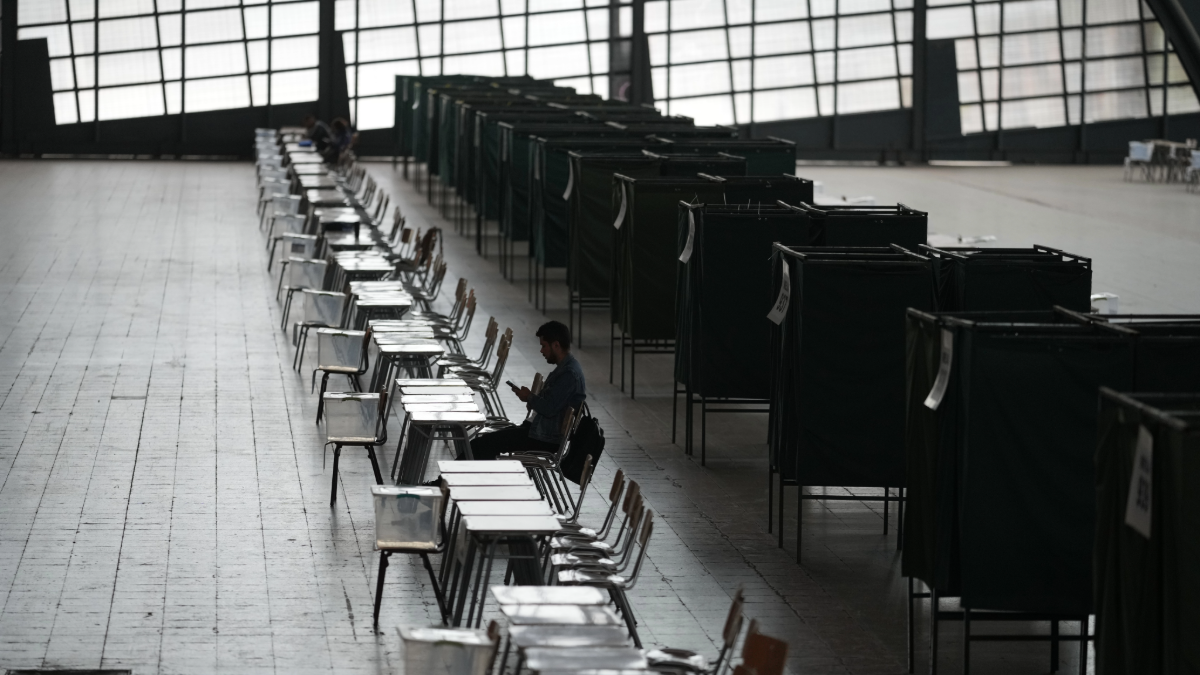
An electoral official sits at a polling station before polls opened for the presidential runoff election in Santiago, Chile, Sunday, Dec. 14, 2025. (AP Photo/Natacha Pisarenko)
In September 2025, a few weeks ahead of the presidential elections in Chile, investigative journalists revealed a coordinated disinformation campaign targeting Evelyn Matthei and Jeanette Jara, the two female candidates in the race. Anonymous online accounts spread false and misleading information, particularly about Matthei’s health, claiming that she suffered from Alzheimer’s disease. The journalists alleged that these online networks were associated with Chile’s Republican Party. However, its leader, José Antonio Kast, who ultimately won the election, denied any involvement. An official investigation into the matter has not yet clarified responsibility for the attacks.
Because of entrenched gender stereotypes, female politicians in Chile and many other countries are indeed more likely than men to be the target of disinformation and other online attacks. As elections raise the stakes, they usually provide fertile ground for disinformation to flourish.
Politicians and other powerful actors exploit these dynamics as they seek to gain or hold on to power. This problem is well-documented. As a recent report by the Observatory on Disinformation of the Complutense University of Madrid revealed, presidential candidates in Chile circulated about 48% of the more than 400 examples of mis- and disinformation observed during the 2025 campaign. Many recent electoral processes, from the USA to Brazil, have been similarly marked by high levels of disinformation by candidates, ranging from false claims against other candidates and electoral authorities to attacks on the electoral process itself.
Debates on how to counter disinformation frequently address platform governance: the online business models that inherently incentivize disinformation and other harmful content. But governments also need to take other urgent actions to address the increasing use of disinformation as an authoritarian practice, described by political scientist Marlies Glasius as “pattern[s] of actions by a configuration of powerful actors to sabotage accountability and entrench power by disabling people’s voice and their access to information.” Disinformation often fits this definition. Confronting it requires a broad set of responses.
Independent journalism is a response to disinformation
Disinformation is more difficult to identify than other tactics to control and manipulate information, such as internet shutdowns or media censorship. Disinformation campaigns involve politicians or state actors but often rely on networks of private, anonymous, or foreign actors, including PR firms, that are difficult to identify.
Independent journalism often plays a key role in uncovering these campaigns. For example, although Matthei, Jara, and other Chilean politicians spoke out against the disinformation targeting candidates during the electoral campaign, it was independent journalists who identified the deceptive coordination behind these attacks and some of the actors using anonymous online accounts. But journalism is under financial strain due to limited public funding and increasing challenges in attracting advertising revenue. In many contexts, independent journalists face harassment, abuse, and violence because of their reporting activities.
Fact-checking is under threat
Second, increased support for independent fact-checking is key because disinformation actors are resorting to increasingly sophisticated tactics and techniques, including the use of artificial intelligence, which makes the determination of what constitutes false content more time and resource-consuming. Fact-checking not only plays an important role in raising awareness of the general public on disinformation, but it also decreases the circulation of mis-and disinformation online and constitutes a solid basis for content-moderation decisions, reducing the risks of removing content that may be protected by freedom of expression.
In spite of its important role, fact-checking, which is often not-for-profit, is under threat because social media platforms are increasingly withdrawing their commitment to third-party fact-checking. Another challenge is that available funding is often provided through short-term grants, and the limited reach makes it challenging to attract advertising revenues or to implement alternative business models.
Advertising and privacy law play key roles
Third, regulations in areas other than platform governance are pivotal to protect people who are targeted with disinformation and ensure there are effective remedies for those affected. Robust privacy frameworks can impose restrictions on the processing of personal data that are used to target people with disinformation. For example, a new privacy law that has just entered into force in Chile this year, similar to the European Union’s regulation on data protection, treats images as personal data and thus establishes restrictions regarding their use by third parties. These laws have the potential to address the use of personal images for fabricating content, including by artificial intelligence. In the context of the Chilean elections, for example, one of the most disturbing patterns was the use by candidates of so-called “deepfakes” for their political campaigns.
Regulations on advertising, including online political advertising, are also important. For example, a new resolution adopted by the Supreme Electoral Tribunal in Brazil restricts the use of generative artificial intelligence to manipulate opinions about candidates and imposes transparency in the use of artificial intelligence more broadly. In the context of the Chilean presidential elections, disinformation permeated political candidate TV broadcasts, as neither the TV regulator nor the electoral authority has powers to control the content of the broadcasts.
Institutional trust relies on a resilient public
Lastly, institutional trust is crucial to protect key institutions and processes from disinformation, including the judiciary and the electoral process. This trust hinges on independent and accountable institutions that are perceived as protecting the public interest. In Chile, for example, the Electoral Service (Servel) is independent from both the legislative and the executive branches of government and is one of the region’s most trustworthy electoral authorities. Servel debunked specific instances of disinformation targeting the electoral process through an internal monitoring system and public communication, which was central to thwarting disinformation and strengthening the public’s confidence in the electoral process.
Building institutional trust needs to come hand-in-hand with building a resilient public that is able to discern what may constitute false information. At a time when the speed and virality with which disinformation circulates is alarmingly increasing, a strong preventive focus involving bold efforts to develop media and digital literacy is essential so that anyone, irrespective of their level of education, is equipped with critical thinking and other skills to detect disinformation.
Countering disinformation while respecting human rights standards
Governments have not fully adapted their responses to these new realities. Many governments have focused on responses to counter disinformation that are wholly ineffective and at odds with international human rights standards. For example, a plethora of governments have enforced laws criminalizing disinformation and/or “fake news” that are often vague, undermine independent journalism, and contravene the right to freedom of expression as they are used by the authorities to silence critics. Other governments pick and choose among a broad set of measures, underestimating the complexity of the actors, intermediaries, vectors and targets of disinformation. Still others engage in efforts to identify possible solutions to disinformation but fall short of ensuring that these are properly implemented. For example, the Chilean former government’s commitment to identify policy solutions to counter, and raise public awareness on, disinformation was not accompanied by a willingness to close legislative gaps.
To address disinformation in the digital age, and to tackle the way in which disinformation is being weaponized as an authoritarian practice to unduly entrench power, responses must be comprehensive and in line with international human rights law. States should implement preventive, legislative, and corrective measures—a mix of responses of which a binding due diligence framework for companies is just one part. Supporting fact-checking, facilitating transparency and access to information, strengthening privacy protection frameworks, and investing in digital and media literacy are central to combating the use of disinformation as an authoritarian practice.
Authors