Congressional Staffing Is the Biggest Tech Policy Problem No One Talks About
Anna Lenhart / Nov 20, 2026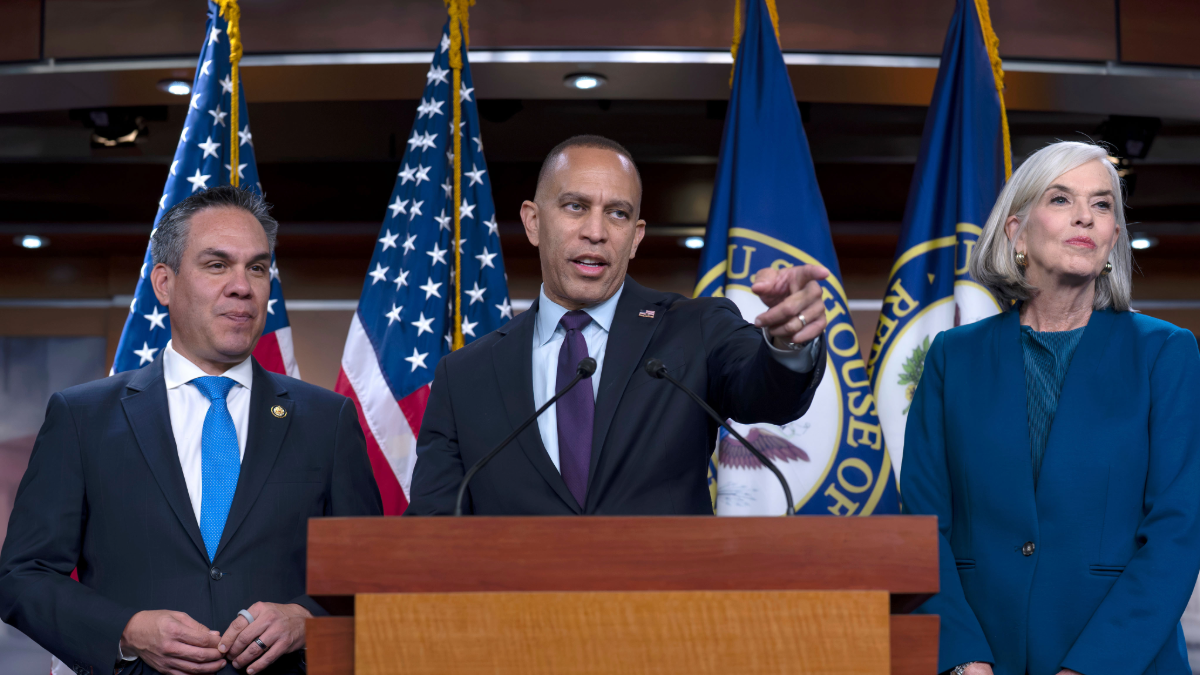
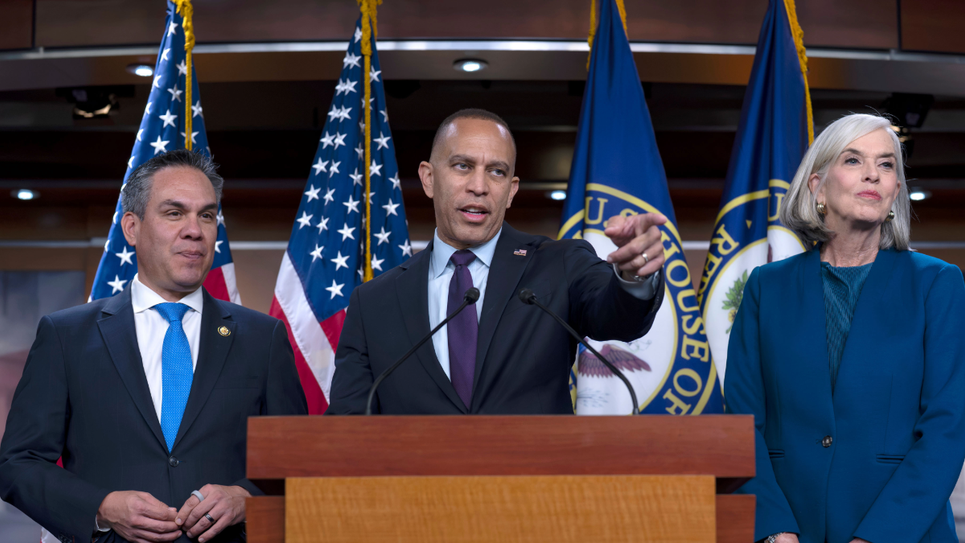
House Democratic Leader Hakeem Jeffries, D-N.Y., center, flanked by Rep. Pete Aguilar, D-Calif., the next House majority whip, left, and Rep. Katherine Clark, D-Mass., the nominee for next House majority leader at the Capitol in Washington, Wednesday, Nov. 18, 2026. (AP Photo/J. Scott Applewhite)
House Minority Leader Hakeem Jeffries, expected to become Speaker of the House in January 2027, recently laid out his priorities in a Dear Colleague letter announcing his candidacy. He writes that “Congress will assume its place as a check and balance on an out-of-control executive branch,” and includes a list of substantial policy goals. Missing from that list, however, is any plan to rebuild the capacity Congress needs to act as a check at all.
This omission requires urgent attention. Congress is overwhelmed. The number of committee staff — the labor force that drives substantial, well-researched, expert-informed policymaking — is just over half of its peak in the early 1990s.
The dearth of staff has contributed to shallow “investigations” that include a letter, press release, and an overly politicized hearing designed to farm likes on TikTok in lieu of deeply researched reports supported by interviews and document requests. Because there are fewer subject-matter experts, Congress produces legislative text that is often narrow, agreeable, and designed to be an ornament on a Christmas tree (lengthy bills filled with provisions for special interests). It is common for legislation to be heavily influenced, if not written by lobbyists representing the billionaires whom voters just rebuked.
House Committee Staff by Year, 1977-2023
Graphic: Anna Lenhart + Tech Policy Press
How did we get here?
Professional committee staff were established by the 1946 Legislative Reorganization Act, a bipartisan effort to prepare Congress to oversee an executive branch greatly expanded by the New Deal and World War II. The Act authorized each standing committee to hire subject-matter experts in the committee’s jurisdiction (e.g., judiciary, agriculture, education). Professional staff were distinguished from staff that do administrative or clerical functions; they were to be hired “without regard to political affiliations and solely on the basis of fitness to perform the duties of the office.” How professional staff are hired has changed since then, most notably when the 1970 Legislative Reorganization Act reserved a share of professional staff positions for the minority party. Professional staff (sometimes titled counsel or policy advisor) remain the primary workforce for in-depth investigations and expert-informed legislation.
When a Republican wave took the House in 1994, Speaker Newt Gingrich surfed in on a set of promises outlined in the Contract with America, a list of reforms signed by 367 Republican candidates leading up to the 1994 midterm. Third on the list was a promise to “cut the number of House committees, and cut committee staff by one-third.” Gingrich followed through on that promise in the opening-day rules package, resulting in a gutting of committee staff, and shifting of power from committees to the Speaker’s office. The institution has never recovered.
Why does this matter for tech policy?
When I served as a technologist and aide in Congress from 2020 to 2023, I was fortunate to have a front-row seat to what I now understand to have been historic, substantive tech policy work led by committee staff: the 2019 to 2020 investigation of competition in digital markets and the 2022 drafting of the American Data Privacy and Protection Act (ADPPA).
Over the course of 16 months, the House Judiciary Antitrust Subcommittee received 1,287,997 documents from the four companies (Apple, Amazon, Google, and Facebook) under investigation and third parties. The investigation’s record included submissions from 60 antitrust experts. Additionally, the Subcommittee conducted interviews with more than 240 market participants, former employees of the investigated platforms, users, and other stakeholders, totaling thousands of hours. The marquee hearing that took place in July 2020 was not just theater. New information was presented to the public, and the CEOs were caught off-guard by the specificity of the questions and had to correct the record three times. Kevin Roose wrote, “If they [CEOs] were expecting to teach tech 101 to a group of clueless lawmakers, they instead found themselves in the principal’s office, being confronted with evidence of the spitballs they’d thrown.”
Similarly, in June 2022, the Energy & Commerce Consumer Protection and Commerce Subcommittee released a 64-page discussion draft of the ADPPA. Over the course of two months they organized hearings and took countless meetings with stakeholders and experts including legal scholars, civil rights advocates, industry actors, and individuals with technical backgrounds. The input culminated in a detailed and negotiated 144-page final bill that was reported out of Committee, 53-2.
The results of both efforts were substantive, market-altering bipartisan legislation with consequences including breaking up Big Tech companies and upending the surveillance-advertising industry. If you tried to hang these bills on a Christmas tree, it would fall over.
There are many reasons neither of these bills made it to the president’s desk, but lack of expertise wasn’t one of them. In rare instances when chairmen allocate their scarce resources to one issue, subject matter experts from the likes of Lina Khan to experienced privacy lawyers can rely on their expertise to lead in-depth research and filter through a wide range of stakeholder input.
Demands outpace institutional capacity
There is a cost. The staff did not follow normal work hours. I witnessed the handful of staff leading the Digital Markets Investigation and ADPPA drafting work nights and weekends for months on end, at an unsustainable pace. I am forever inspired by these teams. Heroic sprints by a handful of staff can’t be the model.
The small numbers of committee staff mean that for every issue in a subcommittee’s jurisdiction that receives attention, dozens fall to the back burner.
While it is hard to get firm numbers (statements of disbursements do not label subcommittee staff), subcommittees typically have three to four professional staff on the majority side and one to two professional staff on the minority side. These staff often report to a staff director who also has subject matter expertise and are supported by junior policy staff. Occasionally, subcommittees can bring in fellows and executive branch detailees to add more capacity. For example, I was a TechCongress fellow when I served on the digital markets investigation.
This is just a handful of experts. Keep that in mind as you consider the full range of issues covered by just one subcommittee: the Subcommittee on Consumer Protection and Commerce (the title when Democrats were last in the majority). Its jurisdiction includes but is not limited to: college sports, horse racing, time itself (yes, daylight saving time), the safety of every car on the road (autonomous or not), and nearly every product in your house, from tip-prone IKEA dressers to car seats to toasters, “smart” or otherwise. It also reaches the full range of harms from data-driven commercial products: surveillance advertising, social media designs that push self-harm content to teenagers, bots and junk fees on Ticketmaster, and counterfeit or dangerous goods on Amazon. There is no way just a handful of experts could effectively oversee this scope.
The Digital Markets Investigation and ADPPA represent the quality of output that will be required to rebuild our institutions, trust in government, and prepare for a future disrupted by increasingly advanced technology — not just in the 120th Congress but for the next several congresses. 2029 in particular will be an opportunity to rebuild many agencies that have been DOGE-ed or Slaughtered (Trump v. Slaughter threatens the independence of independent commissions). We have the opportunity of the century to rebuild agencies such as the Federal Trade Commission, the Consumer Product Safety Commission, and the National Institutes of Health so that they have clear authorities to achieve their mandates and address the AI issues in their jurisdiction. To do so will easily require twice as many mid-career subject-matter and sociotechnical expert staff per subcommittee.
Next steps: Rule X, clause 9
Expanding committee staff is doable and important, but it requires a multi-step process. First, immediately after the Speaker is elected, the House will pass a rules package. Within Rule X, clause 9 of the current House rules, I propose that the House authorize an overall increase in professional staff and an increase in the proportion guaranteed to the minority. When control of the House flips, the party moving into the minority typically has to lay off a large share of its committee staff, and while every committee is different, many choose to keep their staff directors and clerks and fire two to three subject-matter experts. This upends any strong bipartisan relationships that form over an investigation or legislative effort. Setting aside more permanent professional staff positions would enable better cross-aisle relationships and make the job less precarious, perhaps attracting more mid-career and senior-level professionals.
Then the funding for additional committee staff salaries would need to be included in the committee funding resolution and ultimately the annual legislative branch appropriations bill, which must be approved by both the Senate and the White House. The coming budget fights will be complicated, as always, but I hope a proposal to increase committee staff for both parties, backed by a diverse coalition, can make it through.
I understand that people are excited about a Congress that believes in protecting consumers over billionaire profits. I am too. But before you publish your wishlist of policies and investigations, ask yourself: who is going to lead this work in a rigorous manner? Then add funding for expert committee staff to your list.
From where I am sitting, we can have a status quo government put together with duct tape and the gum staff were chewing while they were told to “walk and chew gum,” or we can build the capacity to take on a once in a century opportunity to rebuild and oversee a government that works for Americans from Michigan to Mississippi.
Authors