‘Community Benefits’ from a Hyperscale Data Center are a Mighty Tall Order
Greg LeRoy / Feb 26, 2026Greg LeRoy directs Good Jobs First, a national nonprofit watchdog group on economic development issues.
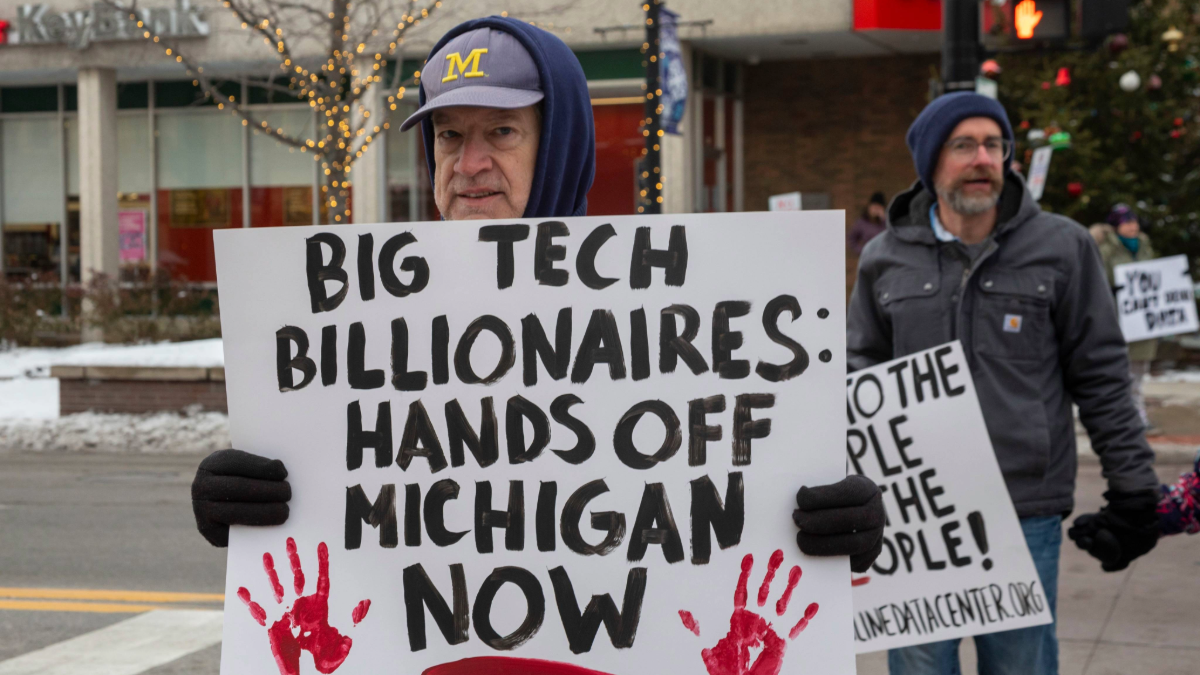
Saline, Michigan, December 1, 2025. Rural Michigan residents rallied against the $7 billion Stargate data center planned on southeast Michigan farm land. Protesters say the data center is being fast tracked by DTE Energy, the large electric utility, and that it could raise residential electricity rates and endanger the water supply. (Photo by: Jim West/UCG/Universal Images Group via Getty Images)
In his State of the Union address this week, President Donald Trump said major tech companies should have to build their own power plants for data centers to avoid driving up household electricity bills. Sen. Bernie Sanders (I-VT) is now openly calling for a federal moratorium on new AI data center construction. The concerns and critiques of the data center boom have gone fully bipartisan — nine states, red, blue and purple, have introduced bills to pause the construction of new data centers. Across the country, the AI boom is colliding with grassroots resistance over noise, tax breaks, power bills, quality of life and community impacts.
Seeking solutions, some have suggested Community Benefits Agreements, or CBAs. As co-publishers of the first how-to manual on CBAs, 25 years ago, we at Good Jobs First are frankly concerned that this powerful tool could get abused in corporate-washing ways.
At their best, CBAs enable community coalitions to reshape major development projects to win local hiring, affordable housing, space for local merchants, and job access via transit. CBAs are especially useful when a development project has a big footprint, like arenas, transit stations, or reclaimed factory brownfields or rail yards. We were all proud when the CBA frame showed up in provisions of recent federal stimulus packages like the Inflation Reduction Act.
At their worst, they’ve been used by cynical developers to whitewash bad deals, sometimes as repackaged strategic philanthropy or even flimsier stunts like free tickets and T-shirts to help justify taxpayer stadium subsidies.
This is exactly what’s at risk with this new generation of hyperscale data centers. Used for artificial intelligence (AI) computing, they can require hundreds of acres of land, millions of gallons of water per day, and enough electricity to power tens of thousands of households. They generate air pollution and often receive enormous tax abatements.
Hence the biggest issue in economic development today: Given their scale and demands, can such huge, extractive facilities ever be modified in ways that are actually win-win? Can we get there from here?
First, the tax-transfer of wealth issue. States find they lose between 52 and 91 cents on every dollar of tax breaks they give data centers, mostly by exempting companies from paying sales and use tax on building materials and equipment. With hyperscale campuses running at $5 billion or more, losing 6% to 8% or more of that in sales tax revenue is real money for states and localities now facing federal austerity. Besides losing the local share of the sales tax, many localities grant data centers local property tax abatements, undermining public schools, health, and safety.
Air pollution is another major issue, especially when data centers are located near Black and Brown communities that have historically borne disproportionate shares of toxics. Hyperscale projects require huge standby power generators to prevent power interruptions — usually provided by diesel-powered generators which must be tested periodically. They emit particulate matter (soot), nitrous oxides, carbon monoxide, hydrocarbons, benzene, and formaldehyde. As data centers stress the US electric grid, some data center projects are planning to generate all of their power on-site, generating continuous emissions.
Next comes the shift in electricity price-burdens. In the nation’s largest energy market, the PJM cluster of 13 mid-Atlantic, Midwestern and Southern states, the Union of Concerned Scientists finds that consumers paid $4.2 billion more for electricity in 2024 to pay for new generating plants and transmission lines needed by data centers. Most states have yet to segregate data centers into their own rate class to ensure they pay their own way for new capacity.
Yet to be calculated is the harm to some states’ “business climates” being caused by data center-driven electricity rate hikes. Auto assembly and parts, pulp and paper, steel, aluminum, chemicals, refining, food, and retailing are especially energy intensive.
States seeking to meet their goals for renewable energy are also finding that fossil-fuel driven power plants, especially natural gas, are required to satisfy AI’s voracious computing needs. Global experts agree that data centers pose a huge new threat to solving climate change.
Then there are water supply and pollution problems. Depending on their location and technology, many data centers require huge amounts of water to cool the heat created by thousands of microchips and servers. Business Insider reports that 40% of existing or planned US data centers are in areas with high or extremely high water scarcity. Rolling Stone reporting from Morrow, Oregon, finds agricultural nitrates at dangerous concentrations in most wells; Amazon cools with water there.
Finally, land use. Data centers need big, level plots, so many are being sited on farmland. In some markets, data center demand has pushed land prices up so high that other uses — especially ones that would host far more jobs — are getting crowded out.
What array of Community Benefits could possibly offset so many big negatives? To get there, states first have to enact reform-benefits.
First: pay your taxes. Ten states already lose more than $100 million per year to data center sales and use tax exemptions on building materials, equipment, and power. Georgia is losing $2.5 billion this year. Virginia is losing $1.9 billion and Texas is losing $1 billion. States need to repeal those exemptions. They must also require data center companies to pay their full-rated property taxes.
Next, developers need to agree to locate in racially neutral locations far from any residences and public spaces and install state-of-the-art pollution-control equipment on standby power plus closed-loop cooling systems that reduce water consumption and water-treatment costs — and create more work for plumbers and pipefitters installing them.
State public utility commissions must put data center companies into a separate class to ensure that homeowners and other businesses are not forced to pay for new power-capacity costs.
Finally, process safeguards. States need to recognize hyperscale data centers as a new species of development project and enact robust advance-disclosure rules that include:
- A full 90 days’ advance notice of a project, with the unredacted project application including the legal name of the facility’s end user (not just the developer or an LLC name);
- Full details of its size, pollution emissions, proposed tax-break subsidies, electricity use, water use, noise levels, and power line siting; and
- At least three public hearings during the 90-days’ notice.
Non-disclosure agreements (NDAs), which are common in data center development, should be prohibited. Of the 31 Virginia communities with data centers, an academic found 25 signed NDAs, preventing meaningful community engagement.
Once all those injustices are addressed, we can talk about local Community Benefits, starting with Project Labor Agreements and requirements to participate in state-certified apprenticeship programs to maximize local construction hiring. There must be Job Quality Standards and local hiring agreements to ensure the permanent jobs pay well and local residents get first crack at them — especially since data centers create so few permanent jobs.
To their organizing credit, members of the International Brotherhood of Electrical Workers wire data centers in many markets, and other Building Trades unions like the Operating Engineers and the Plumbers and Pipefitters also get work in many places. IBEW members also get substantial maintenance work.
Jobs are not the only local issue. Communities need place-specific remedies such as noise- and vibration-abatement features, continuous air quality monitoring, negotiated routing of power-supply lines to minimize disruption to existing land uses, and maximum distance from residential property, schools, and parks.
Combining state reforms with local safeguards, hyperscale data centers could stop damaging state budgets, fobbing their power costs onto others, and endangering local quality of life. That might look like a true Community Benefits Agreement.
Authors