Perspective
Circuit Court Ruling on Border Searches Deals Serious Blow to Privacy Rights
Jake Laperruque / Oct 5, 2026Jake Laperruque is a fellow at Tech Policy Press.
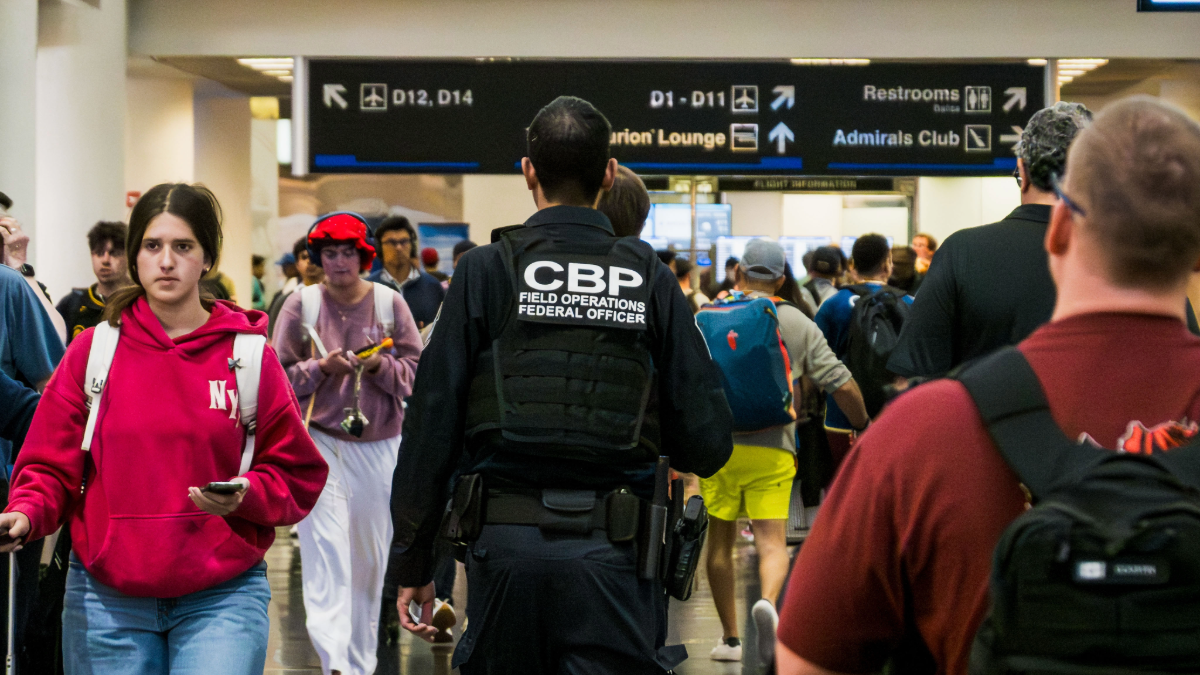
March 10, 2026: US Customs and Border Protection officer walks through a busy airport terminal concourse with travelers in Miami, Florida. Shutterstock
What are the costs of a trip abroad? There’s the price of airfare, lodging, perhaps personal leave from work. But what about privacy?
Because of an outdated legal standard, entering the United States brings with it the serious potential cost of forfeiting Fourth Amendment rights and having private electronic records on your devices searched. Unfortunately, this month an appellate court failed to remedy this issue. Instead, it issued a ruling that overruled protections established by lower courts and kept in place an archaic standard ill-suited for the digital age.
The border search exception is a long-running Fourth Amendment rule that permits warrantless searches of persons and their belongings when crossing the border. But while there is logic in applying such a standard to a barge entering port or a suitcase being carried on a plane, it makes little sense for the phone one carries in their pocket. For these devices, the risk of contraband being snuck across the border is low, but the dangers to privacy are extremely high.
Encouragingly, courts had begun to rein in the border search exception. In 2023, a Southern District of New York (SDNY) ruling in United States v. Alisigwe held that searches of electronic devices when crossing the border must be based on reasonable suspicion. Another SDNY ruling that same year — United States v. Smith — went further and ruled that the border search exception did not apply to searches of electronic devices and that a full probable cause warrant was required. In 2024 the Eastern District of New York similarly ruled in United States v. Sultanov that a full warrant was required to search electronic devices of someone crossing the border.
Unfortunately, the Second Circuit (the appellate court which holds authority over these district courts) just wrenched back this progress. On September 17 the Second Circuit issued a regressive ruling in its review of the Alisigwe case, holding that border searches of electronic devices require neither a warrant nor even suspicion of wrongdoing.
This ruling comes at a time when warrantless border searches of travelers’ personal electronic devices are increasing at a perilous rate. The number of these searches Customs and Border Protection (CBP) conducts has increased almost every quarter (the timeframe data is released for) across the last several years. As a result, CBP warrantless searches of individuals’ devices have nearly doubled since the start of 2023, with nearly 20,000 conducted between April and June of this year:
Warrantless Border Searches of Electronic Devices, 2023-Present
Quarterly device searches at the border have nearly doubled since early 2023.
| Fiscal quarter | Dates | Number of border searches | Change over prior quarter |
|---|---|---|---|
| FY23 Q2 | Jan. 1-March 31, 2023 | 10,007 |
— |
| FY23 Q3 | April 1-June 30, 2023 | 10,462 |
+455 |
| FY23 Q4 | July 1-Sept. 30, 2023 | 11,012 |
+550 |
| FY24 Q1 | Oct. 1-Dec. 31, 2023 | 10,937 |
−75 |
| FY24 Q2 | Jan. 1-March 31, 2024 | 11,273 |
+336 |
| FY24 Q3 | April 1-June 30, 2024 | 12,090 |
+817 |
| FY24 Q4 | July 1-Sept. 30, 2024 | 12,658 |
+568 |
| FY25 Q1 | Oct. 1-Dec. 31, 2024 | 12,092 |
−566 |
| FY25 Q2 | Jan. 1-March 31, 2025 | 12,260 |
+168 |
| FY25 Q3 | April 1-June 30, 2025 | 14,899 |
+2,639 |
| FY25 Q4 | July 1-Sept. 30, 2025 | 16,173 |
+1,274 |
| FY26 Q1 | Oct. 1-Dec. 31, 2025 | 16,083 |
−90 |
| FY26 Q2 | Jan. 1-March 31, 2026 | 16,266 |
+183 |
| FY26 Q3 | April 1-June 30, 2026 | 19,732 |
+3,466 |
Amid these high stakes, it is frustrating to see the Second Circuit roll back protections the lower courts had established, and fail to account for the high sensitivity of the data in modern smartphones. In arguing against prioritizing the privacy interests at hand, the court cites a 1971 case to argue “[A] port of entry is not a traveler’s home.” But — in a manner unimaginable over 50 years ago — a smartphone allows and encourages us to carry virtually all the sensitive records, photos, videos, documents, and messages of our entire life with us. Simply put, phones are the home we take with us in our pocket.
The Second Circuit’s ruling failed to properly account for how the 2014 Supreme Court case Riley v. California should serve as guiding precedent. In Riley, the Supreme Court ruled that the search-incident-to-arrest exception to the Fourth Amendment's warrant rule did not apply to phones. Although the exception at issue is different, the ruling established a foundation that electronic devices are in need of stronger privacy protections than other physical belongings, because “Cell phones differ in both a quantitative and a qualitative sense from other objects.” In making this point, the Supreme Court marveled that “The current top-selling smartphone has a standard capacity of 16 gigabytes (and is available with up to 64 gigabytes).” That was 2014; today the top-selling smartphone (the iPhone 17) has storage ranging from 256GB up to 2 terabytes.
Thus perhaps the Riley Court was ahead of its time in emphasizing that because smartphones contain so much sensitive information — libraries of photos, long-running text communications and emails, web browsing histories, detailed logs of location movements, calendars, “apps for alcohol, drug, and gambling addictions; apps for sharing prayer requests; apps for tracking pregnancy symptoms; apps for planning your budget; apps for every conceivable hobby or pastime” and so on — they create novel risks for privacy that require different treatment than other items we carry.
This holds just as true when someone crosses the border as when someone is arrested. But rather than account for this risk, the Second Circuit court drew an overly general line around all belongings, reasoning the mountain of sensitive data stored in a phone is no more entitled to protection than a piece of luggage. In differentiating device searches from “non-routine” border searches that require suspicion of wrongdoing, the court stated this designation should be “reserved for intrusive border searches of the person (such as body-cavity searches or strip searches), not belongings” (emphasis added). Of course, people’s phones can (and often do) hold photos, videos, and communications that are just as intimate as a strip search; according to a 2024 study, over one in five people keep explicit images of themselves saved on their devices. And phones also hold an array of other equally sensitive data.
Compounding this flawed reasoning, the Second Circuit contrasts how the search-incident-to-arrest exception “historically has authorized the ‘brief physical search’ of ‘a patdown of [the arrestee’s] clothing and an inspection of [items] found in his pocket,” whereas the border-search exception permits “much more extensive searches,” such as of luggage. But these differences are trivial compared to the privacy risks of searching a smartphone. Focusing on the privacy interest of the items in one's pockets versus the items in one’s suitcase when evaluating privacy interest of hundreds of gigabytes of data in one’s smartphone is to miss the forest for two blades of grass.
Perhaps most egregiously, the Second Circuit claims that searching smartphones does not present unique risks since “a similar combination of information could be discovered through a search of everything contained in a traveler’s luggage and vehicle.” This assertion ignores not only the precedent set in Riley, but also a basic understanding of the magnitude of information these devices contain. A modern smartphone can contain the intimate details of your entire life. It could literally store the entirety of the Library of Alexandria. Its contents cannot fit in a suitcase, and an argument equating them strains credulity. As the Riley Court directly said on point, to allege that “a search of all data stored on a cell phone is ‘materially indistinguishable’ from searches of these sorts of physical items… is like saying a ride on horseback is materially indistinguishable from a flight to the moon.”
The wiser course would have been for the Second Circuit to follow the path laid out in Riley: Given the unique privacy threats of searching smartphones, courts should, when evaluating whether a warrant exception should apply, as an initial matter assess whether the unique needs justifying that exception also apply to electronic devices. The search-incident-to-arrest exception is aimed at stopping two specific harms: preventing the risks of an arrestee either wielding a weapon or destroying evidence hidden upon them. Since those risks don’t apply to digital data on a phone in custody of an arresting officer, the Supreme Court reasoned the exception need not apply.
If we apply this Riley-test to border searches, it becomes clear that the reasons for this warrant exception also cannot justify search of electronic devices. The basis for the border search exception is stopping contraband and dangerous materials from being brought into the United States. This goal brings with it the need for some immediate and unfettered ability to conduct searches upon entry. After all, someone might carry into the country materials that pose immediate danger, or alternatively goods so mundane their status as illegally smuggled becomes practically impossible to trace after entry.
But these risks do not exist for digital data. An app on your phone might hold your most sensitive photos or texts, but it cannot hold a kilo of fentanyl or a box of Cuban cigars or an explosive. And while digital data can include dangerous and illegal materials — such as CSAM or malicious code — these items need not cross the physical border to enter the country.
The Second Circuit acknowledges this, noting expert academic commentary on point by Orin Kerr and Jennifer Daskal. However, it then shrugs off the distinction by arguing that “the government is not precluded from barring some avenues of illegal importation because avenues exist that are more difficult to regulate.” But this misses the point: the dispositive issue is not whether a legitimate government interest exists, but rather whether the circumstances create a unique risk that requires a warrant-exception to remedy. And no matter how lax the rules for border searches are, it will not alleviate the risk of digital contraband entering the country via the internet.
More alarmingly, the Second Circuit also justifies its ruling by stretching the rationale for warrantless border searches to go far beyond a battle against contraband. Rather, the court claims the exception is based on a broad government interest in “preventing wrongful actors from entering the country,” “preventing the entry of unwanted persons,” and being able to “control who and what enters the country.” Proclaiming such a sweeping authority is disturbing in general, and especially so at a time when the government appears to have blocked individuals from entering the US because border searches of their phones merely revealed private messages criticizing the President’s policies or meme images mocking the Vice President. And of course, this “preventing unwanted persons” rationale makes little sense in the context of a border search exception that impacts not just visitors, but also lawful residents and US citizens.
This rationale also does not comport with history or precedent: The Supreme Court’s seminal case formally establishing the border search exception (United States v. Ramsey) focused on the dangers of contraband. It justified its ruling by noting the founders enacted customs enforcement powers at the same time as the Fourth Amendment. Earlier rulings assuming existence of this exception described it as based on stopping inflow of contraband. Even the Supreme Court case that the Second Circuit directly cites to assert its “preventing unwanted persons” rationale (United States v. Flores-Montano) states that authority for warrantless border searches is provided “in order to regulate the collection of duties and to prevent the introduction of contraband into this country.” That case was not a broad grant of authority to look inside someone’s heart and mind; it was an approval of customs agents looking inside a driver’s gas tank to find contraband in the form of 37 kilograms of marijuana.
If there is one silver lining to the Second Circuit’s ruling, it is that in a footnote the court declares its ruling only applies to manual review of a phone, rather than the “advanced searches" that involve fully copying, retaining, and subjecting to potential forensic analysis the contents of the device. As I’ve written, these advanced searches raise incalculable privacy risks given the power of AI mobile device analytics. There is also a convoluted circuit-split as to what extent the border search exception applies to them. This split may prompt the Supreme Court to engage on the issue. And hopefully if such review does occur, the Court will apply its rationale from Riley and shield electronic devices from warrantless searches. But for now, international travel will continue to come with significant costs to privacy.
Authors

Jake Laperruque
Jake Laperruque is a policy advocate and expert on privacy and technology, and serves as the Deputy Director of the Security and Surveillance Project at the Center For Democracy & Technology (CDT). His work focuses on national security surveillance, AI surveillance tools, facial recognition, locatio...
Topics
Related
Perspective
The Racial Necrotechnics That Lead to Death By Design at Automated BordersAugust 17, 2026