Brazil’s Presidential Candidates Give Digital Sovereignty Many Meanings
Tatiana Dias / Sep 25, 2026Tatiana Dias is a fellow at Tech Policy Press.
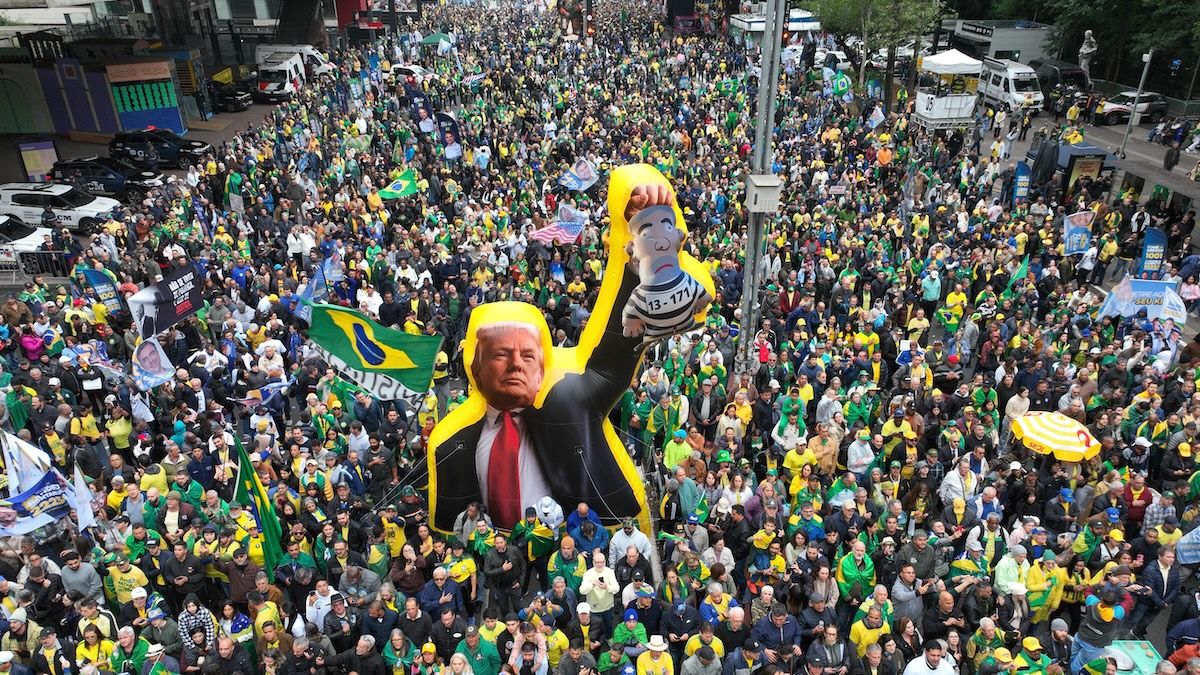
Supporters of presidential candidate Flavio Bolsonaro with a President Trump inflatable, holding a doll of President Lula in a prison unifom, during an Independence Day rally in Sao Paulo, Brazil, Monday, Sept. 7, 2026. (AP Photo/Andre Penner)
In a country split into two opposing poles this election, one thing seems to unite Brazil's five leading presidential candidates, from left to right: they all claim to defend sovereignty. What that actually means, however, varies dramatically – and shows how elastic the concept has become, bending to fit whoever is doing the talking.
The shadow of the United States looms especially large over this election. According to an August poll, 50% of Brazilians considered foreign interference in the election possible; of those, 32% viewed that possibility negatively, while 18% saw no problem with it. Defending Brazilian sovereignty, then, has become electoral currency.
The incumbent President Lula, of the Worker’s Party (PT) is the frontrunner, and treats sovereignty as the central organizing axis of his platform, promising investment in defense, state intelligence, and border protection. On foreign policy, he speaks of a multilateralist approach centered on Latin America and on maintaining independence, "without any kind of strategic subordination."
Lula’s plan casts Brazil as a leader in "building international governance for digital technologies and artificial intelligence, grounded in digital sovereignty, data protection, scientific cooperation, the transfer of strategic technologies, and democratic regulation of digital platforms and AI."
In his current administration, Lula has in fact introduced digital-market regulation and strengthened enforcement mechanisms on platforms, issuing decrees that updated the Marco Civil da Internet (Brazil's internet bill of rights), expanded protections for children, and targeted online misogyny. But there has also been a marked gap between rhetoric and practice, with the administration relying heavily on Big Tech infrastructure in procurements for a "sovereign cloud" and other services.
Lula's platform also calls for sovereign computing infrastructure operated by Brazilian institutions, and for data center and AI infrastructure expansions "accompanied by mandatory socio-environmental safeguards." That promise, too, collides with reality: his government pushed generous data center tax incentives over the past years — first as an executive decree that lapsed, then as a bill signed into law by Lula on Sept. 15.
The government celebrated this ReData law as a matter of "sovereignty," noting that 60% of Brazil's data is currently stored abroad. At the same time, civil society groups, academics, and affected communities criticized the government for insufficient consultation and weak socio-environmental safeguards.
Flávio Bolsonaro's sovereignty “not as ideology”
The far right candidate Flávio Bolsonaro, son of former President Jair Bolsonaro and Lula's main rival, also wants to attract data centers — a point of agreement, as it happens, across the leading candidates' platforms.
In his platform, Bolsonaro invokes the word "sovereignty" too, but "with professionalism, not as ideology," he emphasises, defining "sovereignty" as "a nation's capacity to govern itself, make its own laws, and look after its own territory." It is "exercised in practice, through concrete action — not by repeating the word 'sovereignty' at every turn," the document states.
Bolsonaro's proposal calls for technology to modernize the state and become the economy's "productivity engine," using Brazil's own resources — clean energy and critical minerals — to get there. "We will not just be consumers of technology: we will also be its developers and producers," the plan reads.
The rhetoric, however, is at odds with reality. Flávio Bolsonaro's proposals align closely with US interests: they include what he calls a sweeping cut to "censorship" — a mass repeal of toughened platform accountability measures — paired with a lighter-touch, "pro-innovation" regulatory approach. In a Conservative Political Action Conference (CPAC) speech in Texas in March, Bolsonaro declared that Brazil is "the solution for the United States to break its dependence on China for critical minerals, especially rare earths."
Beyond policy alignment, Flávio Bolsonaro has shown open deference to Donald Trump; he reportedly offered to put his transition team at the disposal of the US government if elected, according to a letter sent to the candidate by US Secretary of State Marco Rubio in June.
In May, Flávio Bolsonaro had traveled to the US to meet with Trump, Rubio, and J.D. Vance, after which the US president posted a photo captioned: "It was very nice having Flávio Bolsonaro in the Oval Office of the White House — A smart young man who loves his Country, Brazil, very much! President DONALD J. TRUMP".
That same day, Trump announced 25% tariffs on Brazilian exports. Brazilian public opinion reacted by blaming Flávio for the punishment, but Rubio made a point of pinning it on Lula instead: "His economic policies are bad for Americans and bad for Brazilians. For the past year, Lula has put his own ego ahead of making a deal for the welfare of the Brazilian people, and these tariffs are the price for that."
In 2025, the US Trade Representative accused Brazil of unfair practices against American companies, citing digital commerce — particularly PIX, the public instant-payment system that has been displacing credit card use — and platform regulation. The investigation request specifically cited “secret orders directing U.S. social media Companies” and a change in the platform liability regime decided by Brazil's Supreme Court (STF) in 2025.
Among the demands Trump has set for lifting the tariffs are a series of political interference attempts — including a requirement that Brazil not restrict the participation of "political dissidents" in the elections — and economic ones, including tariff reductions and demands related to rare earths, deforestation, and digital trade, among others.
The US shadow over this election was visible in plain sight on September 7, Brazil's Independence Day, when Flávio Bolsonaro's supporters took to the streets in his support hoisting a giant Donald Trump inflatable — while chanting for US "intervention."
The election that exposed sovereignty's many meanings
The other three top-polling candidates — Augusto Cury, Ronaldo Caiado, and Renan Santos — also diverge in how they interpret sovereignty. All three sit on the political right, with very different backgrounds.
Augusto Cury is a self-help author and political newcomer who surprised observers by polling near 10%, campaigning on a message of "capitalist mind, social heart." Ronaldo Caiado is a seasoned conservative politician, the former governor of Goiás, an agribusiness champion and tech enthusiast who passed AI and rare-earth legislation in his state, and shortly after signed an exclusivity agreement with the US. Renan Santos is the founder of Movimento Brasil Livre (MBL), the youthful right-wing movement that gained prominence during former president Dilma Rousseff's impeachment in 2016, and is now trying to out-flank Bolsonaro on the right with proposals openly modeled on El Salvadorian President Nayib Bukele’s authoritarian style of governance.
All three explicitly invoke digital sovereignty, but their approaches diverge sharply. Cury emphasizes cybersecurity investment and protection of strategic data, alongside domestic rare-earth processing, with a focus on building national technical capacity. Caiado has a detailed policy that would reserve computing capacity to boost national productivity and development. And Santos uses the word "sovereignty" explicitly, especially around nuclear capability and rare earths, with one wrinkle: that rhetoric coexists with a strategy built mainly on foreign capital, through deals with the EU and the US, in opposition of what he calls the "serious geopolitical problem" of the concentration of rare-earth refinement in China.
Cury and Caiado both propose regulating social media, but differ on implementation: Cury calls for greater platform accountability without committing to specifics, while Caiado's approach builds new rules on top of the existing Marco Civil da Internet framework rather than replacing it. Renan Santos, by contrast, opposes any regulation and defends freedom of expression with no legal mediation whatsoever. Caiado and Santos both have data center proposals, and all three favor market-friendly rare-earth and AI policies centered on "innovation" and tax incentives.
On the left of the spectrum, among the smaller parties, "sovereignty" is an even more common refrain — but as an outright rejection of foreign capital. Hertz Dias's platform for the The United Socialist Workers' Party (PSTU) carries the subtitle "For a Sovereign and Socialist Brazil." Samara, of the socialist Unidade Popular party, also devotes a section of her foreign-policy plank specifically to "sovereignty," promising to end Brazil's "submission" to the United States, China, and "imperialist countries" — and, specifically, to block the handover of Brazil's rare earths to foreign interests.
The symbolic political value of sovereignty
Brazil's election shows how the term's elasticity lets it hold multiple, even contradictory, meanings across the political spectrum under the same umbrella. The word entered the Brazilian political mainstream around Trump's second term, according to Luca Belli, Professor at Fundação Getúlio Vargas Rio de Janeiro Law School, and Director of its Centre for Technology and Society.
"As I see it, this is the moment when everyone should start to grasp the enormous geopolitical risks. Democracy and the economy depend on who's in the White House. And that's a very risky bet to make," says Belli, author of the book Soberania Digital e Inteligência Artificial: Rumo à Autonomia Tecnológica (Digital Sovereignty and Artificial Intelligence: Toward Technological Autonomy).
Belli, who once served as a consultant to the Lula administration's Ministry of Technology and Innovation, defines digital sovereignty as the capacity to understand how a technology works, develop alternatives to it, and regulate it effectively according to one's own values – with self-determination and control over the technologies involved. "The ability to understand, to develop, to regulate – that's the guardian knot of sovereignty."
That's why, in his view, it's unsustainable when candidates invoke the word "sovereignty" while advocating alignment with one pole or another. Sustainability, for him, depends on the capacity to remain independent while building autonomous capability. That doesn't mean cutting ties, but avoiding unilateral alignment, avoiding becoming a digital colony — and recognizing the production chains that sit behind these technologies. "AI systems depend on enabling inputs — minerals, connectivity. If you don't have that systemic view, what the other candidates call digital sovereignty is useless."
Researchers Rafael Grohmann and Alexandre Costa Barbosa have shown that "digital sovereignty" is not a fixed or universally agreed-upon concept. "Instead, it functions as a contested field of meaning, a site where multiple actors with conflicting agendas seek to define the terms of technological governance, whether data, platforms, artificial intelligence or other technologies," they wrote in a 2025 paper.
Grohmann and Costa Barbosa demonstrate how the term "sovereignty" has been co-opted by Big Tech companies selling "sovereignty as a service." "By reframing sovereignty as a service, these companies disembed the notion of sovereignty from its historical associations with collective self-determination, the role of the state and local development,” they write. “In its place, they offer branded frameworks of 'control,' 'compliance,' and 'resilience,' distributed through proprietary infrastructures."
The paper argues that "sovereignty-as-a-service" is a "form of discursive capture in which platform companies define the conditions under which others, whether individuals, corporations, or even governments, can be deemed 'sovereign,' depending on their resources and infrastructural capacities. Rather than sovereignty being exercised over platforms, it is now granted by them, through tools and services that reproduce dependence on their infrastructures."
"The term, in that specific case, is an example of how sovereignty has become a key term – and not just within the world of policymakers, but especially in the current context of geopolitical dispute”, says Grohmann, an assistant professor of Critical Platform Studies at the University of Toronto. “The concept of sovereignty has become something plastic, that depends on who's speaking and in what context they're speaking."
Grohmann explains that the word sovereignty, which emerged in the context of nation-states, takes on different meanings depending on the context. In countries with a history of Nazism or fascism, there's resistance to the concept among progressives because it carries undertones of nationalism; in Latin America, there's popular sovereignty related to social movements for food, ecological, indigenous and territorial sovereignty.
"This shows that even before all this current back-and-forth, the notion was already being contested in terms of meaning. What's happening now is that it's completely fraying,” says Grohmann. “It's become an important currency because it's framed positively in political communication — nobody's going to call themselves anti-sovereign.”
In Brazilian politics, this election is marked by the same phenomenon. Across the spectrum, candidates are reframing openness to foreign capital, submission, deregulation, and outside influence in the very same language — as if Brazil could be sovereign enough to actually choose for itself.
Authors