Brazil's Electoral Court Wants Platform Compliance Plans. Can It Enforce Them?
Laís Martins / Aug 6, 2026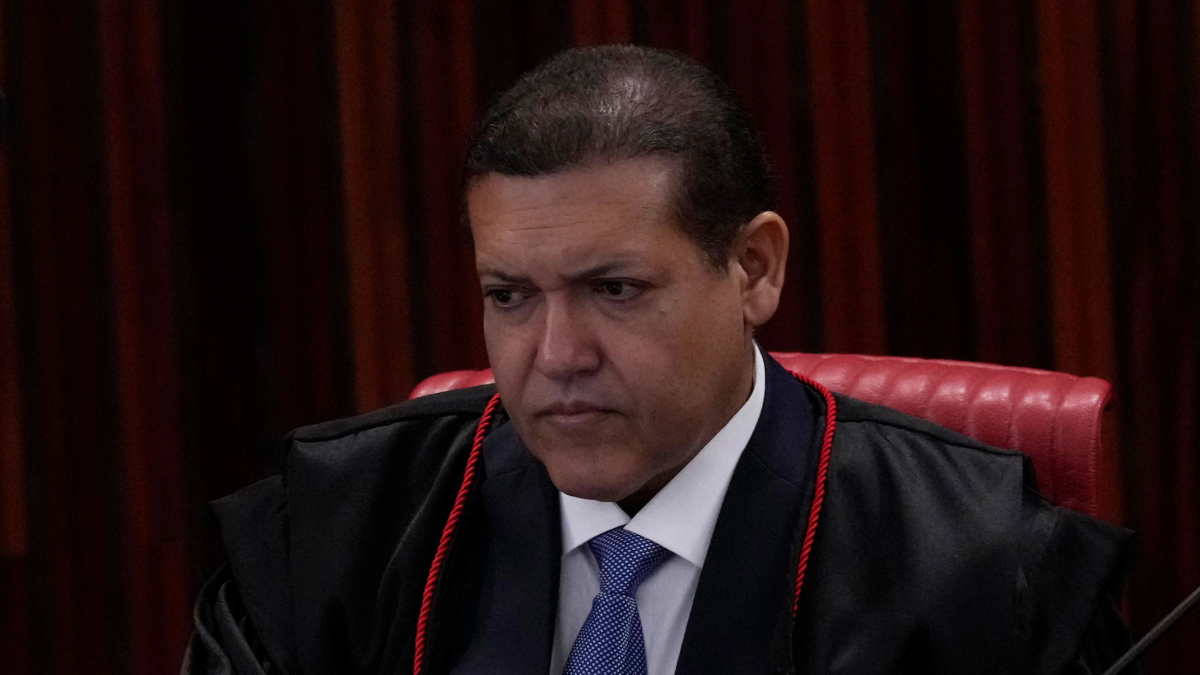
Minister of the Supreme Electoral Court Kassio Nunes Marques attends the trial of former President Jair Bolsonaro at the Supreme Court in Brasilia, Brazil, Friday, June 30, 2023. (AP Photo/Eraldo Peres)
Last week, Brazil’s Electoral Court unveiled an ambitious new instrument to force Big Tech firms to make their election efforts more transparent: compliance plans. In an unprecedented measure, platforms will have to provide comprehensive and structured information on how they monitor, address and counter disinformation, coordinated inauthentic behavior and AI-generated political content.
With just two months before Brazilians head to the polls, the question is whether the Electoral Court will have the means and willpower to enforce it—and if platforms will be willing to cooperate.
In October, Brazilians will head to the polls to vote again for president four years after the elections that put Luiz Inácio Lula da Silva back in the presidential office. Since then, his opponent, former president Jair Bolsonaro, was convicted and is currently serving a prison sentence for a coup d’état attempt which included a plan to assassinate political opponents. With Bolsonaro barred from running, his son, senator Flávio Bolsonaro, became the heir to his political legacy and will be facing Lula in the polls.
In the past two election cycles, Brazil’s Electoral Court has been seen as a stronghold against Big Tech and, particularly, the weaponization of social media by far-right groups. Since the 2020 elections, the court has passed resolutions with rules pertaining to the use of social media during elections and has established cooperation agreements with academic researchers and platforms to ensure rapid crisis responses.
The Electoral Court’s protagonism in producing rules to regulate platforms around elections comes due to a vacuum of legislation, as Brazil has tried and failed to pass comprehensive social media bills in the last decade. In practice, this means ad hoc measures restricted to the election periods very focused on combating information that could compromise electoral integrity, such as attacks on the electronic voting system.
But the new mechanism could shift the logic from this reactive stance to a more proactive posture focused on preventing and mitigating risks, said Tatiana Dourado, Professor at the Department of Communication at the Pontifical Catholic University of Rio de Janeiro and Director of Digital Policies at the Democracia em Xeque Institute, in what she sees as a normative improvement that has been evolving since 2019 leading up to 2026.
“There is a challenge, and a very positive one if it is met, of having platforms provide complete, detailed, comprehensive information,” said Dourado. “And there is another challenge on the TSE’s side on the capacity to follow and track each compliance plan provided by platforms,” she added.
In March, one of the resolutions was edited to include an obligation for platforms to present compliance plans, but the details of what these plans needed to include, what format and deadline were still pending. A decree published in late July laid out the rules, giving platforms a deadline of August 16 to elaborate and present the plans.
The obligation of presenting the documents applies for platforms with over 5 million users in Brazil, either individually or together with other platforms from the same economic group, and excludes email providers and online meeting tools.
Among the requirements, platforms must detail their operational structures to receive, filter and meet court orders during the electoral period, the parameters and criteria used to identify “risk hypotheses” and coordinated inauthentic behavior.
It also demands that generative AI platforms describe the technical safeguards adopted to impede systems from recommending or favoring one candidate over another, to impede systems from generating sexual abuse images of candidates, and the mechanisms used to identify and label synthetic content in organic publications.
The decree determines that failure to meet the deadline could automatically subject platforms to a “regime of direct regulatory supervision.” Under this regime, the TSE would directly order requests for information, indicators and data. Another possible sanction against platforms who fail to deliver the plan would be the impossibility of running political advertisements, an important source of revenue for them.
“One of the differences [from 2024] is opening this window of opportunity for a regulation much more focused on risk prevention and mitigation, and one that demands more responsibility from digital platforms,” said Dourado, mentioning that this happens in the light of a revised understanding from the Brazilian Supreme Court on the intermediary responsibility regime.
Unprecedented window
The compliance plans will also offer academics, journalists and civil society organizations an unprecedented window into platforms’ methodologies and moderation efforts during elections. The decree divides the plans between a public layer and a separate, more detailed, layer limited to TSE servants and collaborators.
The public layer is a direct result of civil society organizations’ efforts to allow it to “become an object of ample scrutiny by society, especially those who follow Big Tech across time, especially during elections,” said Dourado.
This is already much more access than in previous elections, as platforms had been progressively shutting down windows of transparency. From public APIs to ad libraries, many had altogether discontinued measures that permitted academics, civil society and journalists to scrutinize their efforts.
“Transparency in 2024 was restricted to the need of a platform having an ad library. In 2026, the compliance plan demands platforms provide what is their risk assessment, it creates compliance measures for established risks and for the services offered with qualitative and quantitative indicators so they can be monitored,” the professor explained.
Different times, different hands
The Electoral Court is currently presided over by Justice Kassio Nunes Marques, appointed to the Supreme Court by Bolsonaro. That’s a stark contrast to the 2022 elections, when the court was presided over by Justice Alexandre Moraes, the magistrate largely seen as the responsible for Bolsonaro’s conviction. In addition to the cases against Bolsonaro, Moraes has also become known for his rigorous action towards Big Tech.
Since he took over the presidency of the TSE in May, observers have been following Nunes Marques’ measures. Some decisions have prompted more concern. In June, he granted a request from Flávio Bolsonaro’s campaign to censor a poll that showed a drop in voting intentions for Bolsonaro’s son. The poll was the first released after the Intercept Brasil published a story about Flavio’s connections to Daniel Vorcaro, a banker currently under investigation for what has been dubbed as the biggest financial fraud of the country’s history.
In May, Nunes Marques had edited a rule to allow himself and the vice-president of the Court, Justice André Mendonça, who was also appointed by Bolsonaro, to be rapporteurs of court actions about political advertisements. This change put him in charge of some of the most consequential actions that reached the court so far.
But the TSE isn’t the only different variable this time around. In 2022, when Brazil last held general elections, Big Tech were more cooperative and less aligned publicly with US President Donald Trump. They were also not at the center of an ongoing tariff war waged by Trump against Brazil for supposed unfair commercial practices.
On the one hand, a softer stance from the TSE could have a positive effect on not escalating the geopolitical issue, said Andressa Michelotti, a PhD in Political Science at the Federal University of Minas Gerais, a researcher at Margem (Research Group on Democracy and Justice) and a member of Governing the Digital Society at Utrecht University.
“The question is what would things look like with a TSE like in the past, but with Trump now in power,” said Michelotti, referring to the court under previous presidencies that antagonized Big Tech more strongly.
But there is also a question, according to Michelotti, around the feasibility of implementing measures such as the ones required by the TSE’s new resolutions, particularly with smaller moderation teams and with the United States midterm elections taking place the month after Brazil’s vote.
“This is a hypothesis but we may end up seeing a scenario where removing is easier than keeping content online,” said Michelotti, speaking of the risk of excessive censorship by platforms to comply with deadlines and norms imposed by the court given the lack of staff resources.
Platforms’ willingness to comply with the rules is also an open question. While the compliance plans do not allow much leeway, there is a recent history of pushback. Earlier this year, when the Brazilian government published decrees operationalizing the new Supreme Court understanding of the intermediary liability regime, Big Tech and the far-right immediately pushed back.
But what is at play is much more than the risk of fines or other types of punishment. Brazil holds other assets that are very valuable for United States’ technology companies at this moment which could make them more willing to cooperate. “Brazil has leverage in this dispute, not only because of a significant user market—and we consider that users are data and this factors into their monetary and non-monetary calculations—but also because of data centers, this could become a negotiating token,” said the researcher.
Brazil’s incentives to attract data center investments have been a recurring topic on the negotiation table between the country and United States trade authorities. A government-proposed bill with a set of tax breaks and incentives was approved in the Lower House of Congress in February and is now awaiting a vote in the Senate.
Authors