As the UN Launches its Global Dialogue on AI Governance, WSIS Offers Critical Lessons
Jhalak M. Kakkar, Jason Pielemeier, Elonnai Hickok / Jul 2, 2026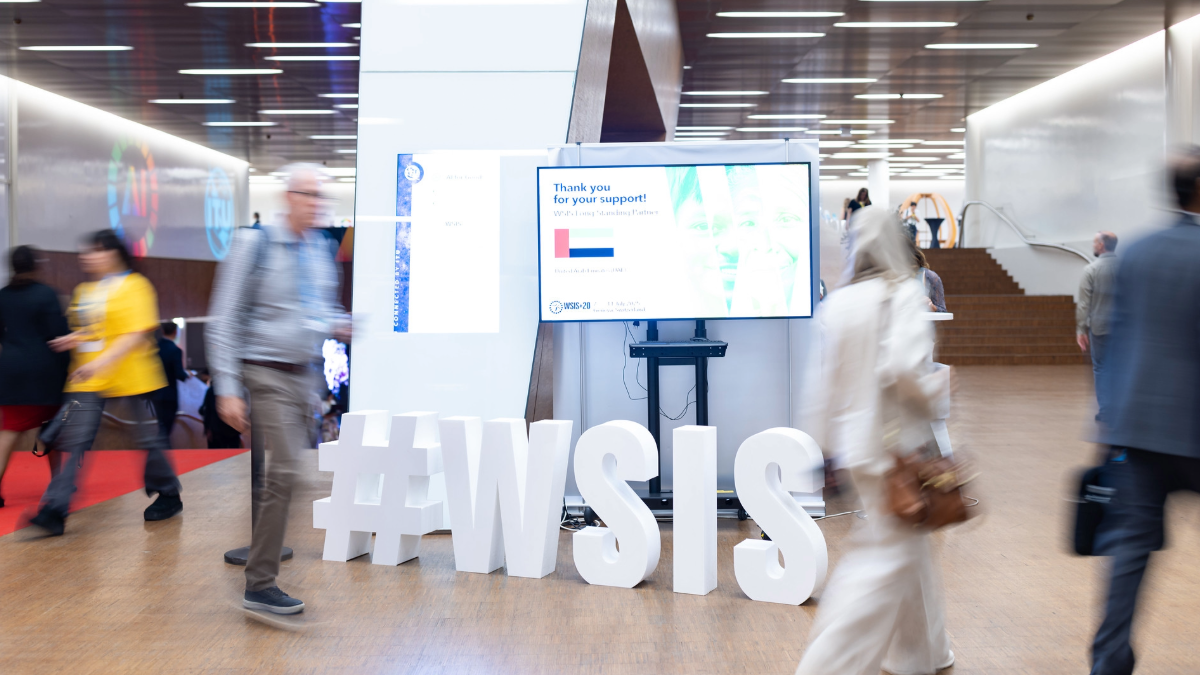
World Summit on the Information Society (WSIS)+20 High-Level Event 2025 by “WSIS” by UN Geneva, CC BY-NC-ND 2.0
Next week in Geneva, two important United Nations processes designed to govern digital technologies will intersect. One will review a two-decade multilateral process “to build a people-centered, inclusive, and development-oriented Information Society,” while the other will mark the UN’s first formal foray into the governance of artificial intelligence. The success of the newer process will hinge in large part on its ability to build on and learn from the former.
The World Summit on the Information Society (WSIS) Forum, which runs from 6 to 10 July, brings ministerial delegations and other stakeholders together annually to review, encourage, and coordinate state and non-state efforts along eleven “action lines.” At the same time and in the same venue, the inaugural UN Global Dialogue on AI (UNGDAI) will take place, convening government officials, company representatives, and civil society organizations — including heads of state and company leaders — “to discuss international cooperation, share best practices and lessons learned, and to facilitate open, transparent and inclusive discussions on artificial intelligence governance.”
This overlap is intentional. AI governance initiatives have proliferated locally and globally over the last two years, and the UNGDAI has the potential to help build coherence across those efforts. While that is a daunting task, the WSIS process offers valuable lessons on how (and how not) to attempt such governance coordination. Perhaps more importantly, it can help illuminate the technical and social arrangements that govern the Internet, which constitutes the technical and social substrate upon which AI is built.
Lessons for AI Governance
Internet governance remains an unfinished project, and learning lessons should not be equated with rote repetition or modeling. That said, too many of the leading stakeholders participating in AI governance seem unfamiliar with — or uninterested in — this deeply intertwined and relevant history. The overlap between WSIS and the UNGDAI presents an important learning opportunity.
Last year, the WSIS+20 review process offered an opportunity to reflect on the relevance of the WSIS framework, understand its role within the evolving digital governance landscape, and reimagine what a people-centered, inclusive, and development-focused information society means today. Throughout that review, key questions included how emerging UN processes like the UNGDAI can and should coexist with WSIS, how they can complement and strengthen each other, and what lessons from WSIS can be applied to these new processes. When answering these questions, it is helpful to analyze what WSIS did well, what it was wise to avoid, and what it did not do well.
What WSIS Did Well
Recognize multistakeholderism. When WSIS was initially convened, the Internet was just beginning to scale and policymaking on relevant topics such as spectrum allocation, infrastructure buildout, and liability rules was largely defined by national governments. But WSIS, reflecting the wide spectrum of organizations involved with and interested in the early Internet, convened an unprecedented range of civil society organizations, technologists, companies, youth organizations, and religious leaders. WSIS was the first global process to formally embrace a multistakeholder approach to governing digital technology, recognizing that “governments, as well as the private sector, civil society and … international organizations have an important role and responsibility in the development of the Information Society and, as appropriate, in decision-making processes.”
The first global AI safety summits – in Bletchley Park in 2023 and Seoul in 2024 – were relatively small convenings, with high-level representatives from OECD governments and tech companies conspicuously overrepresented. The 2025 Paris AI Action Summit featured broader civil society participation, but attendees remained primarily American and European. In February, the India AI Impact Summit finally featured a more diverse, globally representative audience.
While next week’s UNGDAI will be a substantially smaller affair, it should feature a range of speakers who can bring diverse perspectives from different stakeholder groups, geographies, experiences, and expertise.
Going forward, it will be critical for the UNGDAI’s secretariat and the co-chairs of the second UNGDAI, which will take place in New York in May 2027, to think creatively about how to ensure broad and diverse representation, especially from marginalized communities. In doing so, they should draw on recommendations forged over decades of Internet governance experience and recent examples such as the Informal Multistakeholder Sounding Board, which was established to drive diverse participation in the WSIS 20-year review process.
Elevate Global South priorities and participation. While WSIS has not been immune from overarching power dynamics and practical limitations that consistently challenge the democratic legitimacy of multilateral processes, it has nevertheless enabled Global South engagement by explicitly linking digital policy to development, including the UN’s Sustainable Development Goals. National and regional implementation of the WSIS Action Lines enables the framework to be adapted to local realities and needs, and encourages participation from local stakeholders.
It will be critical for the UNGDAI to reflect Global South priorities in its agenda and outcomes. In addition to engaging directly with external initiatives committed to elevating Global South and civil society participation in AI governance, such as MAP-AI, Citizens Track, and the Global South Network for Trustworthy AI, it can also align with and support relevant WSIS themes, action lines, activities, and messages.
This can include developing capacity-building mechanisms for AI, encouraging linguistic diversity in LLMs, promoting financing mechanisms to expand access, preserving cultural heritage in digital content, understanding the upstream social and environmental impacts of AI, fostering risk mitigation and redress measures, ensuring that human rights are centered in AI design and deployment, in line with the UN Guiding Principles on Business and Human Rights, and establishing safeguards to prevent adverse impacts arising from the use of digital and emerging technologies – ideas that are reflected in the WSIS+20 Outcome Document and have been echoed in UNGDAI consultation submissions.
Articulate a comprehensive approach to access. WSIS recognized that meaningful access to digital technologies requires a comprehensive approach—addressing affordability, creative financing, digital literacy, and localized content through relevant policy frameworks. WSIS formalized this approach in the Geneva Declaration Principles, breaking access down into the dimensions of infrastructure, affordability, capacity building, and content.
UNGDAI co-chairs have focused their agenda on four thematic pillars: (i) AI opportunities and implications; (ii) bridging AI divides; (iii) safe, secure, and trustworthy AI; and (iv) respecting, protecting, and promoting human rights. As these are unpacked, participants would do well to draw connections between these themes and relevant WSIS action lines, as well as to acknowledge that efforts to “bridge” digital divides must be front-and-center and approached holistically and in a multidimensional way.
What WSIS Did Well to Avoid
Standardization. WSIS avoided rigid standardization by designing a framework based on flexibility, decentralized cooperation, and high-level principles rather than top-down rules. The Geneva Declaration recognized that digital policy needs to be context-specific by encouraging national governments and regional bodies to implement the WSIS Action Lines and by avoiding attempts to consolidate standard-setting authority within UN bodies.
AI standards processes are already proliferating across a wide range of standards bodies, most of which have also been involved in setting and stewarding key Internet protocols and standards. While the UN can play an important role in helping to draw attention to and encourage participation in these processes, it should continue to resist any impulse to govern them.
Top-down governance: WSIS was successful in part because it did not decide to pursue a global treaty or otherwise establish processes to centralize or unify Internet rule-making. Instead, it created an inclusive and adaptable ecosystem for digital policy and development, embracing a multistakeholder approach that acknowledged and created space for discussions of, but not top-down decisions about, the respective roles of governments, the private sector, civil society, and the technical community.
Central to this approach was the establishment of the Internet Governance Forum (IGF), which has become a key global platform for open, inclusive, and non-binding discussions of internet policy. The value of this approach was recognized last year when the WSIS+20 review permanently renewed the IGF’s mandate. The IGF's components, including its network of national and regional IGFs, Multistakeholder Advisory Group, and intersessional policy networks and dynamic coalitions, are vital to maintaining its inclusive, bottom-up nature. The UNGDAI and other AI-focused governance processes would be wise to plug into and build directly upon this inclusive, transparent, local-to-global infrastructure of convenings, expertise, and experience, rather than to try to create something new from whole cloth.
What WSIS Did Not Do Well
Lack of action and accountability: WSIS has been persistently criticized for its lack of tangible outcomes from dialogue, as well as for failing to develop effective mechanisms to mitigate digital divides and govern what is now a highly commercialized, geopolitically contested, and rapidly evolving digital ecosystem. While important issues have been identified and discussed within the WSIS framework, and some responsive actions have resulted, its underlying objectives have not been effectively resolved. Currently, there is an active debate on how to make the IGF more effective, with the WSIS+20 outcome document calling for the creation of a government track, enhanced intersessional work, and a stronger Secretariat (this will be the subject of discussion at this year’s WSIS Forum).
These are challenges that the UNGDAI should acknowledge from the jump. While the Scientific Panel can provide timely insights into emerging risks and challenges, and the Dialogue can bring diverse stakeholders together to share knowledge and approaches on urgent issues, the success of the process will depend not just on how inclusive and responsive the actual Dialogues are, but also on how it is able to bring coherence and continuity to the efforts that are organized in between and around them.
The UNGDAI should focus on outcomes, ensuring that its convenings generate relevant and ambitious commitments from all sectors, establishing or embracing existing mechanisms to transparently track progress and drive accountability. The impacts of AI are generating significant attention and resources, which should be leveraged to support this architecture of action, including support for civil society efforts to hold government and private sector actors accountable.
What Needs to Happen in Geneva and Beyond
The co-chairs of the UNGDAI, with support from a Secretariat drawn from relevant UN agencies and offices, have done well to set up an open, inclusive process to help shape the Dialogue. They have organized closed consultations with member states, as well as public consultations open to all stakeholders; solicited written inputs on process and substance; articulated four thematic clusters around which the agenda will be shaped and selected “co-leads” for each; and created mechanisms that promote collaboration. For a UN process that was authorized only 10-months ago, this is an impressive set of steps — especially in light of the broader political and funding challenges the UN system is facing.
Notwithstanding these efforts, a lot of uncertainty remains with less than one week to go. While a skeleton agenda was published last month, key questions remain as to how the UNGDAI will balance its mandates to feature “a multi-stakeholder plenary meeting with a high-level governmental segment,” “a presentation of the [inaugural] annual report of the [Independent International] Scientific Panel,” and other “thematic discussions.” Organizations that proposed “side-event sessions” have only recently heard back about which will be included in the agenda, making travel and logistical coordination challenging.
Fortunately, the WSIS agenda provides an overlapping scaffolding of well-structured, multistakeholder sessions featuring business and civil society perspectives on topics ranging from community data governance to “Sex-Stratified Data and the Integrity of High-Risk AI.” There are also critical sessions reflecting on the importance of human rights, and the lessons in multistakeholder governance.
Initiatives like the Multistakeholder Approaches to Participation in AI Governance project (MAP-AI) and foundations like the Heinrich Boll Stiftung have also stepped in to facilitate travel support for Global Majority civil society experts, and a range of experts with diverse geographic perspectives, lived realities, and informed perspectives are creating spaces that build off of the two-day Dialogue, looking ahead toward the second one and to the Swiss government-hosted summit that will take place next year. MAP-AI and others are also doing important work to foster discussion, learning, and collaboration across key stakeholders, including by identifying shared concerns and recommendations for the UNGDAI.
As the UN develops international processes and frameworks for AI amidst rapid innovation, concentrated corporate power, and a divided geopolitical landscape, it cannot afford to start from scratch. Instead, it should examine successful strategies and learn from past failures in internet governance to prevent repeating the same errors.
Authors